
Pump
PUMP — the heart moves blood to every cell. circulation is delivery.
Press play to listen along. The line being read lights up as you go.
Show full transcript
Loading transcript…

Two thirds of the way up the ridge above Bioforge, Pump quit running, folded forward with both hands braced on their knees, and laughed — a breathless, delighted sound, like they'd been handed something they'd wanted for years.
They were round and strong, in a scuffed red vest, and their chest was going thump-thump, thump-thump so hard the fabric moved with it. A younger kid named Alex clawed up the last of the slope behind them, wheezing, certain that a person whose heart pounded like that was about to fall over.
"Are you okay?" Alex managed. "It sounds like your heart's trying to get out."
"It's working," Pump said, still gulping air, still grinning. "That's not it breaking. That's it doing the finest thing it knows how to do. Here — feel your own."
Alex flattened a hand against their own ribs. It was hammering too, fast and hot, and for the first time in their life they actually noticed it.
"That," said Pump, straightening, "is the best delivery service that has ever existed, and it just shifted into top gear without asking permission." They swept an arm down the slope and out across the whole valley. "Every muscle in your legs just sent up the same message at the same time — more oxygen, please, and quickly. And your heart didn't argue. It said coming right up and started pushing the supply out to every cell in you at once. Not the important ones. Not the ones nearby. Every one. It has never learned how to skip a single customer."
Alex stared at their own forearm, then their calves, as though meeting them. "It reaches... all of me?"
"All of you." Pump touched their own wrist, then Alex's ankle, then the crown of Alex's head. "Fingertip. Little toe. The furthest, foldedest back corner of your brain. There is no part of you too far away and no part it likes better than the rest." Their breathing began to gentle, the pounding easing into something slow and even, a drum settling after a march. "Come on. Before you get your breath all the way back, let me show you the map — it makes more sense while you can still feel it."
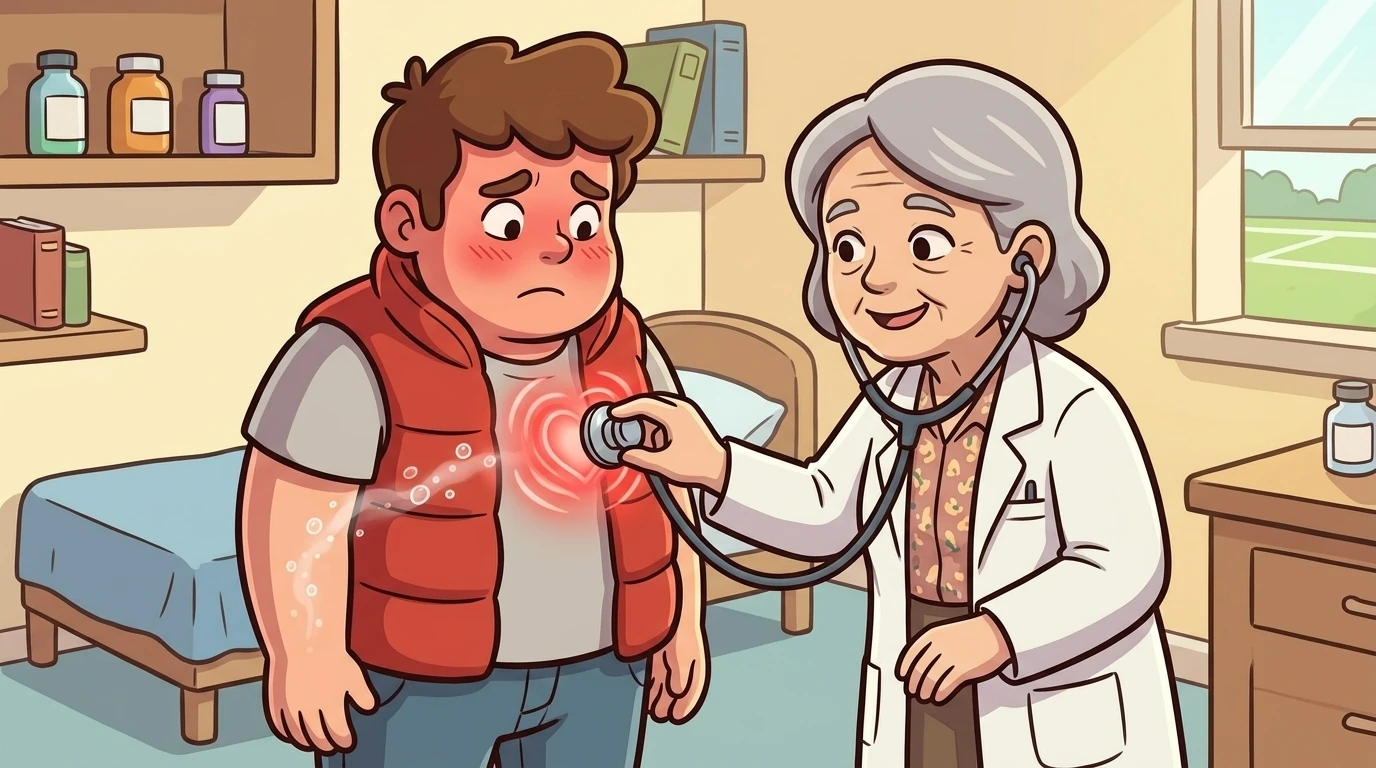
Pump had not always loved that pounding. For a long stretch of being small, they had been afraid of it.
They had been the slowest runner in their year, and every single time the pack tore ahead, their heart would throw itself against their ribs so violently it frightened them. Something is wrong with me, they would think, scarlet-faced and last, convinced the thumping was a fault — that everyone out in front had been built to some better plan, and Pump had been built to a broken one.
It was the school nurse who undid that, though she never once told Pump to run faster. She was old, with cool dry hands and a stethoscope rubbed smooth as a river stone, and one afternoon she pressed the little cold disc to Pump's chest right after a brutal lap and simply held it there.
"Listen," she said. "You feel how strong that is?"
Pump had listened, mortified, sure the sound was evidence against them. Thump. Thump. Thump.
"That is not a thing going wrong," the nurse said, unhurried. "That is your heart delivering harder because your legs are asking harder. It is the honest sound of a body that is being taken care of from the inside. Fast runners haven't got magic tucked away somewhere. They've got a heart that grew good at delivery, one hard lap at a time. And yours is growing good this exact second — whether you cross that line first or dead last makes no difference to it at all."
Pump did not win a race the whole year. But the pounding stopped landing like an alarm bell. It began to feel, instead, like an answer — proof that something inside them replied every single time it was called, no matter what shape had turned up to do the asking.
Pump walked to Bioforge at twelve, reasoning that a place devoted to studying living things ought to have room for the one part of them that keeps every living thing alive.
Dr. Vega, who ran the anatomy workshops, met Pump at the door and did not ask them to run, or lift, or step onto any scale. She asked one thing. "What does the heart actually do?"
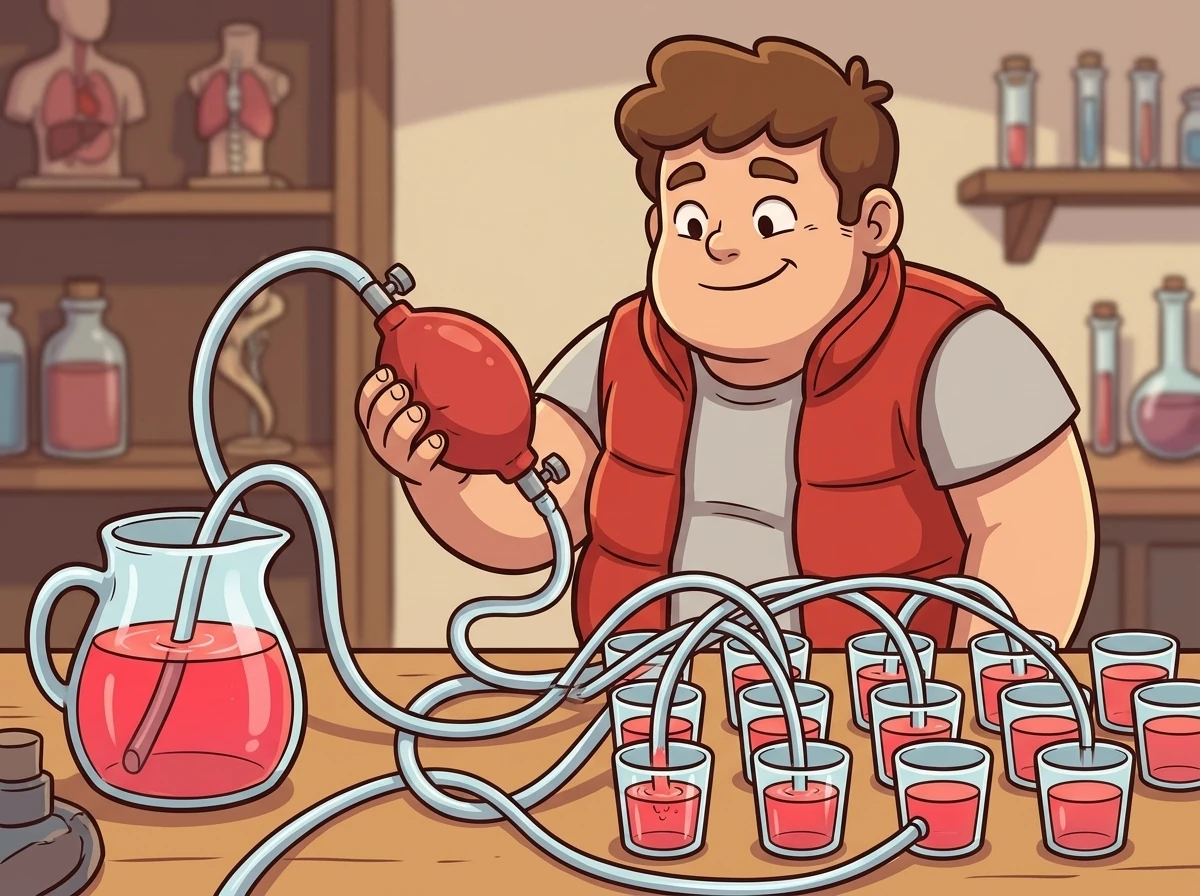
Pump answered with their hands. They took up a jug of red-tinted water and a long, looping run of clear tubing that split and split again until it fed a dozen small cups set out in every corner of the room. Then they squeezed the pump-bulb in the middle of it — once, twice, patient as a resting pulse. The red water surged along every branch at the same moment. One after another the far cups filled. Not one sat empty.
"It isn't a container," Pump said, squeezing again to keep the loop alive. "People picture a bucket of blood sloshing about. It's a deliverer. The blood carries oxygen and food and chemical messages, and the heart's whole job is making sure every cup — every cell, right out to the edges — gets its fair share. Then that same water comes back carrying the waste, runs past the lungs to swap the waste for fresh oxygen, and heads straight out again. The loop never opens. It never stops. No cup left dry, from before you're born to the very last beat."
Dr. Vega watched the final cup fill and go still. "You belong here," she said.
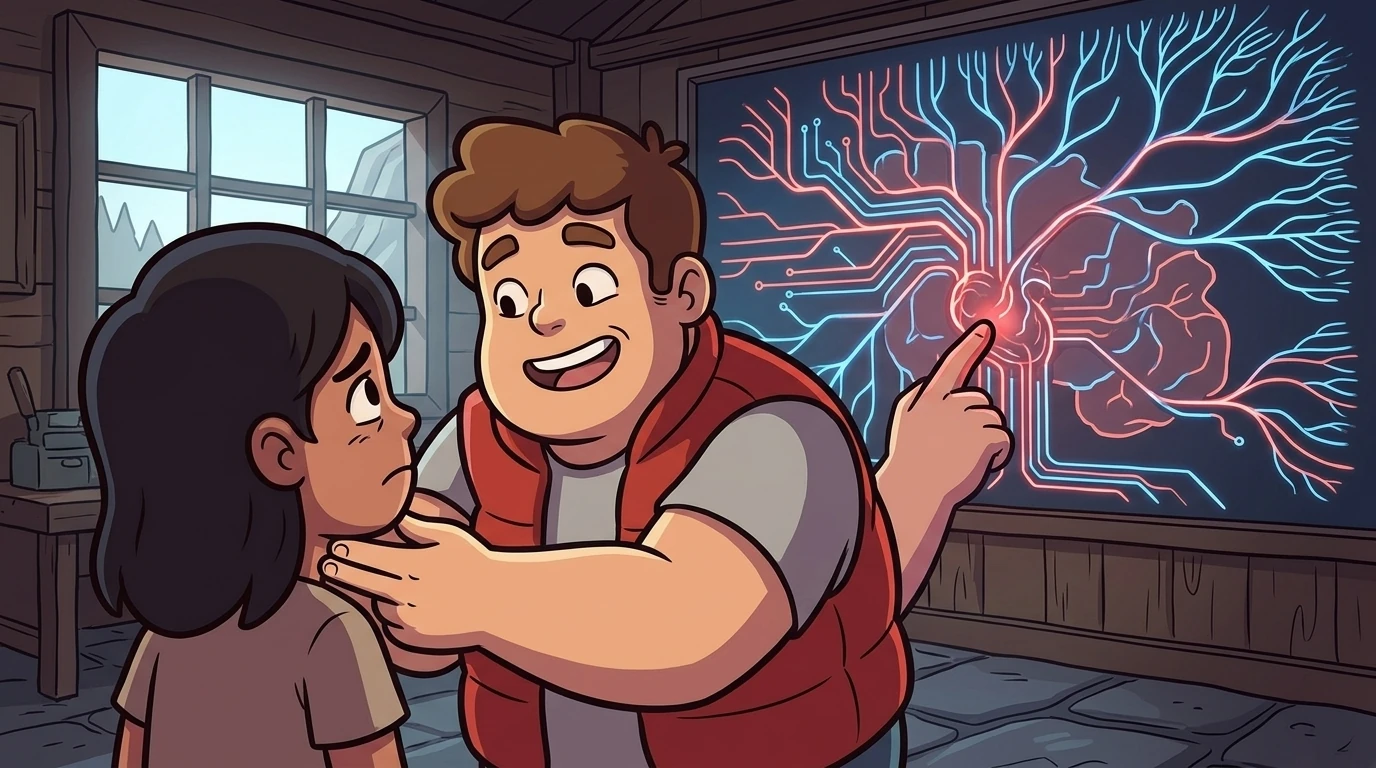
Pump's workshop had one entire wall that glowed — a living map of a body, red roads branching outward and thinning into threads too fine to draw, blue roads gathering the same threads back toward the center.
A girl came in one afternoon with her arms locked across her chest. Gym class had lined everyone up and ranked them by how they looked, and she had come out near the bottom of the row. "I'm just not built fit," she said, flat and certain. "You can see it. Everyone could see it."
Pump tilted their head. "Could they? Put your fingers here." They guided the girl's hand to the side of her own throat. "Feel it?"
"...My pulse."
"Count a few. That is your heart delivering right now, while you stand here furious at a mirror that told you a lie." Pump ran a fingertip up one red line on the map, from the heart out to a far, forking corner. "Fitness doesn't live in the mirror. It lives here — in how completely this river reaches every cell, and how strong the heart grows at pushing it. That's what the word cardiovascular means, and here's the part the ranking never mentioned: you cannot see one drop of it from the outside. Not a drop."
The girl frowned — at the map, then at her own quietly beating throat. "So how do you make it better?"
"You ask your heart for more, over and over, until it learns to give it." Pump grinned and pointed at the door, and the ridge past it. "Run, climb, swim, dance — anything that gets it going thump-thump like it means the message. Every time you do, the muscle thickens a little and learns to deliver more with each single beat. Tall body, round body, small body — it doesn't change the rule at all. Every one of you carries a heart that gets stronger by the exact same path." They squeezed the bulb, and the red water raced out and filled the cups. "The mirror doesn't get a vote in this. Your heart does the whole of the voting. And it votes yes every second you're alive."
Later, when the workshop had emptied and the light had turned to honey, the girl stopped at the door with one last question, quieter than the first.
"When I'm just sitting still," she said, "not running, not doing anything worth counting — is it still working then?"
Pump laid a hand flat over their own chest and went completely still, until the room quieted enough to nearly hear it.
"This moment," they said gently. "While we're talking. While you sleep tonight. While you're bored out of your mind in some lesson next week. It has not paused for one beat in the whole length of your life, and it has never once asked you to say thank you or even to notice." They smiled. "That warm, worn-out, still-going feeling behind your ribs after a hard run — that's the plain truth of being looked after from the inside, by something that only knows one thing, which is how to keep giving to every last part of you."
The girl put her fingers back to her throat and just felt it a while. Thump. Thump. Thump. And Pump watched the crossed arms come unfolded, watched the tight line of the girl's shoulders drop the same slow way their own had let go, years back, at the tail end of a race they hadn't won. Something warm and steady rose in Pump's chest and settled there, quiet and sure — the deep, loosening gladness of watching a kid stop believing they were the wrong shape to be cared for. Nobody is, they thought, and breathed out easy. The river reaches everyone. It always has.
The BioForge ensemble
Pump is part of BioForge's distributed-narrative cast. Each character embodies a different curricular primitive; together they teach the full subject.
-

Bellows
Respiratory (lungs, oxygen exchange)
-

Sprout
Digestive (stomach, intestines, nutrients)
-

Flicker
Nervous (brain, signals, reflexes)
-

Strand
Muscular (contraction, movement)
-

Beam
Skeletal (bones, levers, support)
-

Ward
The immune system: recognizes what does not belong, sends defenders to fight germs, and remembers each one for next time.
-

Courier
The endocrine system: sends slow chemical messages through the blood that tell faraway body parts to grow, rest, or fuel up.
-

Mantle
The skin: a living wall that keeps the outside out, holds your warmth, feels the world by touch, and heals itself.
-

Sieve
The kidneys: filter the blood clean, keep the good stuff, and balance the body's water so the inside stays just right.