Cable and Arch
cross-curricular math bridges — Cable is math you can HEAR (frequency ratios in music), Arch is math you can SEE (golden ratio + symmetry in art). Together they show that math lives outside the page.
Press play to listen along. The line being read lights up as you go.
Show full transcript
Loading transcript…
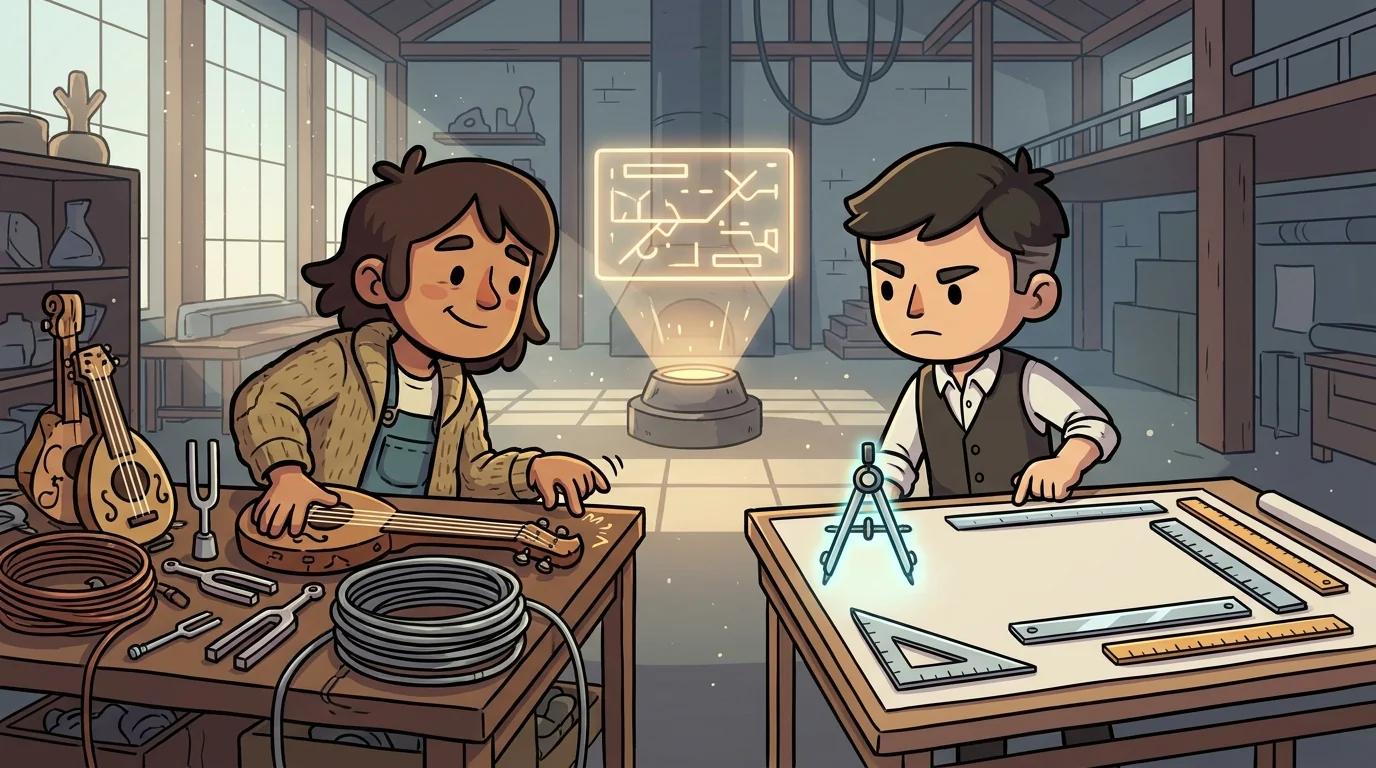
The Bridgeforge hummed with a low, steady sound, a quiet energy that filled the vast studio. Dust motes danced in the light shafts, illuminating two very different workspaces. On one side, Cable’s listening table overflowed with coils of wire, gleaming tuning forks, and strange, stringed instruments. It looked like a musician’s secret laboratory. On the other side, Arch’s drafting board presented a clean, orderly world of sharp lines, polished compasses, and rulers of every conceivable shape. It was the domain of precision and design. Between these two distinct realms, a single passage from a student’s portfolio shimmered in the air, projected from the forge’s central lens.
"Feel that rhythm?" Cable murmured, their head tilted. They listened as if to a distant, intricate melody. Their fingers tapped a gentle, complex pattern on the table’s edge. "The words have a beat. Thump-thump-da-da-THUMP. It’s almost like a heartbeat, or a drum."
Arch squinted at the glowing text, ignoring the sound entirely. "Forget the beat," they countered, their voice as crisp as a freshly ironed sheet of paper. "Look at the shape of it. See how the first sentence stretches long, then the next two are short and quick? The last one is long again. It creates a balance. It has weight. It feels… stable, like a well-built structure."
Cable smiled, still tapping their rhythm. "It’s stable because it sounds right to your ears."
"It sounds right because it looks right to your eyes," Arch replied, a faint smile pulling at their own lips. This was their favorite kind of argument. They often circled the same truth from opposite directions. Cable heard the world, while Arch saw its underlying structure.
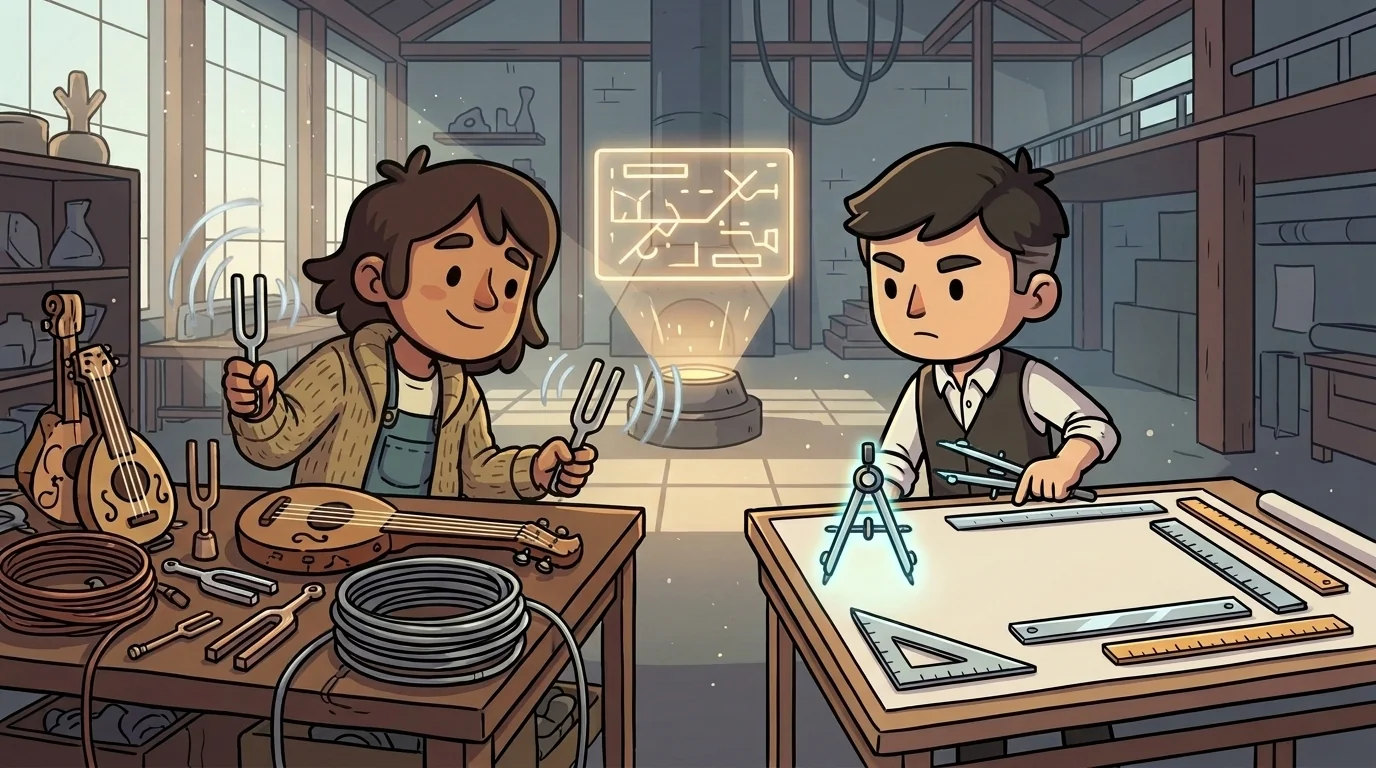
"Okay, listen closely," Cable said, moving to their listening table. They picked up two gleaming silver tuning forks. "This first big idea, the main point of the whole paragraph, sounds like this." They gently tapped the first fork against the table. A clear, steady note, pure and resonant, filled the air. Pinggggg. Cable let it ring for a moment. Then they tapped the second fork, and a different note, higher and sweeter, joined the first. Piiiiiing.
The two notes hung together, not clashing, but blending. They created a feeling of openness, a sense of new possibilities unfolding. "See?" Cable said softly. "It’s a sound that asks a question. It feels like it’s reaching out, inviting you forward."
Then, they selected two different forks. These were crafted from a warmer, bronze-colored metal. Cable waited for the silver notes to fade completely, then tapped the new pair. The sound was distinctly different. These two notes were closer together, a tighter harmony. When they rang out, they felt solid and complete. It was the sound of an answer. The sound of a door clicking shut, everything settled. "And that," Cable finished, "is the sound of the final sentence. It feels finished. Resolved. The entire paragraph sounds like it makes perfect sense." Arch stood by their drafting board, listening with an expression of deep, thoughtful curiosity.
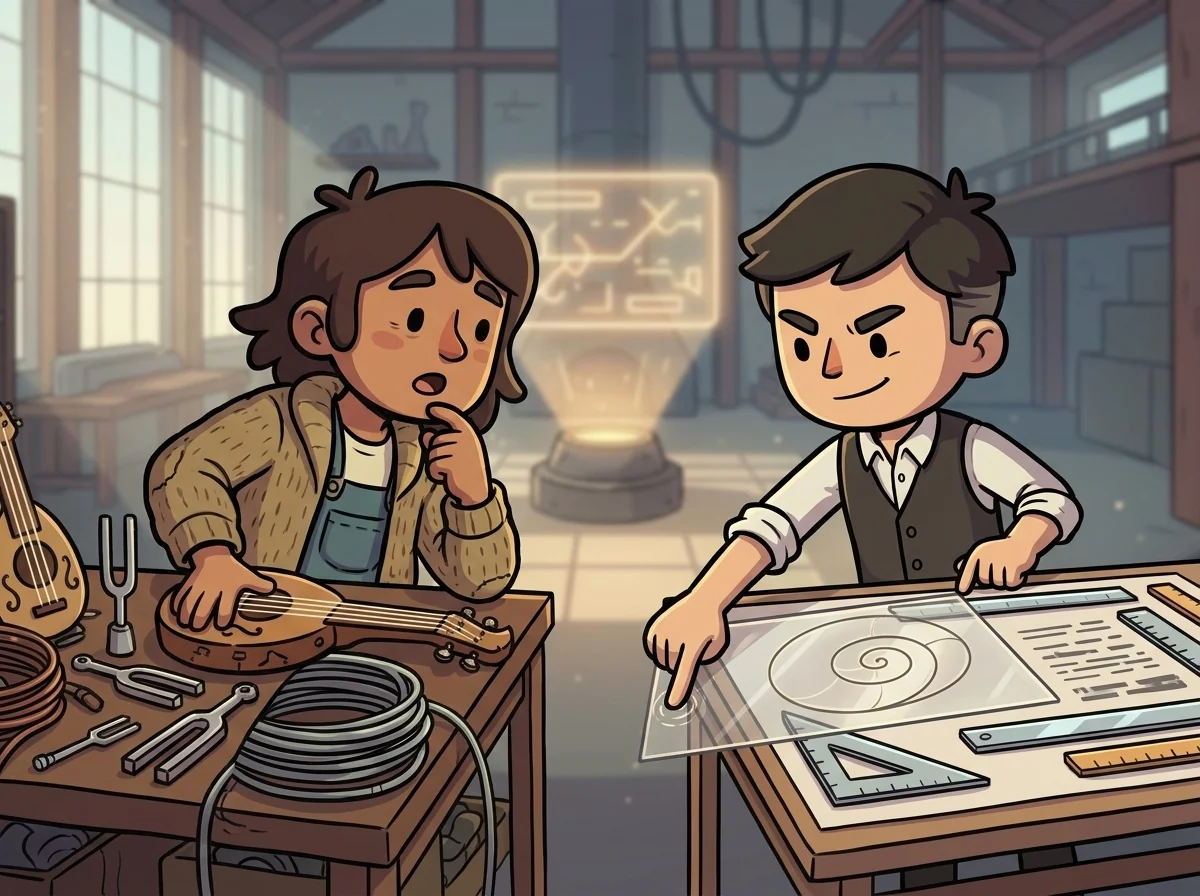
"An interesting theory, indeed," Arch said, turning back to their own workspace. "But let me demonstrate what’s truly happening." They took a large, translucent sheet of plastic. They laid it carefully over their drafting board, where a copy of the student’s paragraph was now displayed. Etched onto the sheet was a perfect, swirling spiral, reminiscent of a snail's shell or a distant, spinning galaxy.
Arch meticulously positioned the overlay. "Observe," they instructed. They pointed a long, slender finger at the very center of the spiral. "The most important part of the paragraph, the sentence you called a question, rests right here. It’s the heart of the entire design." Their finger then traced the spiral as it expanded outward. "And the smaller, supporting sentences? They follow this curve. They build on each other, one after another, perfectly spaced along the path."
They picked up a special hinged ruler, a tool that looked like a pair of silver calipers. Arch measured the length of the longest sentence, then the one immediately following it. They adjusted the calipers with precise movements and showed Cable. "The relationship between this length and this length is exactly the same as the relationship between that length and the one before it. It’s a recurring pattern. A visual echo. That’s why it feels so strong. It’s built on a secret blueprint. The paragraph looks like it makes perfect sense."
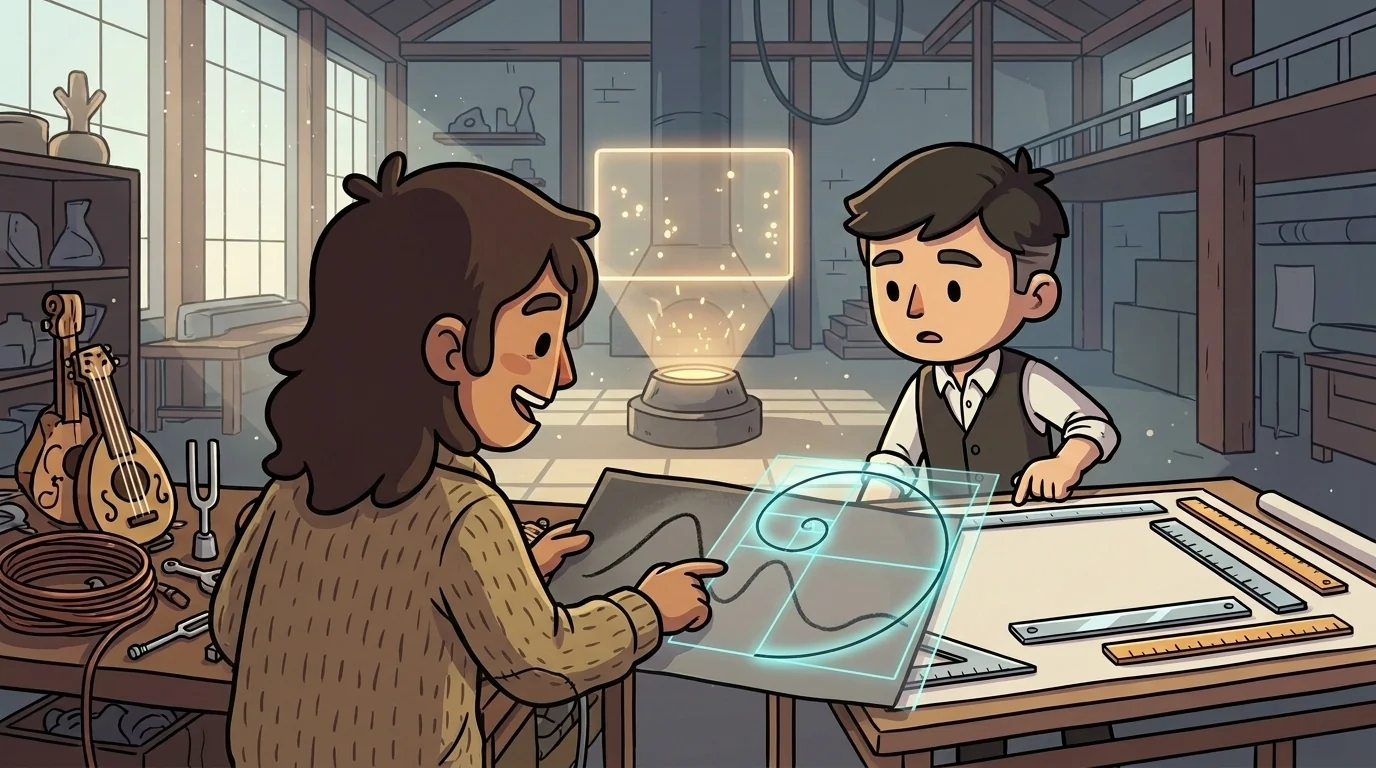
Cable’s eyes widened, a sudden understanding dawning. "A visual echo... Wait. Hum those notes again, the first two."
Arch looked momentarily puzzled but obliged, humming the two open, questioning notes. As Arch hummed, Cable grabbed a piece of charcoal. In a few swift, practiced motions, they drew a wave on a fresh sheet of paper. It was a simple, flowing line that rose and fell with the subtle shifts in Arch's voice.
"Okay, now give me the second pair," Cable said, their hand hovering over the drawing. Arch hummed the two resolving, final notes. Cable’s charcoal moved again, drawing a second wave right next to the first. This one had a different shape—calmer, more settled, a gentle curve downward.
"Now," Cable said, a spark of pure excitement in their voice. "Bring your spiral over here."
Arch lifted the transparent sheet and carefully laid it on top of Cable’s charcoal drawing. They both leaned in close, their heads nearly touching. It was uncanny. The highest point of the first "questioning" sound wave touched the exact center of Arch’s spiral. And the calm, final wave settled perfectly along the spiral’s widest, outermost curve. The sound fit the shape. The shape fit the sound. They weren’t two separate ideas at all. They were two halves of the same hidden truth.
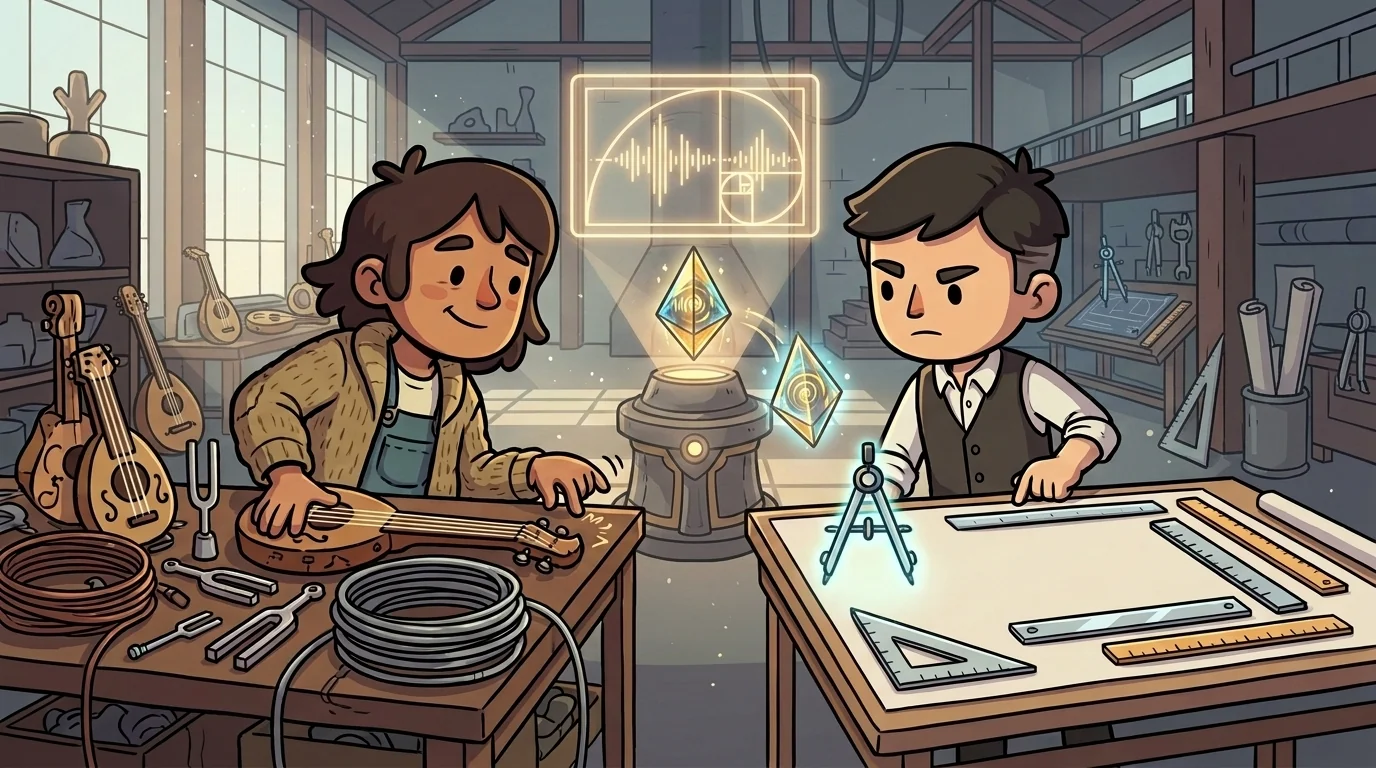
"Whoa," they both whispered, a shared breath escaping their lips. They stood back, gazing at the combined image. It was a drawing of a sound, perfectly contained within a beautiful, ancient shape. They had found the *hidden structures*, the invisible bridge that held the student’s words together with such subtle power.
"So, it’s not just a beat, and it’s not just a shape," Cable said, tracing a finger over the drawing. "It’s... a song with a blueprint. A melody you can see."
"Or a blueprint that sings," Arch added, their voice tinged with wonder. "The math we can hear and the math we can see are telling the exact same story." This was the true magic of the Bridgeforge. It was about discovering the deep-down patterns that made things feel inherently right, whether seen or heard. It was about revealing the genius already present in the world.
Arch touched a glowing rune on their drafting board. The image of the sound wave inside the spiral lifted gracefully off the paper. It floated toward the central lens, condensing into a shimmering, jewel-like object. This was a new bridge for the student's portfolio. It wasn't a mere grade or a simple correction. It was a map, a luminous guide, showing the secret, beautiful structure the student had built all on their own.
Cable and Arch stood together and watched it drift toward the lens. Neither spoke for a moment. They only felt it—that warm, settled happiness that comes from handing someone proof of the good thing they made without knowing. That was why they did the work. Not the spiral, not the chord. The quiet glad feeling of a student learning their own creation was beautiful all along.
***
The BridgeForge ensemble
Cable and Arch is part of BridgeForge's distributed-narrative cast. Each character embodies a different curricular primitive; together they teach the full subject.
-

Truss
Math↔Science bridges — causal-evidential connection (measurement + replication; both sides need numbers)
-

Arch
Math↔Art bridges — proportion-aesthetic connection (golden ratio + symmetry; math you can SEE)
-

Cable
Math↔Music bridges — ratio-temporal connection (frequency ratios + rhythm; math you can HEAR)
-

Pier
Math↔Social-Studies bridges — data-narrative connection (statistics in history + civics; numbers + people)
-

Splice
Math↔ELA bridges — structure-metaphor connection (sequence + symmetry in writing; math is the bones)