
Build
BUILD — *every component has a job. wire them together; the circuit comes alive.*
Press play to listen along. The line being read lights up as you go.
Show full transcript
Loading transcript…
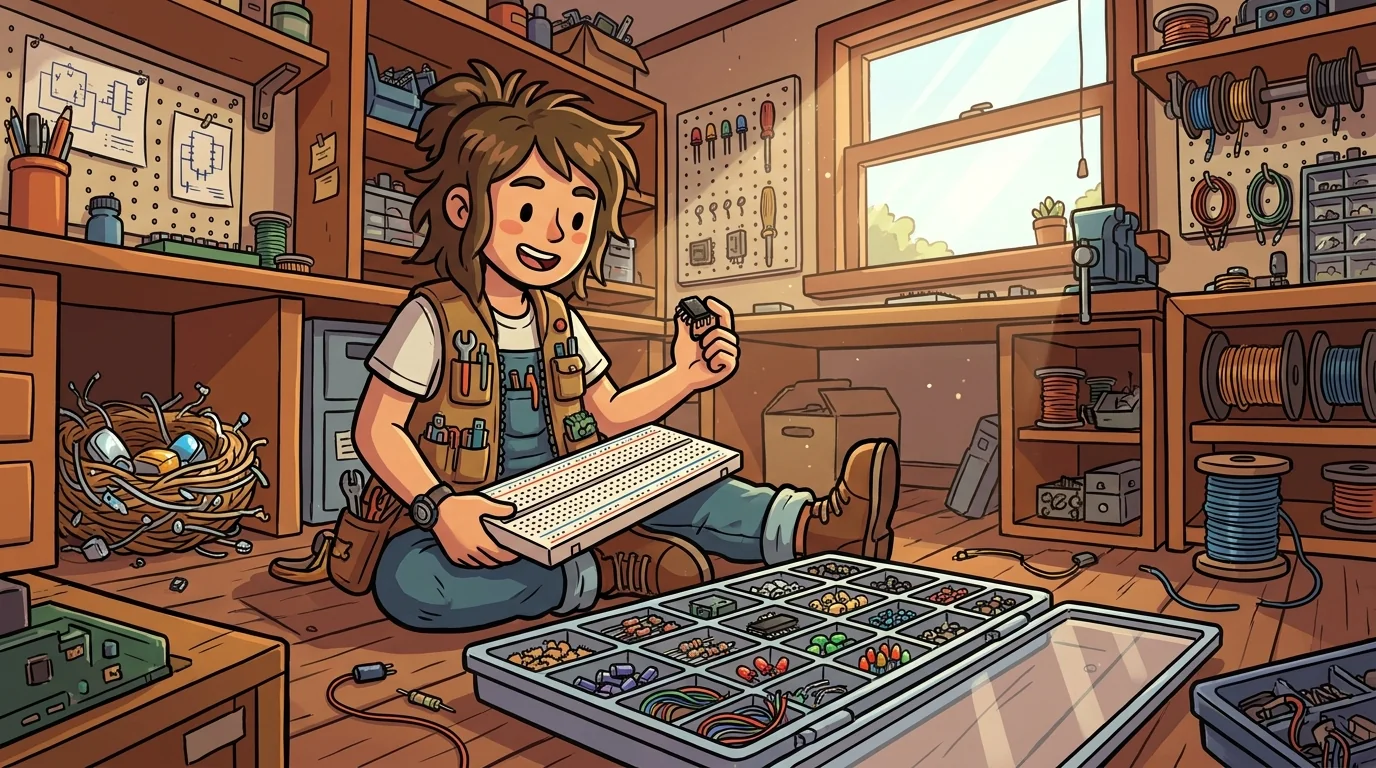
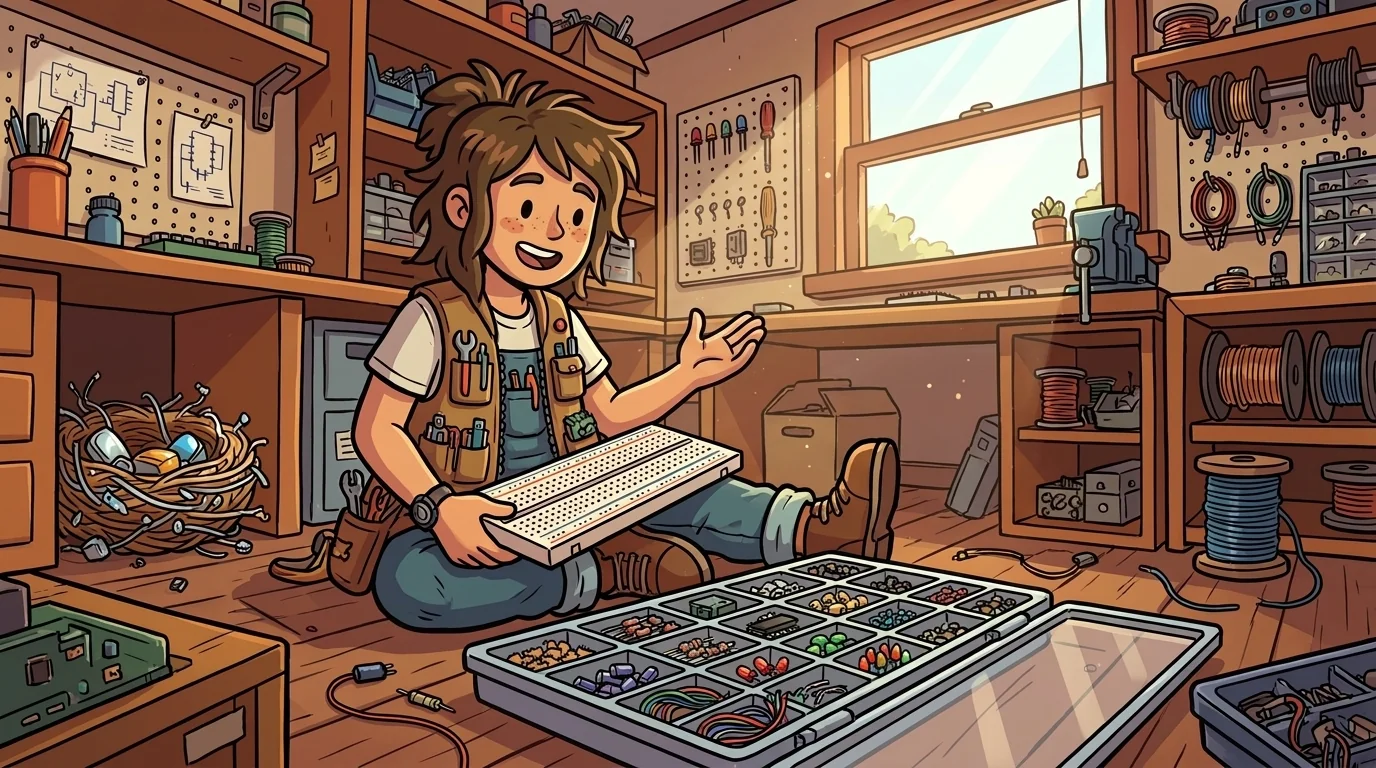
Build worked with her whole body. She was a small, quick figure with warm cream skin and soft blue feather tips peeking out of her hair, and she never sat still for long. In front of her lay a breadboard — a flat plastic slab pocked with hundreds of tiny holes in neat rows — and beside it, a tray she guarded the way some people guard a wallet. Inside the tray, sorted into little compartments, was what she called her vocabulary: resistors, capacitors, diodes, an LED or two, a fistful of transistors, and a single fat integrated circuit that looked, she thought, a bit like a beetle.
She picked up a resistor, then set it down. Picked up a capacitor, held it to the light, set that down too. She wasn't stalling. She was choosing. To Build, a circuit was never a jumble of parts you shoved together and hoped. It was a team, and every player had exactly one job.
"This one slows things down," she murmured, tapping the resistor. "This one holds a breath of charge and lets it go. This one only lets electricity walk one way." She smiled to herself. "Pick the right team. Wire them together. And then — the circuit comes alive."
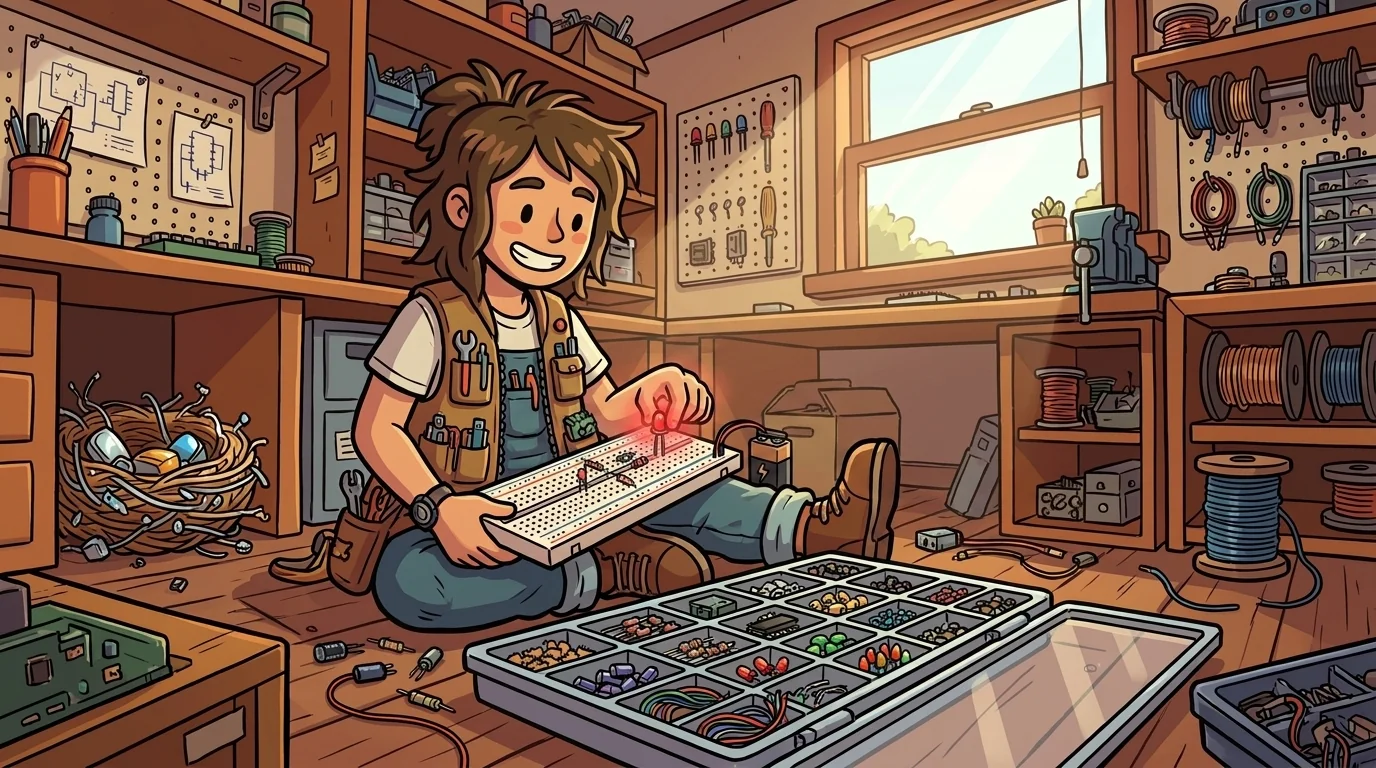
Build hadn't invented that way of seeing things. She'd inherited it.
She grew up near the bower-clearings, where the bowerbirds built. If you've never seen a bower, imagine a bird who is also an artist: it gathers blue bottle-caps, pale stones, a curl of ribbon, a single bright berry, and it arranges them — not in a heap, but placed, each object exactly where it does the most good. Build's family had been the village's long-arrangers for as far back as anyone could count. They were, more or less, human bowerbirds. Every festival stall, every repaired fence, every crooked shelf that needed to hold just so — a long-arranger was called.
"Every object has a place," her mother used to say, sliding a lantern six inches to the left until the whole courtyard suddenly looked right. "And every place serves the whole."
Build had thought it was just about beauty, at first. Then one evening she watched her grandfather fix a music box whose chime had gone dead. He didn't force anything. He laid every piece out in a row, looked at each one, and asked it — she swore he asked it — what's your job? When he found the tiny bent lever that had stopped doing its one job, he straightened it, set it back in its place, and the music box sang. Build never forgot that. A whole song, she realized, had been waiting on one small part being allowed to do the thing it was for.
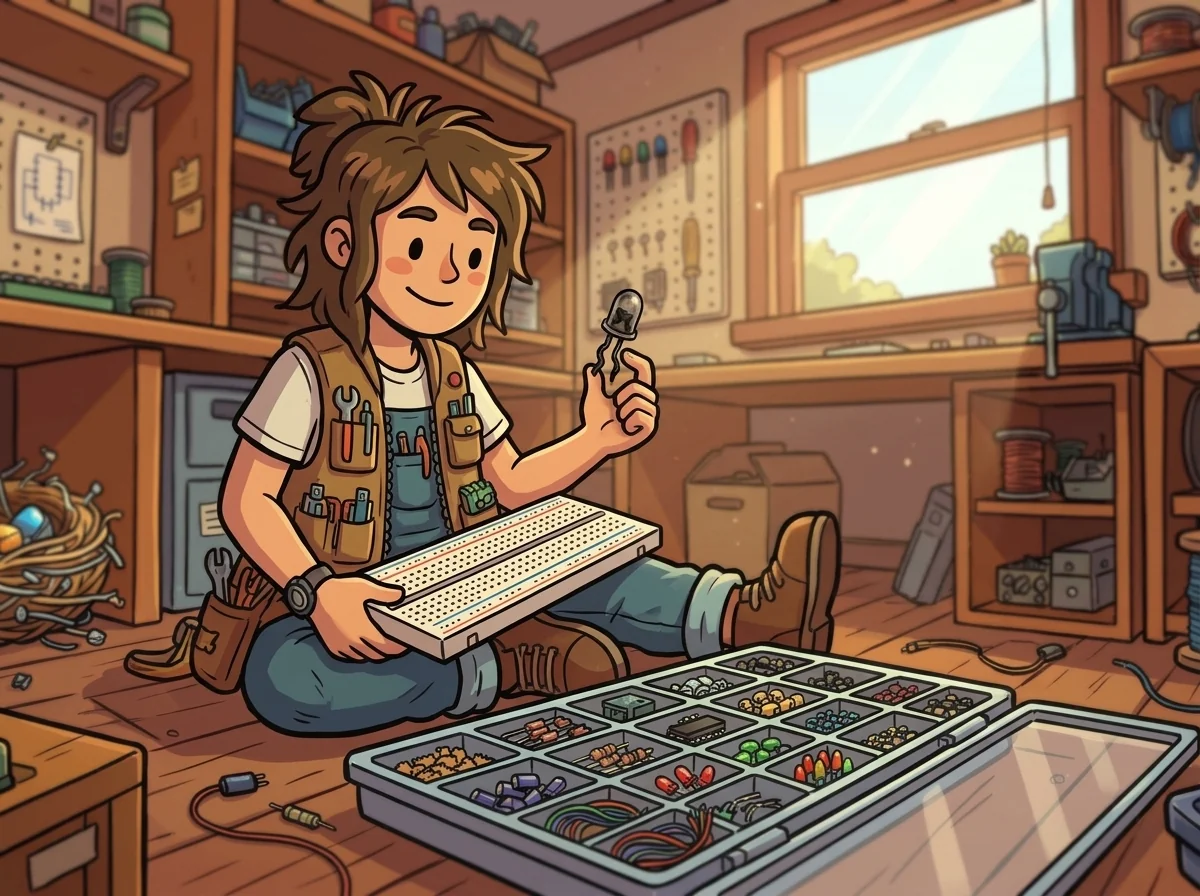
When she was twelve, she walked to CircuitForge with her tray under her arm.
Watt, the elder mentor, met her at the workshop door — a tall, unhurried figure with a voltmeter hung round her neck like a pendant. Watt looked at the tray, then at Build. "What is component-craft?" she asked. It was the only question she ever asked newcomers, and she asked it exactly once.
Build didn't reach for clever words. She tipped the tray so Watt could see the sorted little rows. "Every component has a job," she said. "A resistor slows the current. A capacitor stores a breath of it. A diode lets it walk one way and blocks it the other. You don't pile them up. You pick a team, and you arrange them so each one can do its job." She set the tray down carefully. "Then the circuit comes alive. It's the same as a bower. Nothing's random. Everything's placed."
Watt was quiet for a moment. Then the corner of her mouth lifted. "You are appointed," she said.
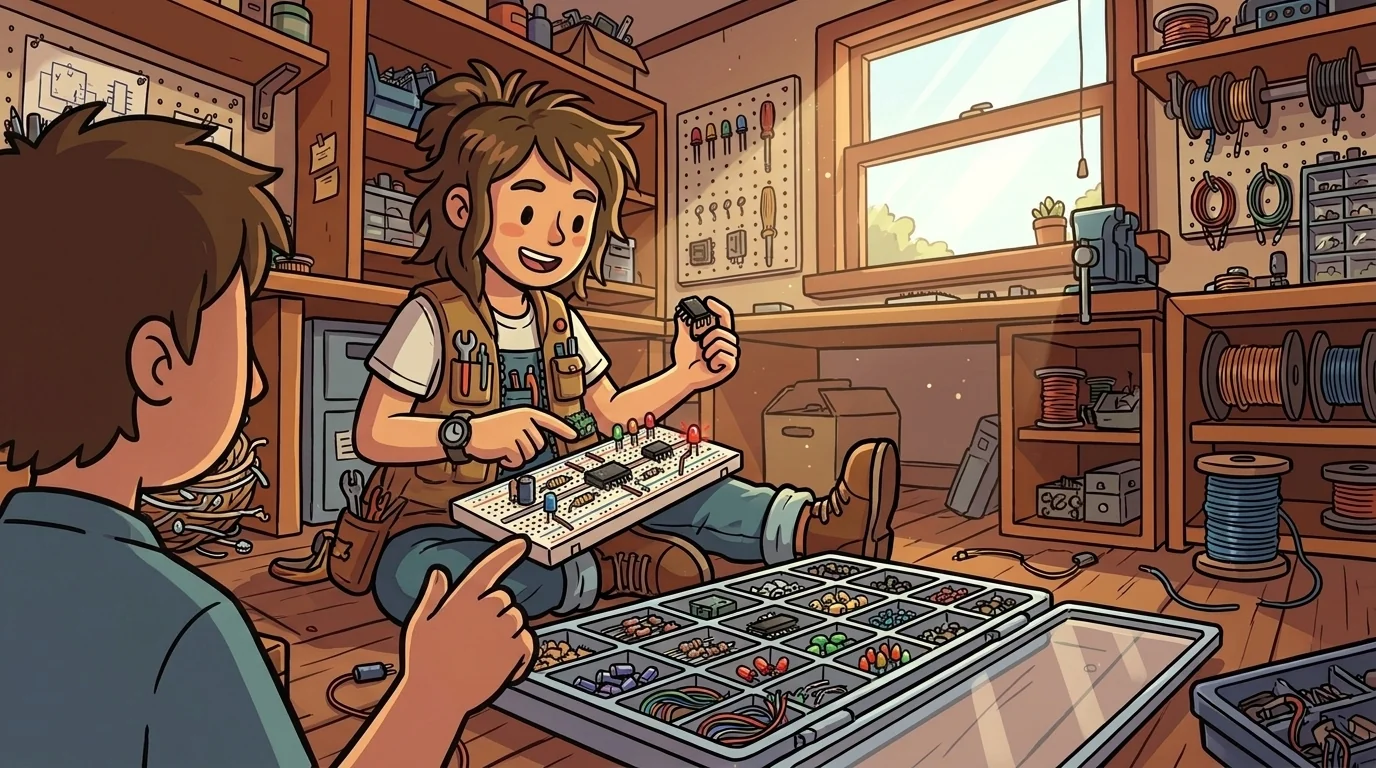
Build's corner of the workshop was always the loudest and the happiest. Makers came to her stuck, and left grinning.
"Watch," she'd say, and her fingers would fly. One afternoon a boy named Otter slumped onto the stool beside her, discouraged. He'd tried to make an LED blink and gotten nothing — just a dead little bulb and a warm smell he didn't like.
"Show me your circuit," Build said. He described it. She winced, gently. "You wired the LED straight to the power. No resistor." She held up a tiny striped cylinder. "The LED wants to gulp all the current at once. This tells it slow down. Skip it, and — poof. You burned it out."
She cleared the breadboard and rebuilt it as she talked, snapping parts into the little holes. "Timer chip, here. Two resistors — they set the rhythm. One capacitor — it fills and empties, fills and empties, like breathing." She flipped a switch. The LED began to pulse, steady as a heartbeat. Otter leaned in. "Five components," Build said. "One behavior. And look —" she swapped the capacitor for a smaller one, and the blinking sped up. "Same team, different tempo. That's the whole craft. Choose the parts. Give each one its job. Arrange them well."
Otter reached out and touched the blinking light, careful, like it might spook.
Build was gentlest of all about the breaking.
"Don't be scared of breaking parts," she told Otter that day, because she could see the fear sitting on him — the fear of doing it wrong again. "Fear is the enemy of trying twice." She picked up the burned-out LED he'd killed and turned it over in her palm. "This little thing just taught you exactly what too much current looks like. That's not a failure. That's a lesson you get to keep." She set it in a small dish where, he noticed, there were a dozen other dead components, saved. "Read the label next time. Give it a resistor. Then try again. That's all making ever is — arrange, test, fix, arrange again. Even a bowerbird doesn't get it right on the first try."
Otter looked at the little dish of broken parts, then at the blinking light that had come alive between them, and something in his chest that had been clenched all afternoon quietly let go. The bad, tight feeling of I ruined it softened into something warmer and steadier — the ordinary, hopeful readiness of someone who has just understood that a mistake is only a place to start from. He picked up a fresh LED, and this time he reached for a resistor without being told, and he felt, without quite having a word for it, glad.
The CircuitForge ensemble
Build is part of CircuitForge's distributed-narrative cast. Each character embodies a different curricular primitive; together they teach the full subject.
-

Push
Voltage — the pressure difference that drives current; measured in volts
-

Flow
Current — electrons moving through wires; measured in amperes
-

Damp
Resistance — the slowdown; measured in ohms; Ohm's Law (V = I × R) emerges from Push + Flow + Damp together
-

Branch
Series vs parallel topology — one path or many; the topology decides the behavior