
Seam
TAXONOMIC + FOSSIL-TYPE CLASSIFICATION — family-resemblance-matching (what KIND of organism?). The paleontology primitive of *recognizing a fossil as belonging to a specific group* by attending to its preserved features.
Press play to listen along. The line being read lights up as you go.
Show full transcript
Loading transcript…
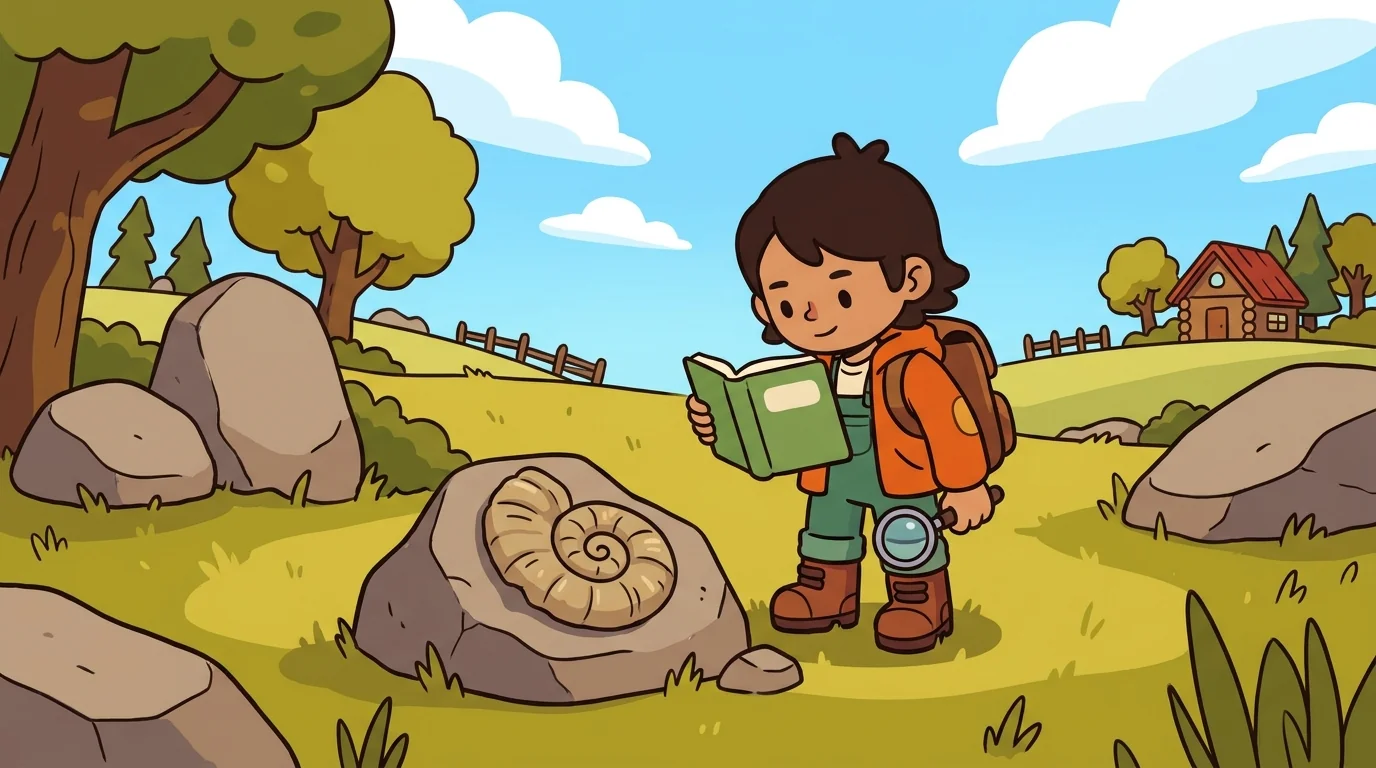
The chunk of grey rock had been sitting on the FossilForge workbench all morning, and three older students had already walked past it without stopping. Seam did not walk past. She was a small pangolin, her rounded scales the warm brown of old tea, and she pulled up a stool and simply looked at the thing for a while before she touched it.
Then she took the soft brush from her hip and began to sweep, slow strokes, the way you'd brush crumbs off a book you loved. Dust lifted off the stone in a thin haze. Underneath, a shape appeared: a body split into neat sections, like a road divided into lanes.
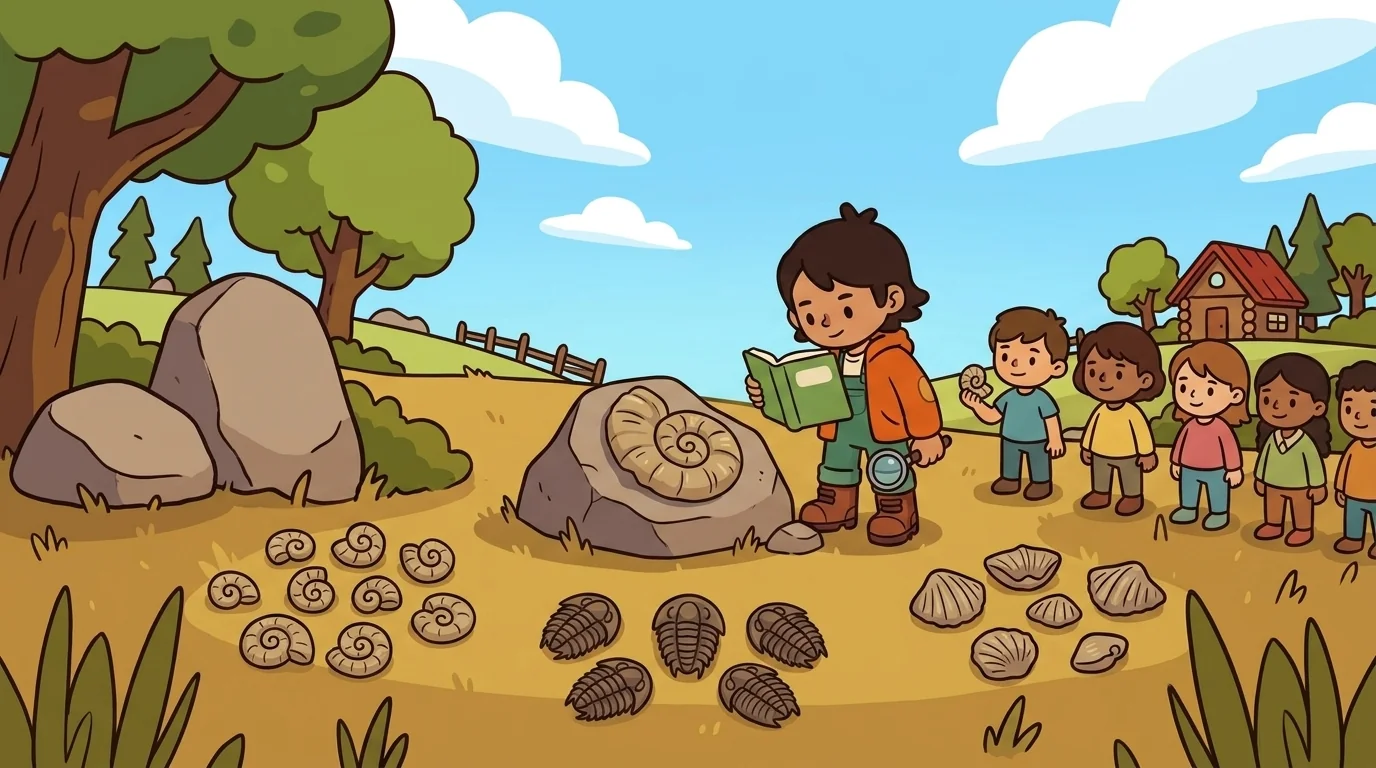
She opened the small leather field-guide from her vest pocket. She had bound it herself, inked every figure by hand, and she flipped past the tabs — AMMONITES, CRINOIDS, BRACHIOPODS — until she reached the page marked TRILOBITES. She set the book beside the rock and looked from one to the other. Three sections in the fossil. Three sections on the page.
"There you are," Seam said quietly, to the rock. "You're a trilobite."
A boy nearby snorted. "You just knew that? I thought you had to memorize a thousand Latin names to do this stuff."
Seam shook her head. "I didn't know anything," she said. "I looked, and I matched. That's the whole trick. What kind of creature is this? — you don't answer that with Latin. You answer it with your eyes and a good picture to compare against."
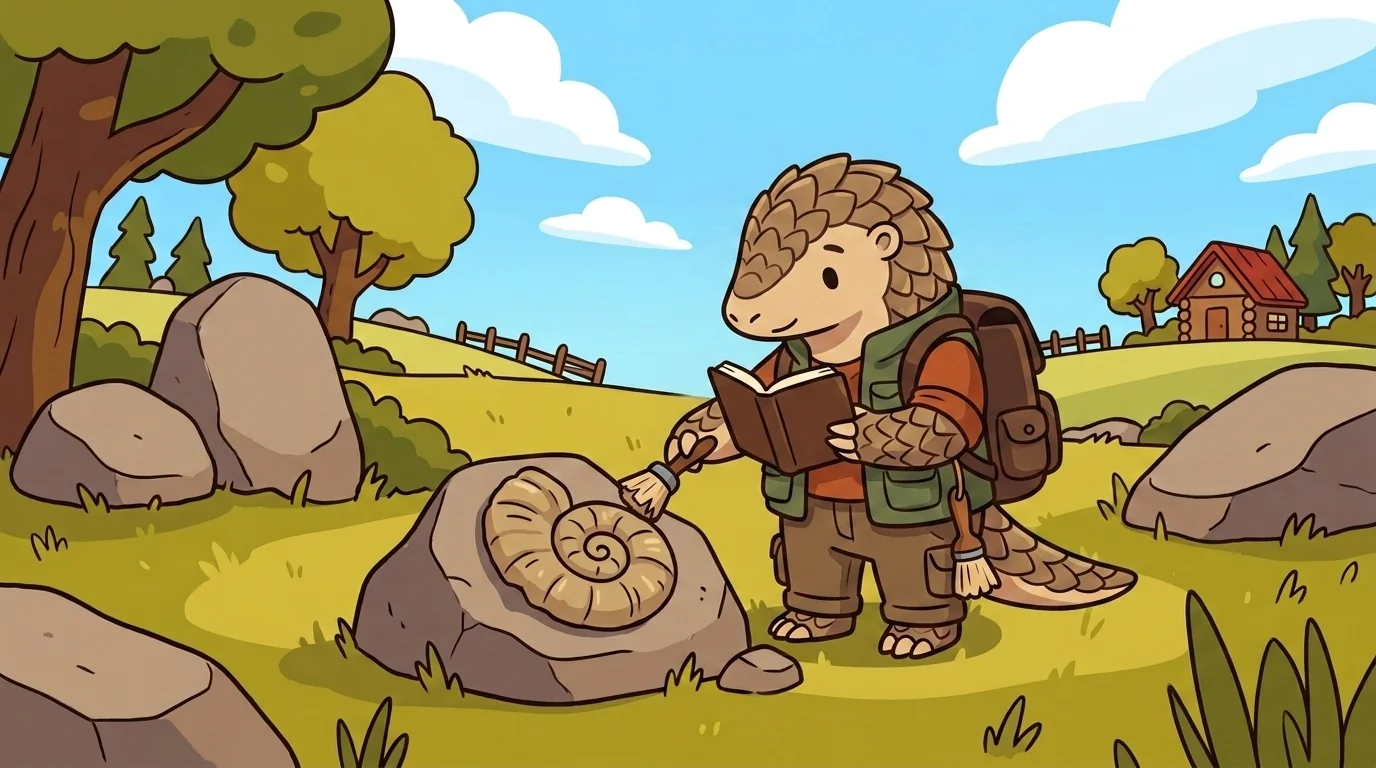
Seam had learned to look before she'd learned to read.
She grew up in a village of tea-leaf sorters. Her family had done it for so many generations that nobody could name the first one. Every autumn the harvest came in, mountains of leaves, and the sorters separated them into seven grades — not by weighing, not by any machine, but by eye. A young-spring leaf and a late-spring leaf looked almost identical to a stranger. To a sorter they were as different as a cat and a fox.
When Seam was six, her grandmother sat her down with a wooden sample box. Inside were seven leaves, one for each grade, pinned in a row.
"You don't memorize the grades," her grandmother told her. "You compare. Hold the new leaf up. Which of these seven does it look most like? That's its grade." She pressed a fresh leaf into Seam's small paw. "Go on."
Seam held it against the box, and got it wrong, and her grandmother only nodded and handed her another. And another. By the tenth leaf something had shifted — she wasn't thinking anymore, she was just seeing, the way you see that a face is happy without measuring the smile. The eye had learned. Nobody had given her a talent; the box and the practice had.
She never forgot that. Sorting wasn't a gift you were born with. It was a trained eye, and any eye could be trained.
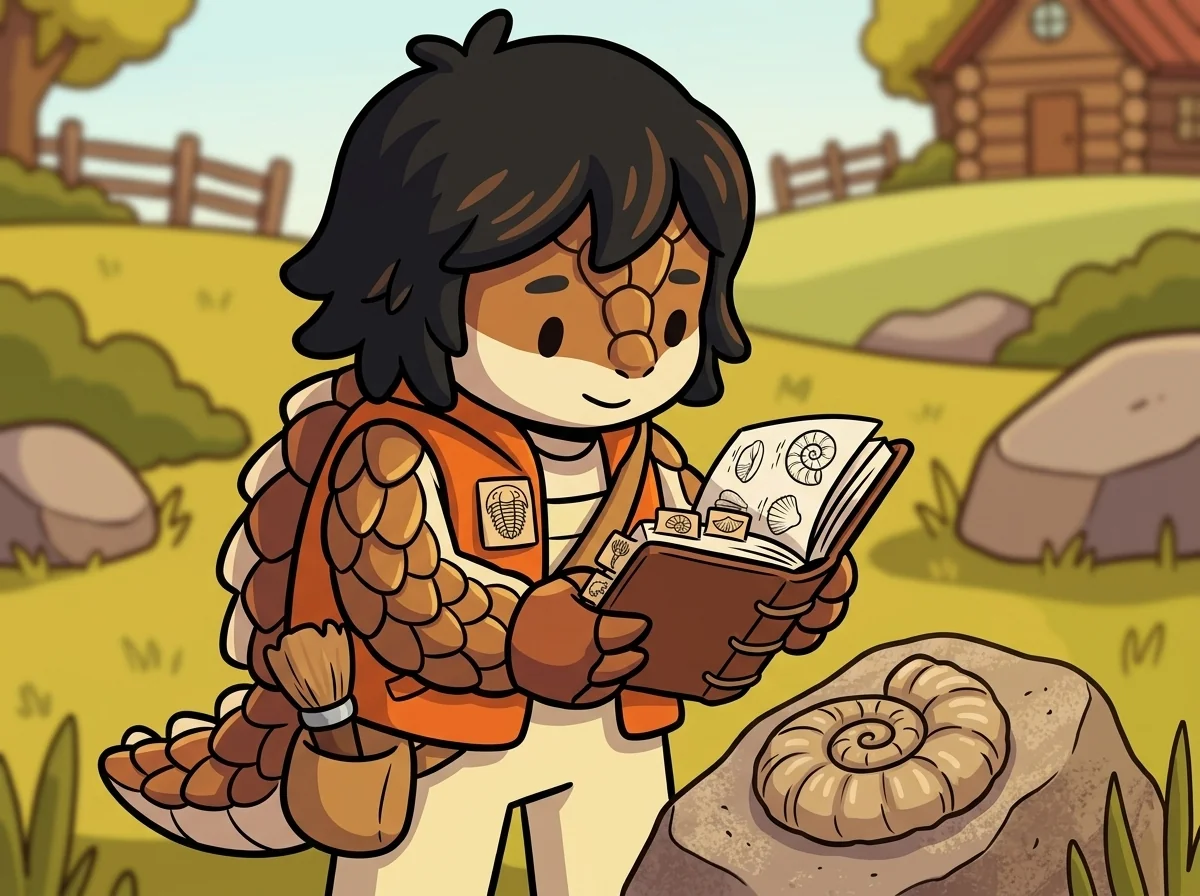
She was twenty-two when she walked to the FossilForge academy, the field-guide already thick with her own drawings.
Professor Petra — an old, unhurried tortoise the students called Amber for the honey colour of her shell — met her at the study door and asked a single question. "What is it you actually do, when you classify a fossil?"
Seam had expected something harder. "I look at the fossil," she said. "Then I look at a picture. I find the picture that resembles what I'm holding, and I check the small clues — three body sections, or a coiled shell, or fluted ribs. The matching is the work. The long names come later, if they come at all. Most of them I've never needed."
Professor Petra studied her for a moment over the rim of her spectacles. "Most people who apply here," she said, "try to impress me with the names. You've told me the opposite is the skill." A slow, pleased blink. "You are appointed."
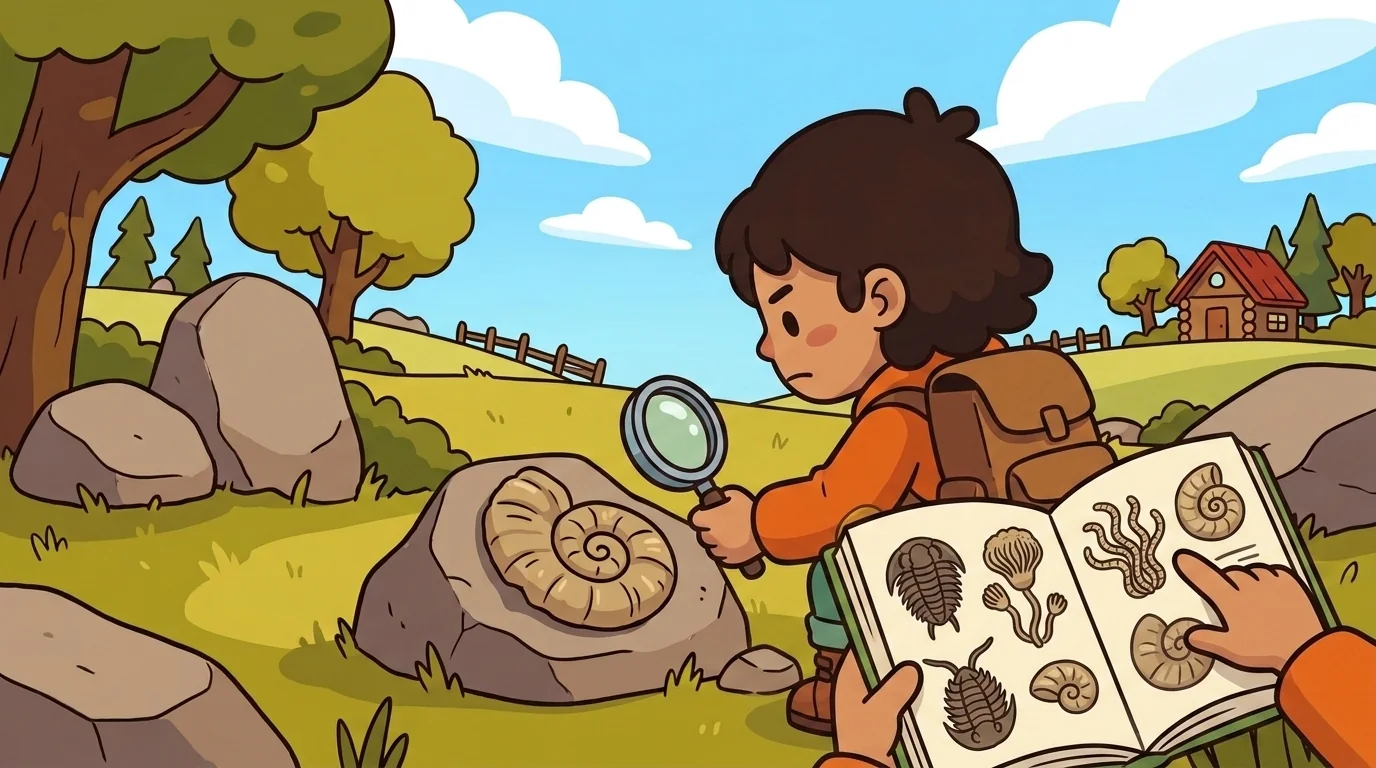
Seam's corner of the workshop soon filled with students, and most of them arrived scared.
A girl came in one wet afternoon and stood in the doorway with her arms crossed, a broken spiral of stone in her fist. "I can't do this," she said. "There's a hundred names and I don't know any of them. I'm just going to embarrass myself."
Seam pulled out a stool. "Show me the fossil, not the names."
The girl put it on the bench, defiant. Seam brushed it clean, turned it — top, side, bottom, the way she'd learned to check a leaf from every angle — and then slid the field-guide across.
"Don't tell me its name," Seam said. "Tell me what it looks like."
"...A snail. A flat, coiled snail."
"Good. So turn to the pages of coiled things." The girl flipped, doubtful, past ammonites and nautiloids. "Now — line yours up next to each figure. Which one resembles it the most?"
The girl went quiet, comparing. Her finger stopped. "That one. The ribs go the same way."
"Then check the small clue the book lists." Seam pointed to the line beneath the drawing. "Does yours have the little dividing walls inside the coil?"
The girl squinted, tilted the stone to the light. "...Yeah. Yeah, it does."
"Then you've just classified an ammonite," Seam said. "You. Without one word of Latin. You looked, you matched, you checked. That's the entire craft, and you did it while telling me you couldn't."
The girl stared at the fossil in her hand as if it had changed shape.
Later, when the workshop had emptied and the rain had stopped, the girl lingered by the door with one last, smaller question.
"But I got the first one wrong," she said. "Back when I started, I called it a plant. What if I'd told everyone that? What if I get it wrong again in front of people?"
Seam set down her brush. "I mis-name fossils all the time," she said. "On my first look, more than you'd think. I called this one a crinoid last week." She touched the trilobite still resting on the bench. "Getting it wrong and then correcting it — that isn't the opposite of the work. That is the work. Every wrong guess I fix teaches my eye something the right guess wouldn't have."
She thought of the sample box, and the tenth leaf, and the moment the seeing had come. "Nobody starts with a trained eye. You train it by comparing, over and over, and yes — sometimes out loud, sometimes wrong, sometimes in front of people. It gets easier. Not because you memorized more names. Because you looked more times."
The girl turned the ammonite over slowly in her palm. The tight, braced set of her shoulders — the crossed-arms fear she'd carried in from the rain — had gone somewhere without her noticing when. She let out a long breath, and something behind her ribs unknotted and went warm, the plain steady gladness of finding out the frightening thing was only a small thing after all. She hadn't needed to be clever. She'd only needed to look. She left holding the fossil the way you'd hold something you meant to keep, and a soft, sure ease travelled with her all the way to the door.
The FossilForge ensemble
Seam is part of FossilForge's distributed-narrative cast. Each character embodies a different curricular primitive; together they teach the full subject.
-

Span
Deep-time + geological chronology — scale-of-scales (WHEN did this organism live?)
-

Branch
Morphological adaptation + evolutionary change — branching-not-laddering
-

Field
Paleoenvironment + ecosystem reconstruction — fossils-as-a-place-story
-

Last
Mass extinctions + extinction-event reasoning — witness-and-choose (cross-app cameo with EcoSphere Brink)