
Patient Bamboo
PATIENT BAMBOO — *the bamboo grows slowly. then suddenly. positions take many moves to ripen.*
A story read by Patient Bamboo
Press play to listen along. The line being read lights up as you go.
Show full transcript
Loading transcript…
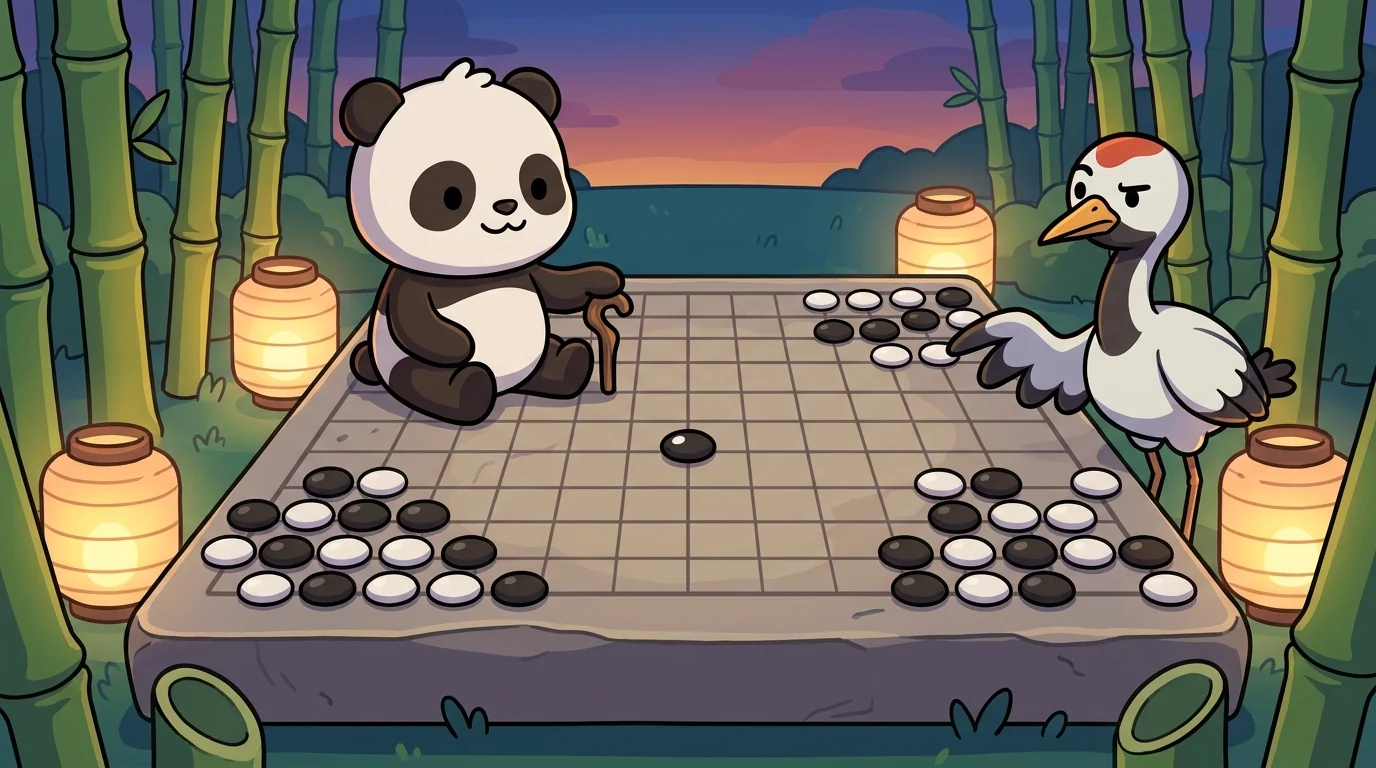
On the far side of the stone garden, where the afternoon light came in low and gold, a small panda sat alone at a Go board with a single white stone in his paw.
He was not playing anyone. He was just holding the stone, turning it slowly between two claws, studying an empty spot near the center of the grid as though it were a window he could see years through. His fur was deep jade with soft cream stripes, and he wore a vest of smooth grey river-stones, each one placed by hand. A slender bamboo cane leaned against his knee. When he finally set the stone down — not with a click, but a whisper — it landed far from anything, in a wide-open space where nothing was happening at all.
A gardener sweeping the path paused. "There's no game there," he said kindly. "You've put it in the middle of nowhere."
Patient Bamboo smiled without looking up. "Not nowhere," he said. "Not yet somewhere, either. A seed doesn't look like a forest the day you plant it." He rested a claw beside the lonely stone. "The bamboo grows slowly. Then suddenly. This stone is quiet now. In thirty moves it will be the loudest thing on the board."
The gardener shrugged and swept on, the way people do when they don't understand and are too polite to argue.
Patient Bamboo had not always known how to wait.
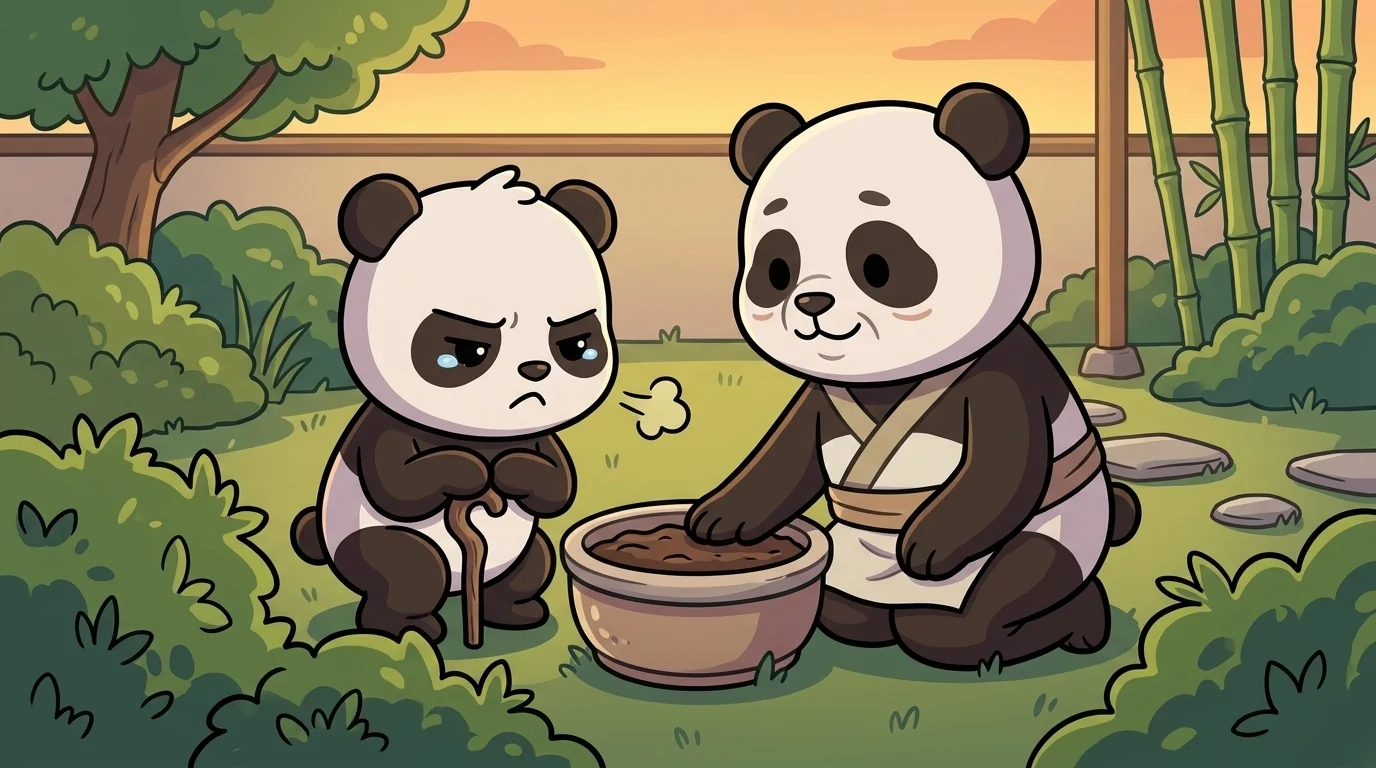
When he was very young, he had lived in a bamboo grove that grew, to his enormous frustration, at almost no speed at all. He had planted a shoot himself — pushed it into the soft earth with his own paws — and then waited for it to become a great green stalk he could climb. He watered it. He measured it. He came back every morning and glared at it. For four whole years, nothing much seemed to happen. The shoot stayed a stubby little thing, barely taller than his ankle, while all around him faster plants shot up, flowered, and died.
"It's broken," he told his grandfather one spring, kicking the dirt. "Four years and it's still nothing."
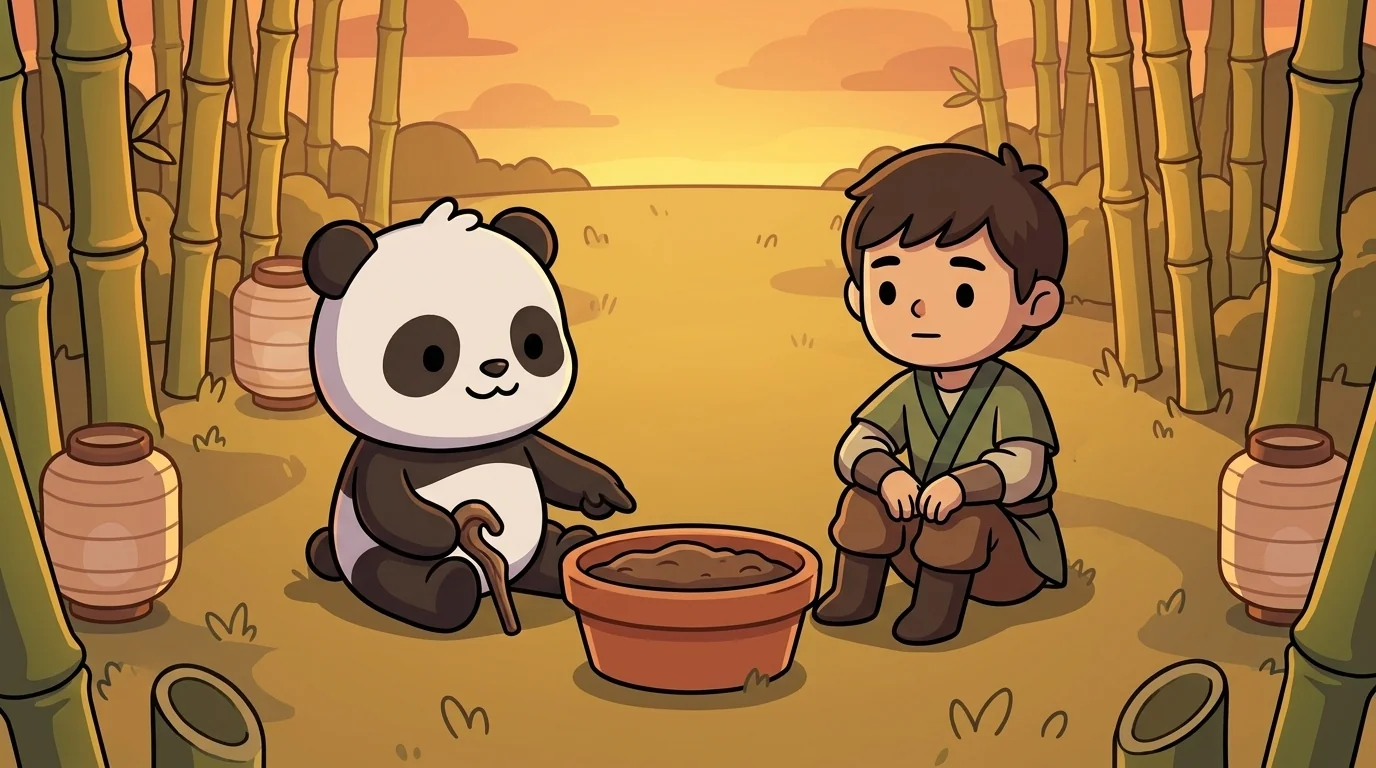
His grandfather, an old panda with moss on his shoulders and endless calm in his eyes, did not scold him. He knelt beside the shoot and touched the earth around it. "Under here," he said, "it has been building roots. All this time you thought it was doing nothing, it was making a foundation wide enough to hold what's coming." He looked at his grandson. "Wait one more season. Do not dig it up to check."
Patient Bamboo almost did dig it up, more than once. But he waited.
That summer the shoot grew ninety feet in six weeks. He watched it climb past his head, past the roof, past the tallest trees, so fast he could nearly see it moving. The slow years had not been wasted. They had been the price of the sudden ones. He never forgot the feeling — the astonishment, and under it, a deep and settling trust.
He came to the StoneSong academy when he was already old enough to have grey in his stripes, because a place that taught the long game needed someone who had actually lived one.
Master Snail met him at the gate, moving at his usual unhurried pace, and asked the question the academy always asked its cast. "Patient Bamboo — what do you teach?"
Patient Bamboo did not give a tidy answer. Instead he reached into his vest and drew out a worn position-card, its edges soft from handling. On it was a single Go position, sketched years ago. "This stone," he said, tapping a lone mark near the center, "sat useless for twenty moves in a game I played as a young panda. My opponent laughed at it. Then the whole board folded inward, and that useless stone turned out to be the only thing holding my territory together." He looked up. "I teach that some things pay off slowly. That you cannot judge a move by what it does today. You judge it by the shape of the whole board thirty moves from now."
Master Snail regarded him for a long, slow moment. "Most of the cast here want to teach the exciting things," he said. "The captures. The clever traps." His shell gleamed. "You'll teach the students to see what isn't happening yet. That's rarer. Stay."
A young student named Hungry Crane found Patient Bamboo maddening.
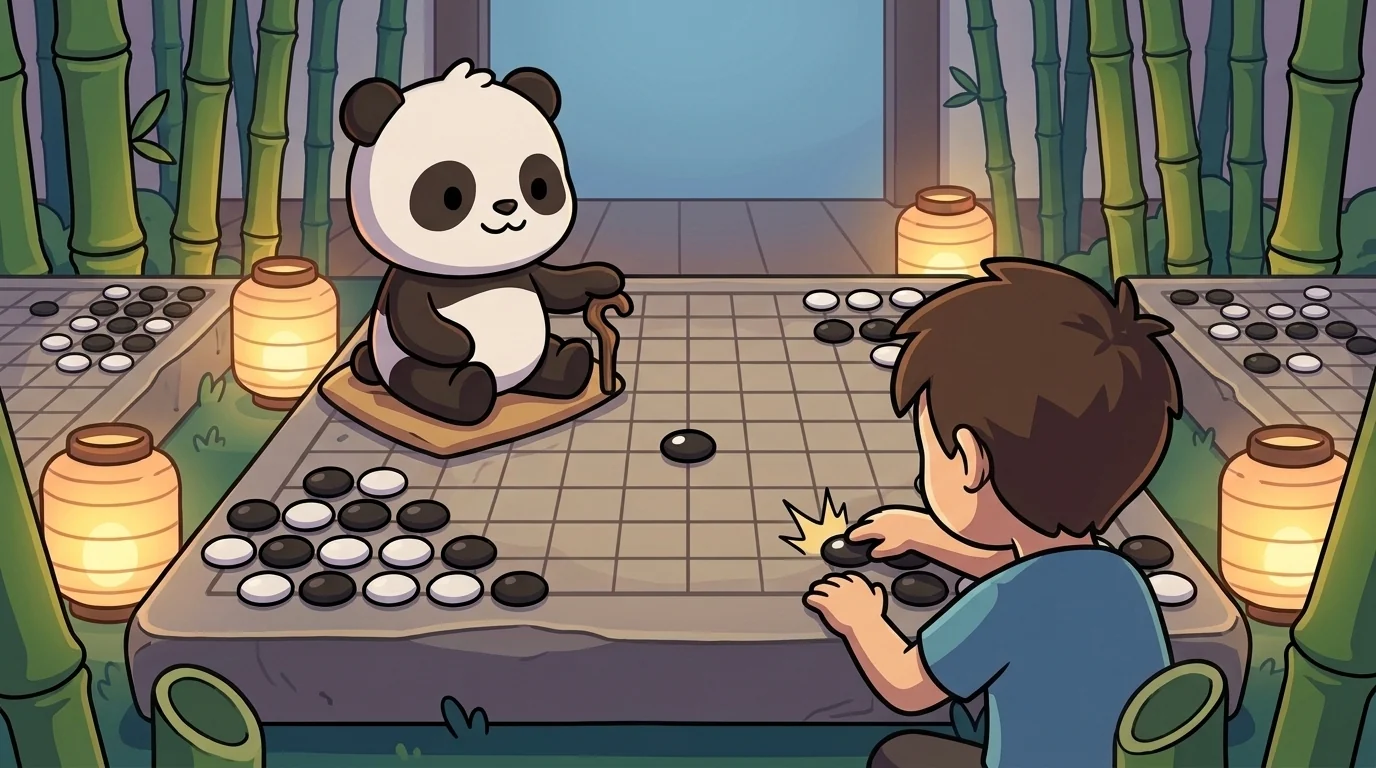
Crane was all sharp angles and quick decisions, forever hunting for a capture, forever wanting each stone to do something the instant it landed. One afternoon they sat across a thirteen-by-thirteen board, and Crane watched, twitching, as Patient Bamboo placed a single white stone dead in the center — far from every skirmish.
"That does nothing," Crane snapped. "It's just sitting there."
"Right now," Patient Bamboo agreed, his voice like still water. "But watch what right now becomes."
Crane played fiercely. He snapped up corners, built quick walls, threatened to cut Bamboo's groups apart, and grinned every time he took a few stones. Patient Bamboo did not defend flashily. He connected his groups with slow, solid, unremarkable moves, spreading a quiet web across the board, stone by patient stone. Ten moves passed. Fifteen. The corners began, one by one, to merge toward the middle.
Then — suddenly — the fighting broke open in the center, exactly where Crane had never bothered to look. His scattered groups, once so proud, scrambled for footholds and found none. And there, calm in the heart of the storm, sat the white stone Crane had mocked, now the keystone of an unbreakable network of white.
Crane stared. His beak dropped. "It's holding everything," he whispered.
"It always was," Patient Bamboo said gently. "You just couldn't see it grow."
That evening, after the board was cleared and the lamps were lit, Crane lingered by the doorway, quieter than Patient Bamboo had ever seen him.
"I hate waiting," Crane admitted. "It makes my chest feel tight. Like I'm losing while nothing's happening."
Patient Bamboo nodded slowly. He remembered a stubby shoot and four impatient years and a boy who had almost dug up his own foundation. "I know that feeling," he said. "I felt it beside a bamboo grove that grew slower than I could stand. I thought slow meant broken." He picked up the single white stone from the empty board and set it in Crane's palm, closing the young crane's sharp fingers around it. "It doesn't. Slow is just the part you can't see yet. The roots go down before the stalk goes up."
Crane looked down at the stone in his hand for a long time. And slowly — the way the light was slowly leaving the room — the tightness behind his ribs began to loosen. His shoulders, which he hadn't noticed were hunched up around his ears all day, came quietly down. Something in him unclenched, like a fist finally opening after holding on far too long, and in its place came a small, steady warmth: the ease of a boy who has just been told, and for the first time believed, that waiting is not the same as losing.
The StoneSong ensemble
Patient Bamboo is part of StoneSong's distributed-narrative cast. Each character embodies a different curricular primitive; together they teach the full subject.