Slide
SLIDE — *two plates sliding past; they catch, they hold, then they let go.*
Press play to listen along. The line being read lights up as you go.
Show full transcript
Loading transcript…
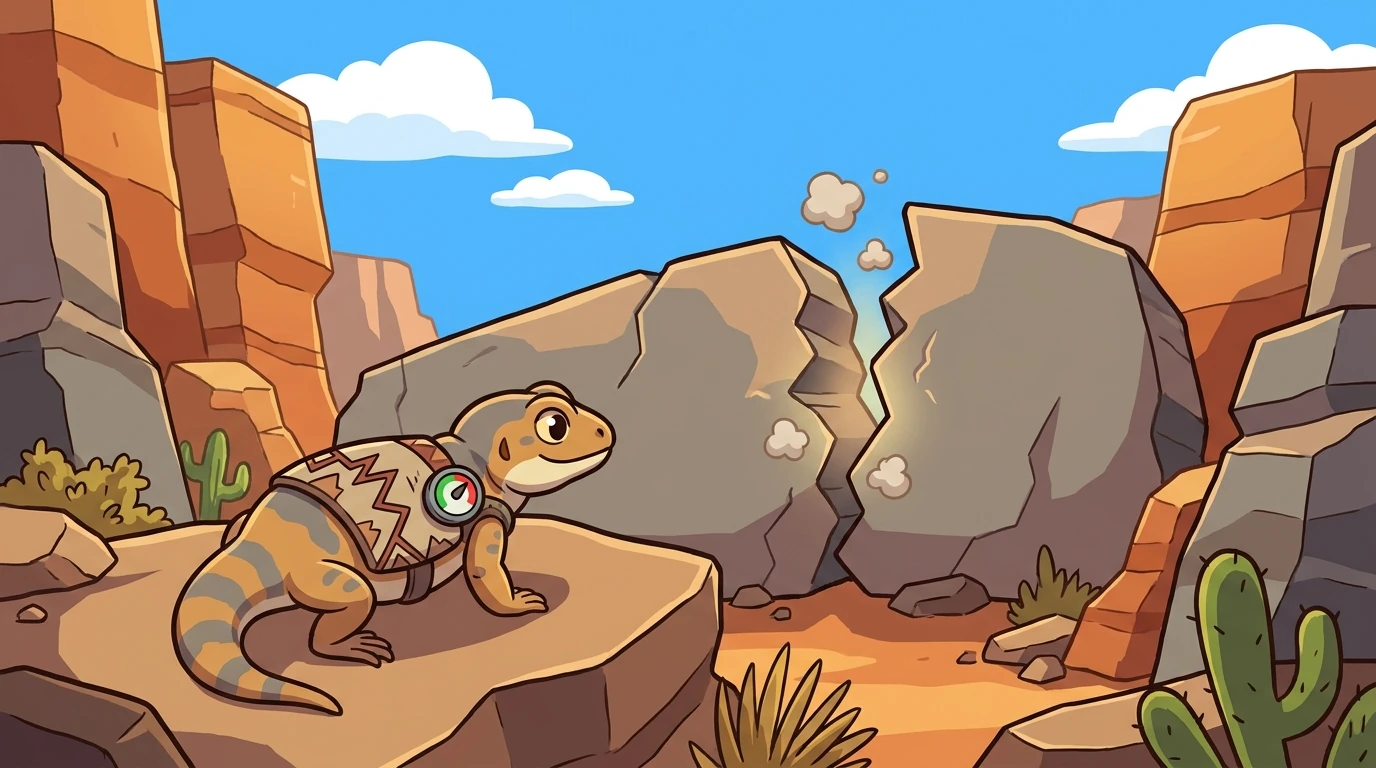
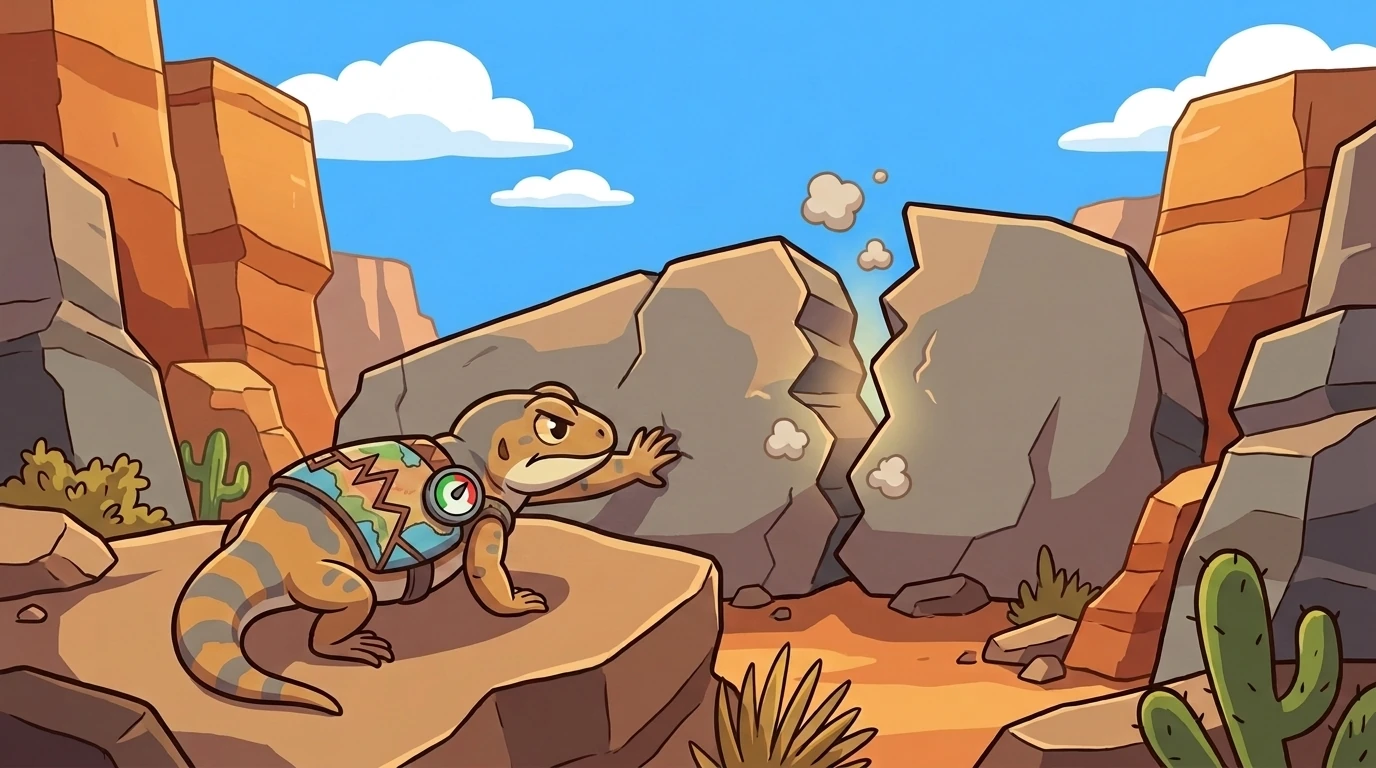
Slide pressed both her small palms flat against each other in front of the class and pushed. Nothing happened. She pushed harder, her banded arms trembling with the effort, and still her hands stayed locked — friction gripping palm to palm so tightly that neither would give.
"They're stuck," a student offered.
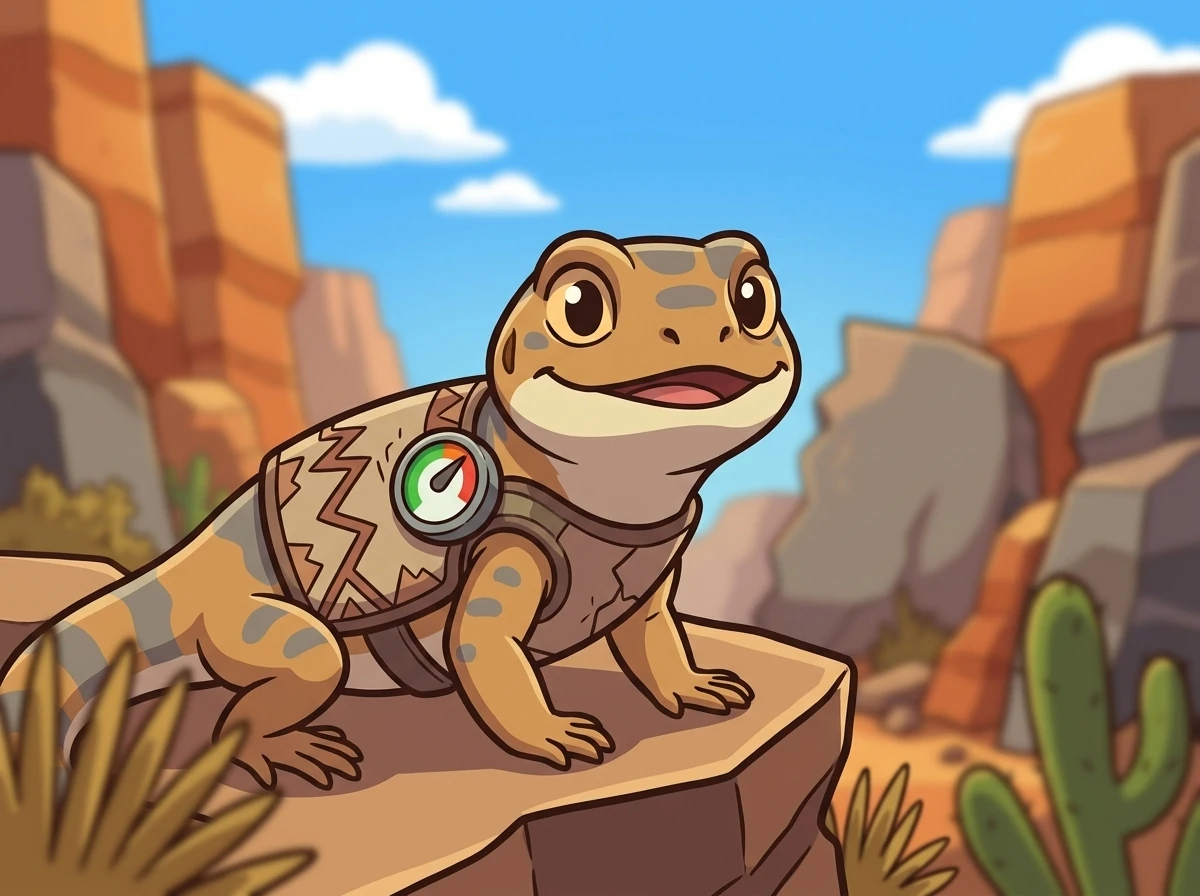
"They're caught," Slide corrected gently. She was a chuckwalla, round and soft and tan, no bigger than a loaf of bread, and she did not look like anyone who spent her days thinking about the ground splitting open. "Watch. I keep pushing. The pressure keeps building. My arms are shaking now — see? All that effort is going somewhere. It's being stored." She leaned in, and her hands, unable to hold any longer, snapped past each other with a soft clap. "And then they let go. That's a fault, sliding. Two plates pressing past each other. They catch, they hold, then they let go."
The little stress-meter clipped to her vest flickered red, then green. She had built her whole life around that single motion.
Slide had not always understood the ground. She had grown up in a village at the edge of a fault-zone, in a family of chuckwallas who called themselves ground-listeners. It was not a grand title. It meant that when the earth was restless, they lay down flat on the warm rock and felt it — the small tremors that ran through the stone like a shiver, the ones too faint for standing feet to notice.
"The ground is talking," her grandmother would say, one wrinkled cheek pressed to the earth. "Small tremors come before the big slip. A family that listens is a family that gets ready."
When Slide was very young, this frightened her. She thought the ground was angry, or that it was warning of some punishment coming for something she'd done. One evening she asked her grandmother if the earth was mad at them.
Her grandmother sat up slowly and took Slide's small hand. "No, little one. It isn't angry, and it isn't random, and it isn't after you." She pressed Slide's two palms together the way Slide would one day press her own for a hundred classrooms. "It's only this. Rock pushing against rock. It catches. It holds. It builds up all that held-back push until it can't hold anymore — and then it slips. That's all an earthquake is. Held-back pushing, letting go." She smiled. "Frightening things get smaller when you understand them. This one gets small enough to carry."
Slide had carried it ever since.
She walked to the academy at TectonicForge when she was thirteen, her fault-line map rolled under one arm and her homemade stress-meter ticking at her chest.
Geo, the old mentor who ran the lessons hall, met her at the gate. He was known for asking each newcomer a single question and listening to how they answered more than what they answered.
"What is a transform boundary?" he asked.
Slide didn't reach for a definition. She simply pressed her two palms together, pushed until her arms shook, and let them snap past one another. "This," she said. "Two plates sliding past each other. Not crashing together. Not pulling apart. Just grinding side by side — catching, holding, then letting go. The letting-go is what people feel and call an earthquake." She lowered her hands. "And it isn't a punishment. It's a cycle. Which means you can be ready for it."
Geo looked at her for a long moment. Then he nodded, slow and certain. "You are appointed," he said. "Most who come here want to teach people to be afraid of the ground. You want to teach them to be unafraid of it. That is rarer, and it is harder, and it is what this hall needs."
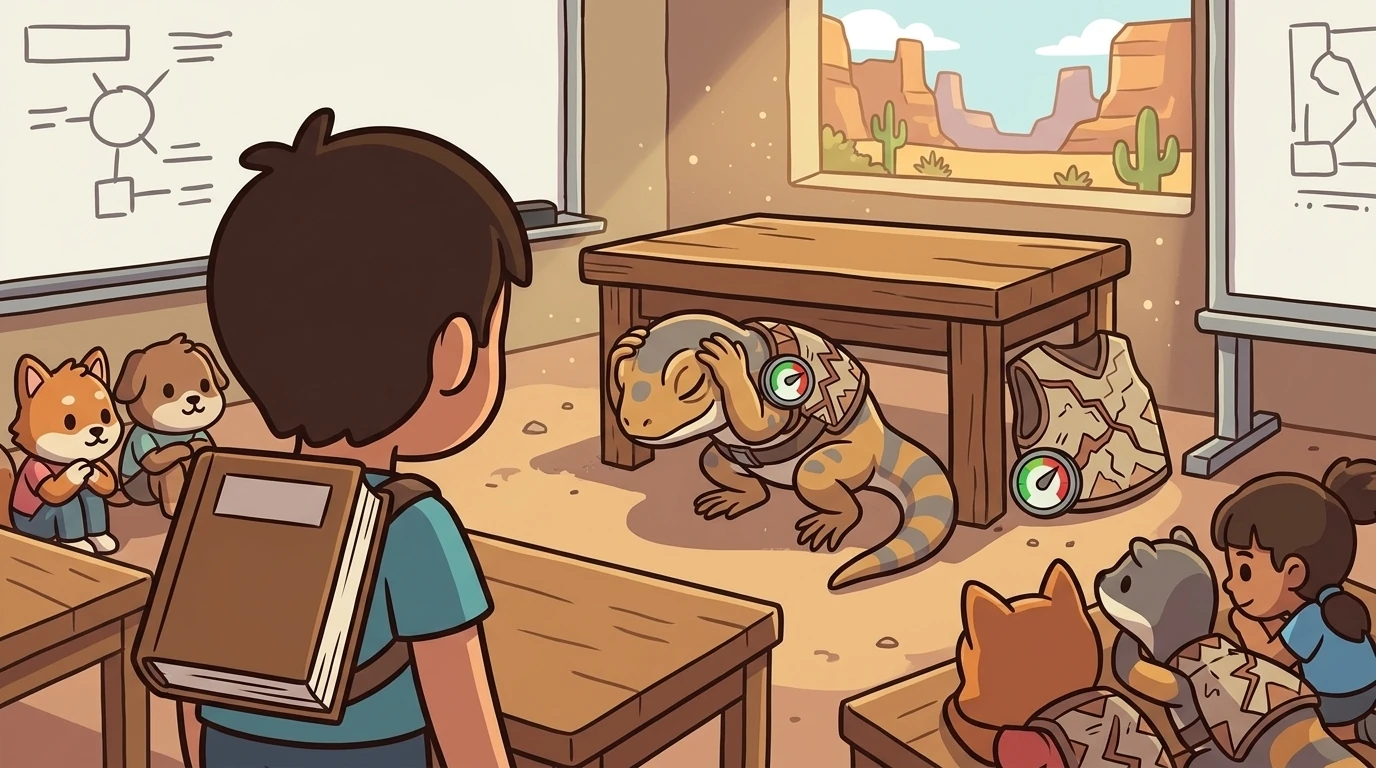
Slide's workshop filled, over the years, with kids who arrived already scared.
One afternoon a girl came in with her arms wrapped tight around herself. She had felt a small quake the week before — the dishes had rattled, a picture had fallen — and she hadn't slept right since. "I don't want to learn about earthquakes," she said. "I want them to stop."
"I can't make them stop," Slide said honestly. "The plates are going to keep sliding whether we like it or not. But I can show you exactly what's happening, and I can show you what to do. Sometimes that's better than stopping. Do you want to see?"
The girl hesitated, then nodded.
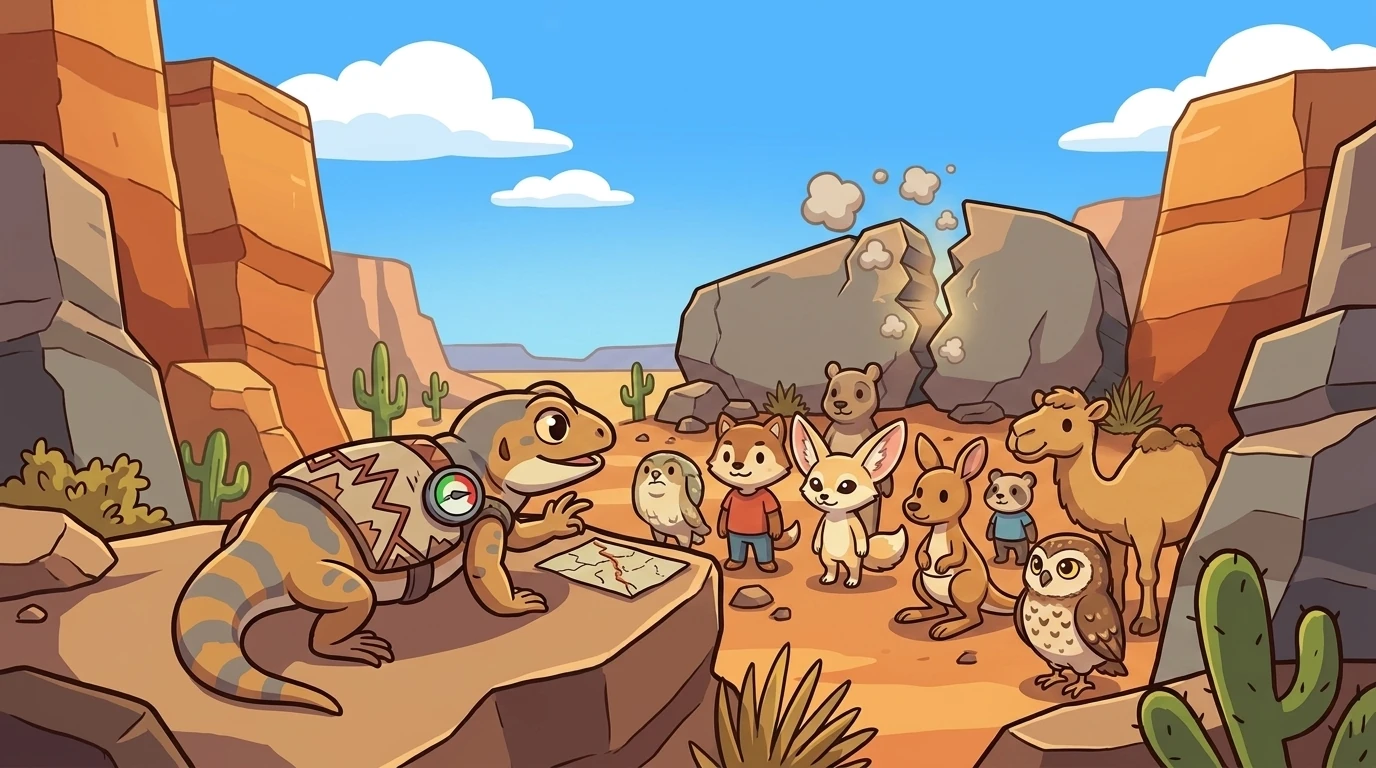
Slide spread her map across the bench and traced a long line with one careful claw. "This is the San Andreas Fault, in California. Here the Pacific Plate slides north, past the North American Plate — about three to five centimeters a year. Slower than your fingernails grow." She tapped the stress-meter. "But it catches. Friction holds it. And while it holds, the push builds up — right here." The meter glowed red, brighter and brighter. "Until—" With a small click, it flashed green, and a gentle tremor buzzed through the tabletop. "There. It let go. That's a real one, made small enough to hold in your hands."
The girl touched the still-buzzing table. "So it's not random."
"It's never random. It's stored push, releasing." Slide crouched down to the girl's eye level. "And here's the part that matters most. When the ground shakes, you drop — down to your hands and knees. You cover your head and neck, get under a sturdy desk if there's one. And you hold on until it stops. Drop, cover, hold on." She smiled. "You just took the biggest step. You stopped freezing and started knowing. That's preparedness. That's not fear."
She named a few real quakes then, quietly and with respect — the 1994 Northridge quake in California, the 2010 Christchurch quake in New Zealand and the hard aftershock that followed — not to frighten the girl, but to honor the people who had lived through them and rebuilt. "We remember them," she said. "And we learn what they teach us. That's how we honor them."
After the others had gone, the girl lingered by the bench, her arms no longer wrapped around herself.
"I thought if I learned about it, it would feel scarier," she said. "But it feels... smaller."
Slide rested her claw over the quiet stress-meter. "That's the trade. Not-knowing makes a thing enormous — it takes up the whole dark room. But when you know how it works, and you know what your feet and hands are supposed to do, it shrinks down." She pressed her two palms together one last time, gently, and let them slide past. "Catch, hold, let go. That's all it ever is."
The girl breathed out — a long, slow breath she seemed to have been holding for a week — and felt the tight place behind her ribs go loose and warm. The picture that had fallen, the rattling dishes, the sleepless nights: they didn't vanish, but they settled, the way the ink had settled on Slide's map, into something she could carry without shaking. She walked home that evening standing a little taller, not because the ground had promised to be still, but because she finally knew what to do when it wasn't. And that knowing sat in her chest, steady and quiet, like a hand resting on solid rock.
The TectonicForge ensemble
Slide is part of TectonicForge's distributed-narrative cast. Each character embodies a different curricular primitive; together they teach the full subject.
-

Sink
Convergent/subduction boundary — the heavier plate finds its way down; it takes a long time; that's okay
-
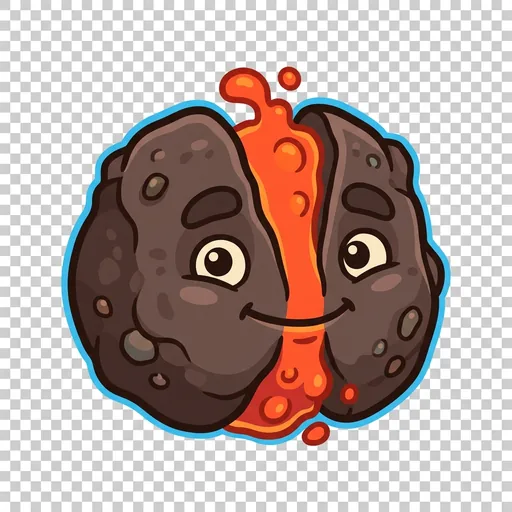
Spread
Divergent boundary + new crust — when something pulls apart, something new is forming in the middle
-

Vent
Volcanism + magma chemistry — eruptions tell us what was happening below
-
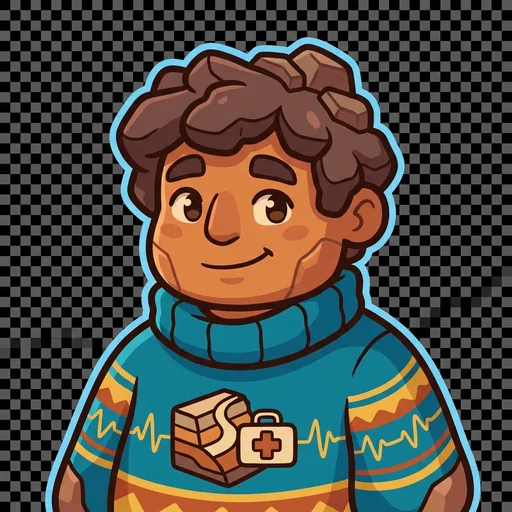
Tremor
Seismology + earthquake preparedness — earthquakes are the Earth telling its story; we can read the lines; we can be ready