Tremor
TREMOR — earthquakes are the Earth telling its story; we can read the lines; we can be ready.
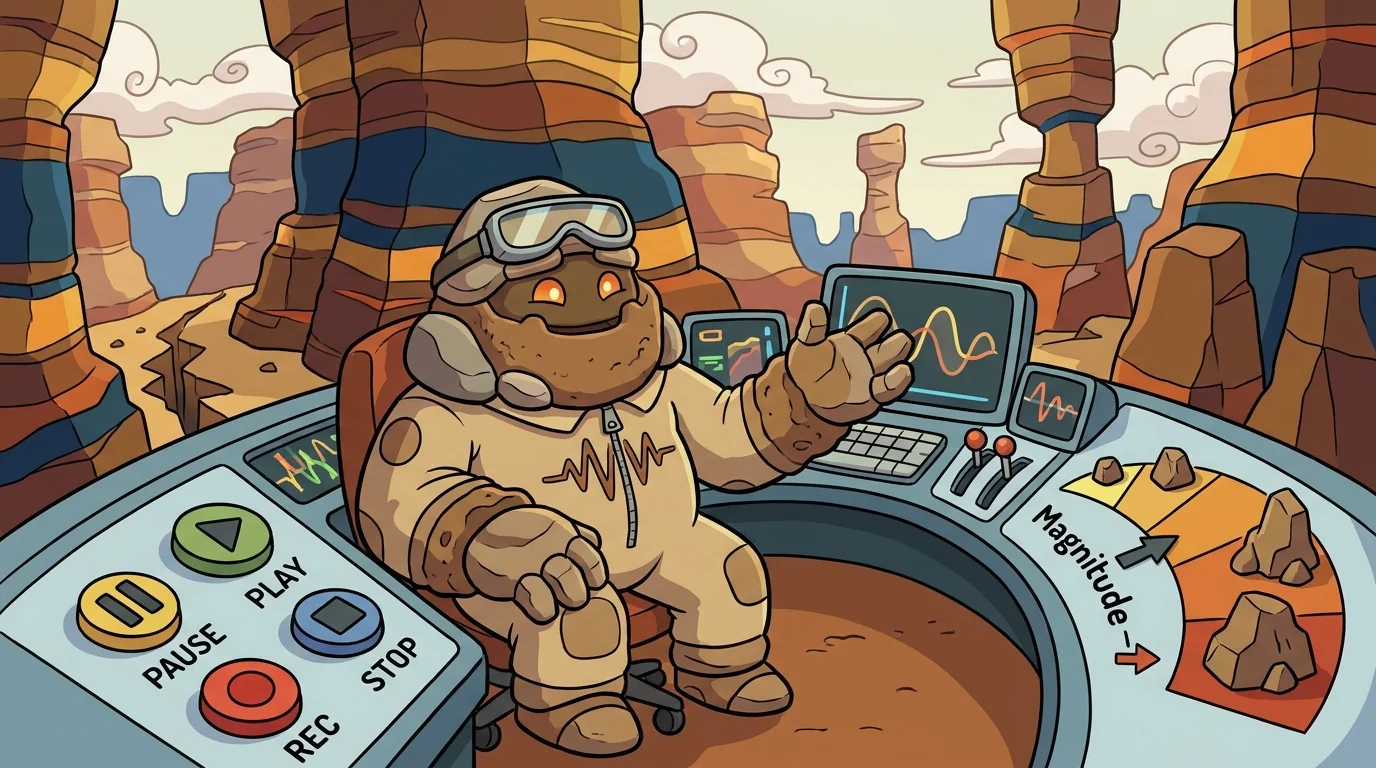
Press play to listen along. The line being read lights up as you go.
Show full transcript
Loading transcript…
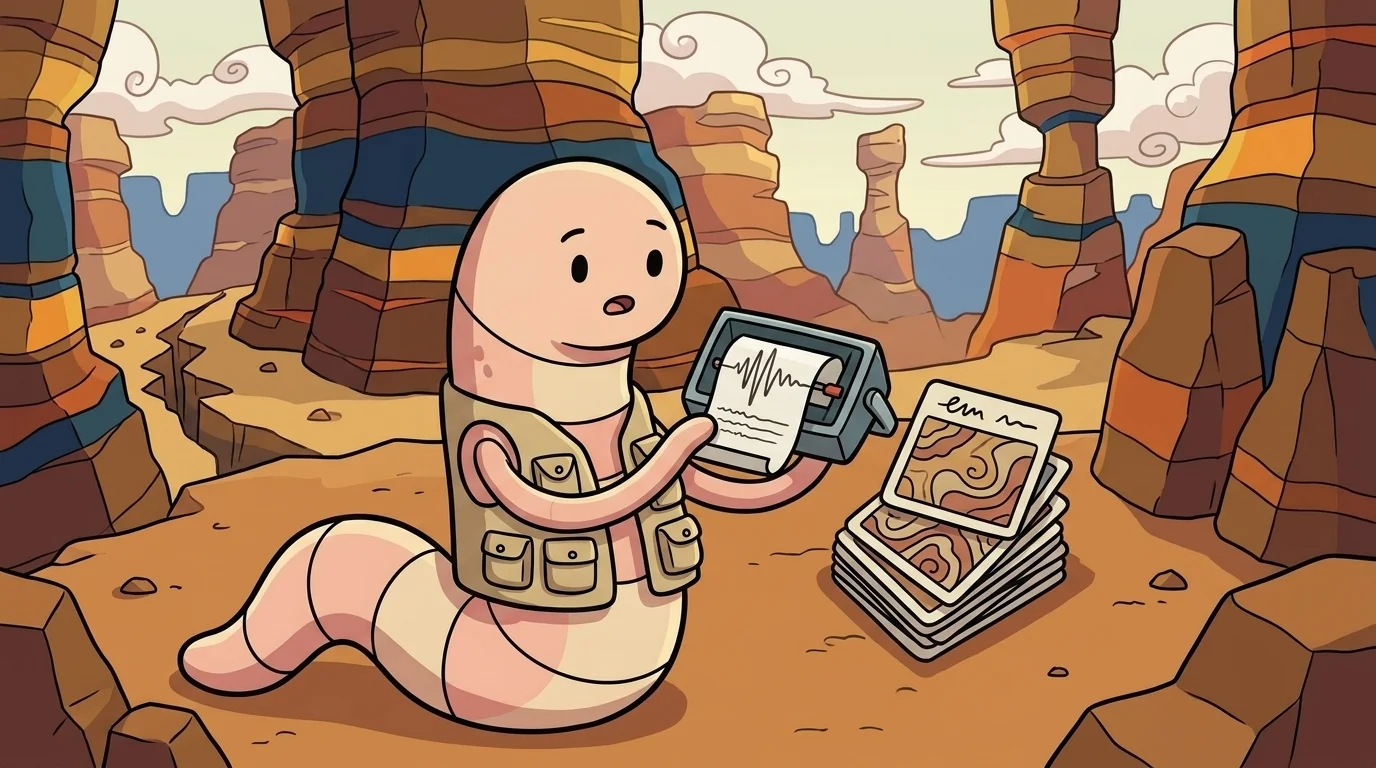
Deep at the bottom of the TectonicForge workshop, where the floor met the soil and the light went soft and brown, a small earthworm sat with her segmented body curled around a little machine, listening.
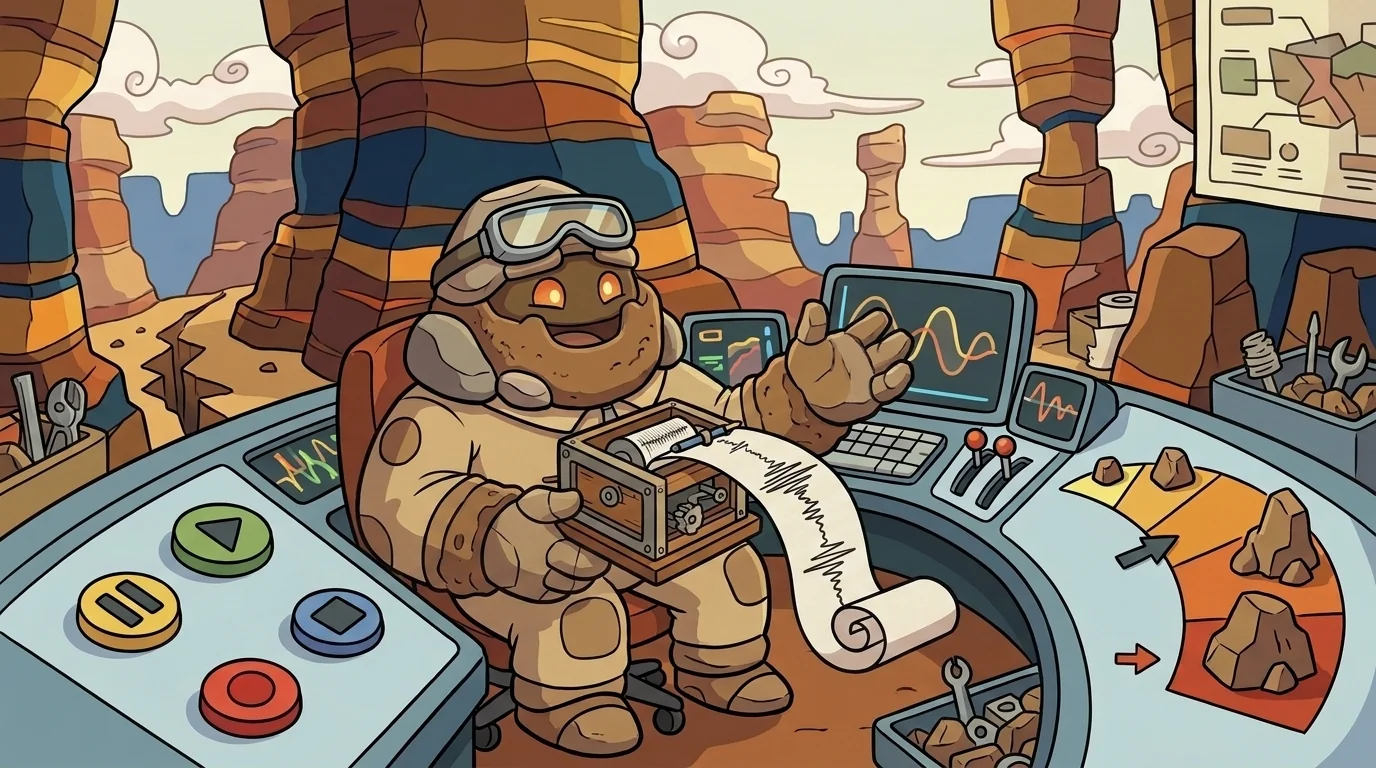
The machine was a seismograph — a boxy thing with a roll of paper feeding slowly through it and a thin pen resting against the page. Tremor wasn't building anything. She was reading. The pen had drawn a long, calm line all morning, and she watched it the way some people watch a river, patient and unhurried, waiting for the water to say something.
A young learner crept down the ramp and crouched beside her. "Is it broken? It's just drawing a straight line."
"It's not broken," Tremor said, not looking up. "It's telling me the Earth is quiet right now. That's a sentence too." She tapped the paper gently, and the pen jumped — a small, sharp spike, then a slow settling wobble. "There. I just made the ground move a tiny bit, and the pen wrote it down. Every wave that runs through the rock leaves a line right here." She smiled at him. "Earthquakes are the Earth telling its story. My whole job is learning to read the lines."
Tremor had not always been able to read them.
She had grown up underground, in a family of earthworms whose bodies were so sensitive they could feel a footstep three fields away. Her grandmother called them vibration-readers, and it was true — Tremor had felt the ground's tiniest shivers her whole life. But feeling a shiver and understanding it were two different things, and for a long time the difference frightened her.
She remembered the first big tremor of her childhood. She had felt it coming a full second before it hit — a strange pressure, a push through the soil — and then the ground had rolled, and she had frozen, small and stiff, certain the world was breaking. When it stopped, she couldn't stop shaking. The waiting had been the worst part. Not knowing.
Her grandmother had found her curled tight in the dark. She didn't tell Tremor to be brave. She set a stack of worn cards in front of her instead. "That push you felt first," she said. "That was a P-wave, running ahead. The roll that came after was slower. If you learn which is which, the ground stops being a surprise." She tapped the top card. "Fear lives in the not-knowing. So we go and find out. A family that reads the lines is a family that stays calm."
Tremor had studied those cards until the fear had somewhere to go — until the shaking, when it came, was a thing she could name.
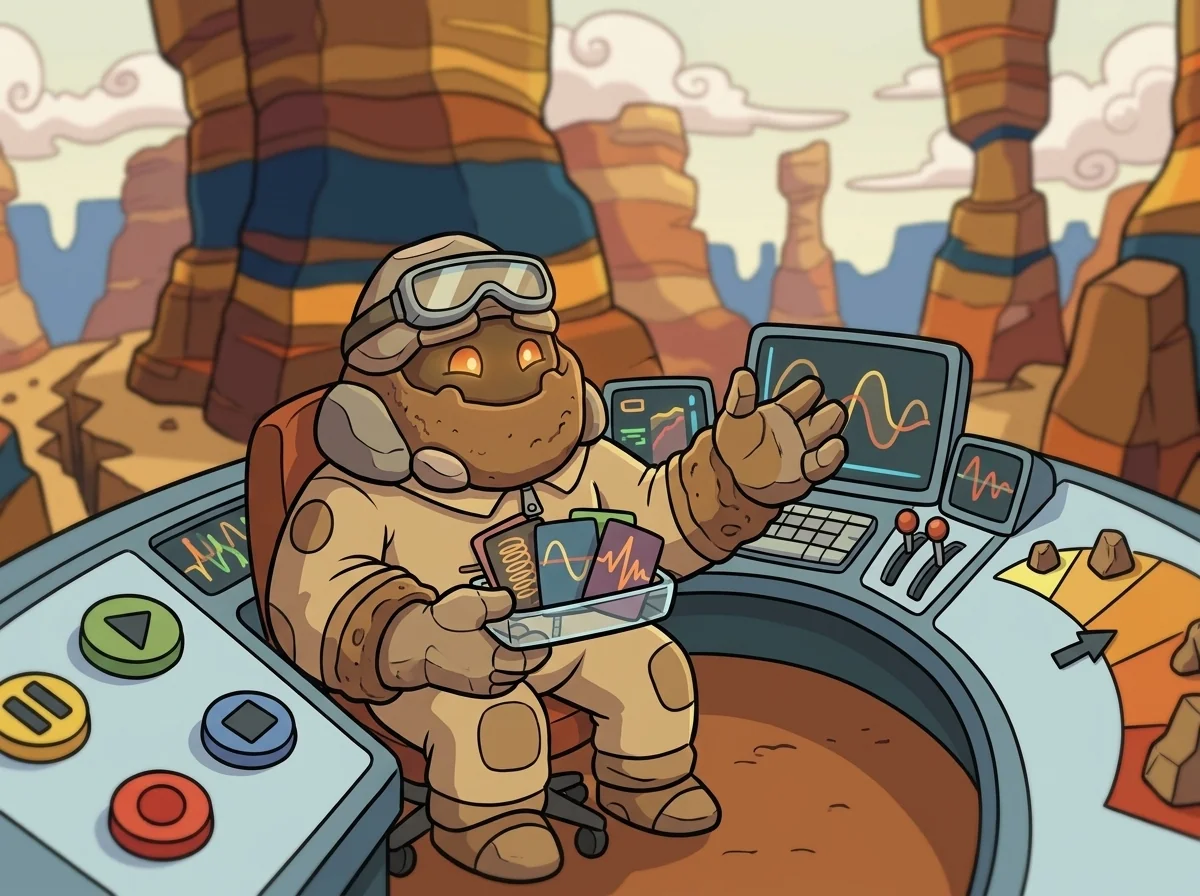
She walked up to TectonicForge when she was twelve, carrying the cards in her vest pockets.
Geo, the old mentor of the workshop, met her where the ramp came up out of the soil and asked one question, the way the mentors there always did. "What is it you understand, that this place needs?"
Tremor didn't recite a definition. She reached into her vest, pulled out her small seismograph, and set it on the ground between them. Then she pressed one segment of her body flat against the floor and held still. "Something's coming," she said quietly. "Small. Far off. Maybe a cart on the far road." A moment later the pen twitched — a faint, ragged little line — exactly as she'd said.
Geo looked at the line for a long time. "You felt it before the machine drew it."
"I've felt them my whole life," Tremor said. "But feeling them just scared me, until I learned to read them. Now the ground talks and I understand it. I want to teach that. Reading the lines, and knowing what to do — that's how you stop being afraid." She looked up. "That's the part people are missing. They think an earthquake is a surprise. It's a sentence. You can learn the language."
Geo nodded once. "You belong here," she said.
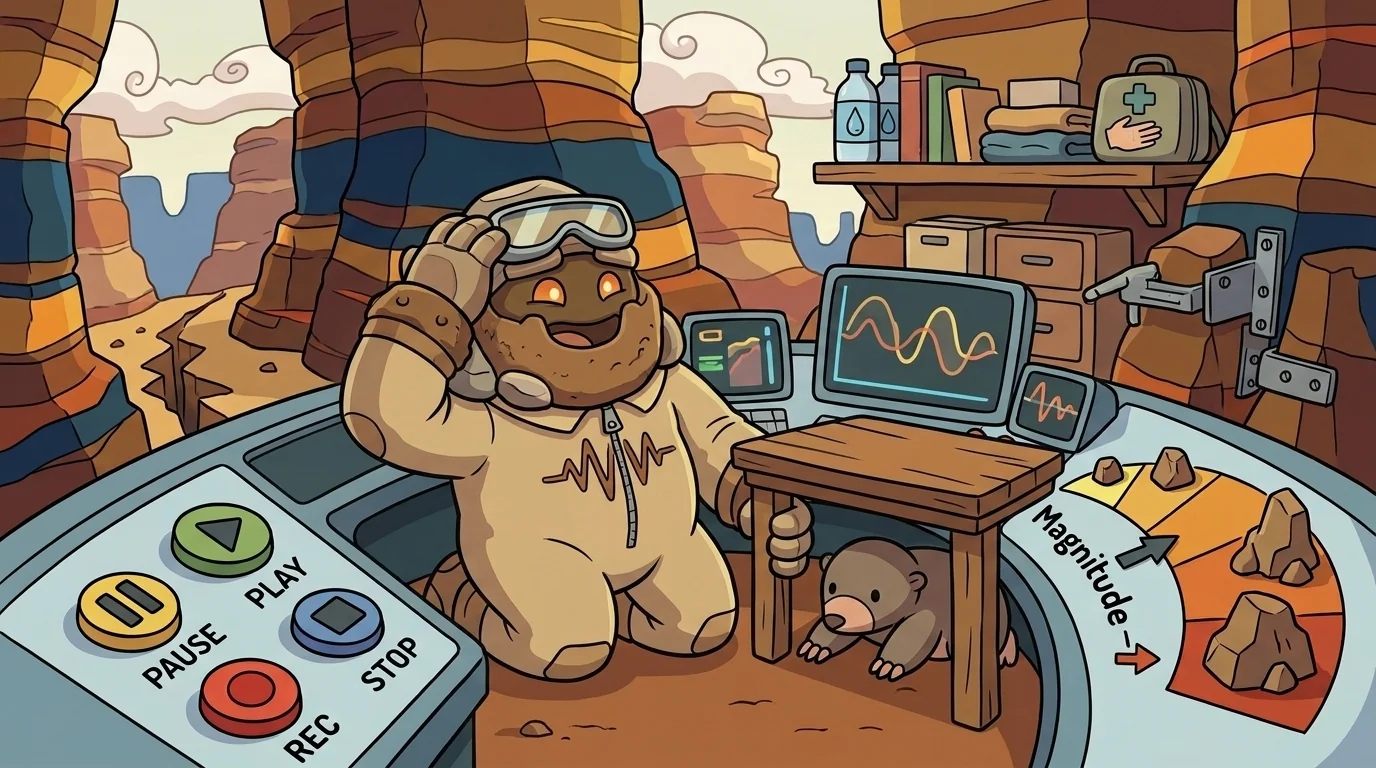
Tremor's corner of the workshop filled, over the seasons, with learners — and often the ones who came were the ones who were scared.
One afternoon a girl came down the ramp with her arms wrapped tight around herself. "I don't like this part," she said. "We learned about earthquakes at school and I couldn't sleep for a week. I don't want to read about the ground breaking."
Tremor didn't argue with her. She just patted the floor beside the seismograph. "Then don't read about it," she said. "Watch it. Watch me tap the table and watch the pen." She tapped, gently, and the pen drew its quick, sharp spike. "That's a P-wave. A push, like squeezing a spring. It's the fastest, so it always arrives first — it's the ground clearing its throat before it speaks." She tapped again with a small wiggle, and the pen rolled out a slower, wider line. "That's the S-wave. It comes behind, side to side. And because one is fast and one is slow, the gap between them tells you how far away the whole thing is." She traced the space between the two marks. "Three machines in three places, three measurements, and you can find the exact spot it started. The Earth can't hide it from you."
The girl leaned in despite herself. "So you always know."
"We're getting very good at knowing," Tremor said. "In some places, machines catch that first fast wave and send out a warning before the slow, shaking one arrives. Seconds. Sometimes a whole minute." She held up one small segment. "And a minute is enough time to do three things. Drop." She sank to the floor. "Cover — arms over your head and neck." She tucked in. "And Hold On to something steady." She gripped a table leg. "That's it. That's the whole thing. Practice it until your body does it without asking."
The girl practiced it, once, awkwardly. Then again, better. "That's... smaller than I thought it would be."
"Most of preparedness is small," Tremor said. "A plan for where your family meets. A kit with water on a shelf. Heavy furniture strapped to the wall — an adult helps with that part. None of it is dramatic. All of it gives your hands a job when the ground moves. And hands with a job aren't as scared." She rested her card down softly. "That's the secret nobody tells you. Being ready isn't about the earthquake. It's about you."
Later, when the workshop had gone quiet and the brown light had dimmed, the girl came back with a smaller question.
"The ones that already happened," she said. "The really big ones. How do you think about those without it just being sad?"
Tremor was quiet for a moment. She thought of the tremor from her childhood, and the shaking that wouldn't stop. "You hold them carefully," she said. "There were big earthquakes — in Japan, in Türkiye and Syria — where a great deal was lost, and people are still rebuilding, and the world came to help. We don't skip past that. We don't turn it into a scary story either." She smoothed the card in her lap. "We say: those people mattered. And then we learn the science because they mattered, so the next family has their kit ready and their plan practiced. Honoring them and being ready are the same motion."
The girl nodded slowly. "And if it's still too much? If someone's actually felt one?"
"Then they PAUSE," Tremor said gently. "They skip what they need to skip. The knowledge waits — it's patient, it doesn't go anywhere. Nobody has to be ready all at once."
The girl sat with that, and Tremor watched the tightness she'd carried down the ramp go soft in her shoulders — the same loosening Tremor had felt, long ago, when the cards had finally given her fear a name. The girl took a slow breath, and let it out, and for the first time all day her body wasn't braced for something. She wasn't waiting to be surprised anymore. She knew what the lines meant now, and she knew what her hands would do, and in the quiet brown light that knowing sat in her chest like something warm and steady she could lean against — not the absence of fear, exactly, but fear with somewhere to go, and a calm that had grown up right where the scared feeling used to be.
The TectonicForge ensemble
Tremor is part of TectonicForge's distributed-narrative cast. Each character embodies a different curricular primitive; together they teach the full subject.
-

Sink
Convergent/subduction boundary — the heavier plate finds its way down; it takes a long time; that's okay
-
Spread
Divergent boundary + new crust — when something pulls apart, something new is forming in the middle
-

Slide
Transform boundary + stored energy — two plates sliding past; they catch, they hold, then they let go
-

Vent
Volcanism + magma chemistry — eruptions tell us what was happening below