
Tempo and Tone
rhythm-timbre pair — Tempo is speed (BPM, pulse, push and pull of time). Tone is timbre (which instrument, which sound color, which feel). Together they teach that a song has both how-fast and what-it-sounds-like.
A story read by Tempo and Tone
Press play to listen along. The line being read lights up as you go.
Show full transcript
Loading transcript…
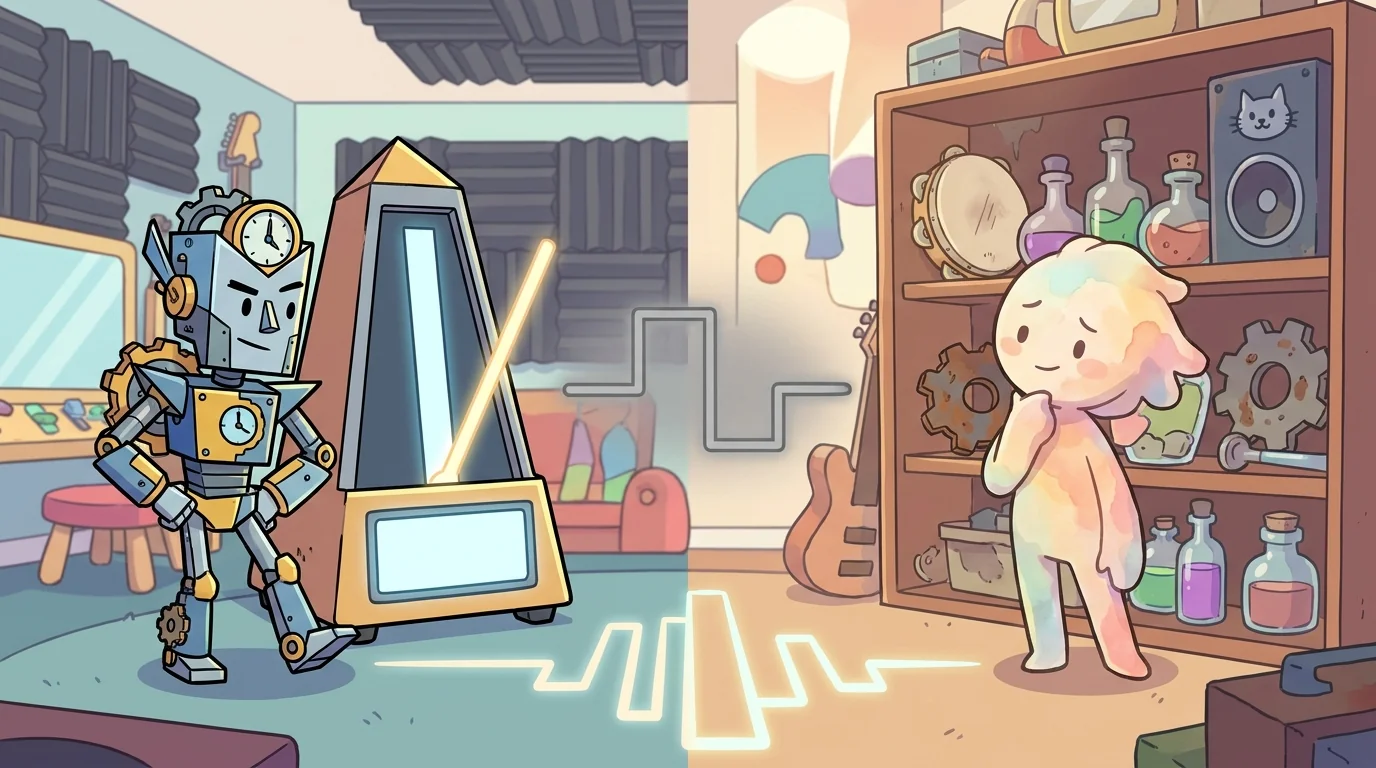
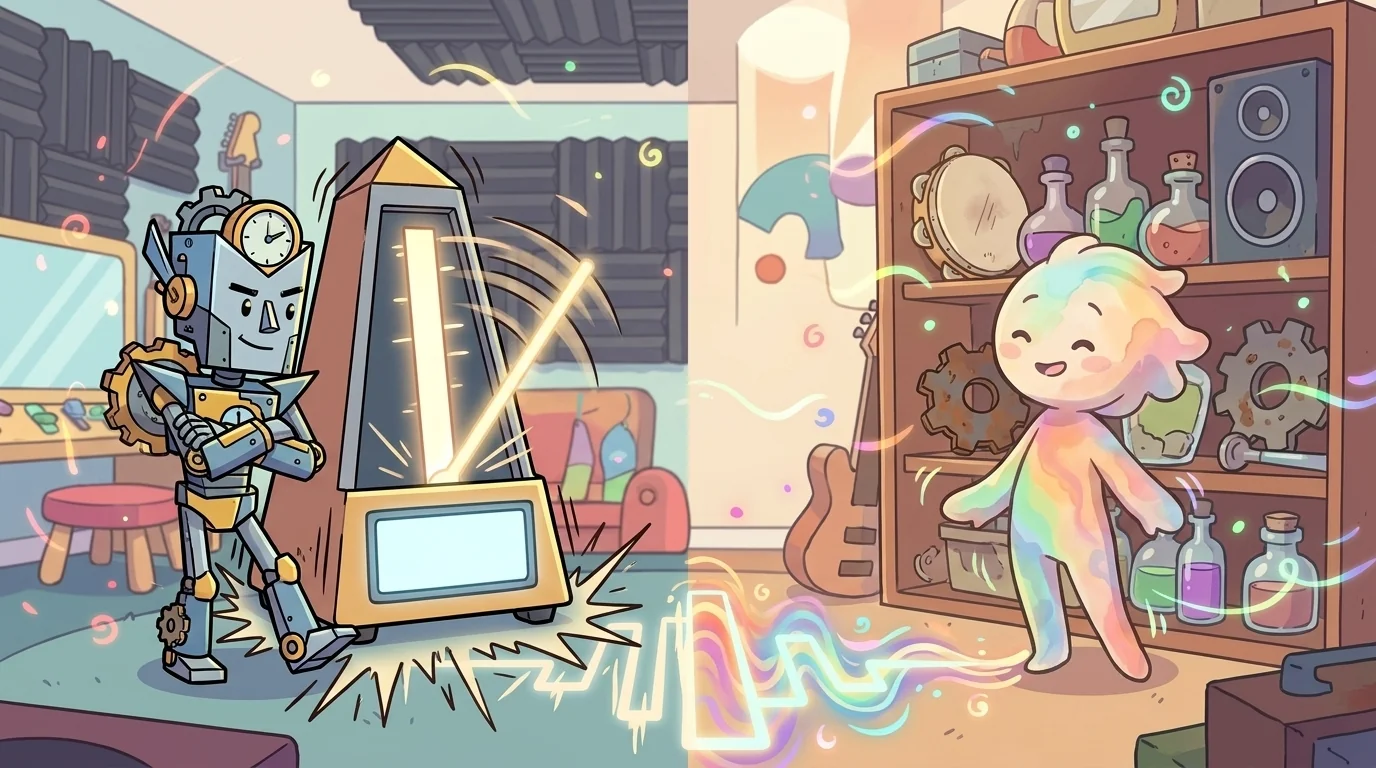
The beat you had just created looped around the studio, filling the vast space between Tempo’s gleaming wall and Tone’s shimmering one. On Tempo’s side, a colossal, glowing metronome swung a silent pendulum of light, its digital display holding steady at 90 BPM. Across the room, Tone’s shelves overflowed with an eclectic collection of objects: a dusty tambourine, a row of glass bottles filled with varying amounts of colored water, a rusty gear, and a speaker clearly labeled cat purr.
Your beat, honestly, was just… okay. The kick drum thumped, the snare snapped, and a simple melody plinked along. But it felt flat, like a piece of gray cardboard waiting for something more. It was present, but it wasn't alive.
Tempo, a being composed of sharp lines and meticulously clicking clockwork parts, tapped a metal foot perfectly in time with the looping rhythm. “It is technically correct,” Tempo stated, their voice crisp and even, each word landing precisely. “The notes land on the grid. One, and, two, and, three, and, four, and. But the pulse is weak. It has no urgency.”
Tone, whose form was softer and seemed to shimmer with a gentle hum, tilted their head. Their presence was less defined than Tempo’s, like a living watercolor painting. “It has no color,” Tone murmured, their voice a low, melodic sound that seemed to flow rather than speak. “The sounds are just… sounds. They don't evoke anything. They don't tell a story.”
Tempo pointed a precise finger at the glowing number on the metronome. “The problem is the when.”
Tone gestured vaguely towards their shelves of oddities. “No, the problem is the what.”
They both looked at you, waiting. The plain beat looped again, insistent in its blandness. Thump-snap. Thump-thump-snap. You felt a familiar prickle of frustration. How could something so simple be so complicated?
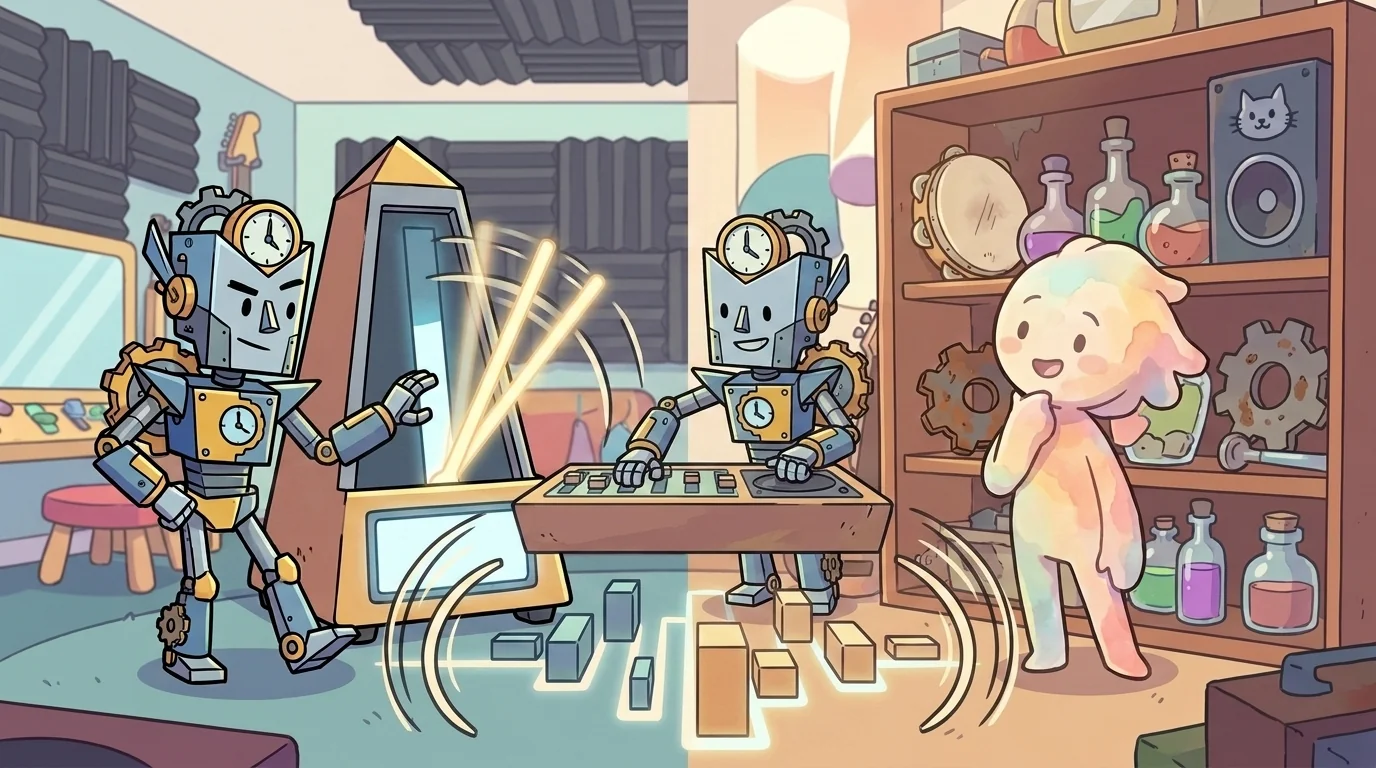
“Let’s simplify,” Tempo announced, striding with purpose towards the main console. With a few precise clicks, they muted your melody, leaving only the drums. Thump-snap. Thump-thump-snap. “Forget the sounds for a moment. Just listen to the pattern. The engine.”
Tempo’s hand moved to the giant slider next to the metronome. The air in the studio seemed to thicken as they dragged it down. The light-pendulum slowed, its swing becoming a languid arc, and the beat followed, stretching out like taffy. The digital counter dropped steadily: 80… 70… 60 BPM.
Thump... snap... Thump... thump... snap...
“See?” Tempo asked, their voice now slower, heavier, matching the rhythm. “Now it’s a giant, trudging through a swamp. It’s heavy. It’s sleepy. The feeling is completely different, but the pattern is exactly the same.” You felt the weight of it, a slow, deliberate movement that made your own shoulders slump slightly.
Then, with a sudden, decisive push, Tempo shoved the slider all the way up. The pendulum blurred into an almost solid arc of light. 100… 120… 140 BPM!
Thump-snap. Thump-thump-snap. But now it was fast, frantic, and full of an almost manic energy. It made you want to tap your own feet, a nervous flutter starting in your chest. “Now it’s a squirrel in a coffee shop!” Tempo declared, their voice quick and bright. “It’s jittery! It’s exciting! The speed—the *tempo*—changes the story. Is your song a sleepy giant or a caffeinated squirrel? You have to decide how fast its heart should beat.” It was a surprising thought, that a simple change in speed could completely transform the story a sound told. You’d never considered music that way before.
“A fine choice,” Tone hummed, a gentle ripple passing through their form, as you set the tempo to a peppier 110 BPM. “But even a fast squirrel is boring if it’s gray.”
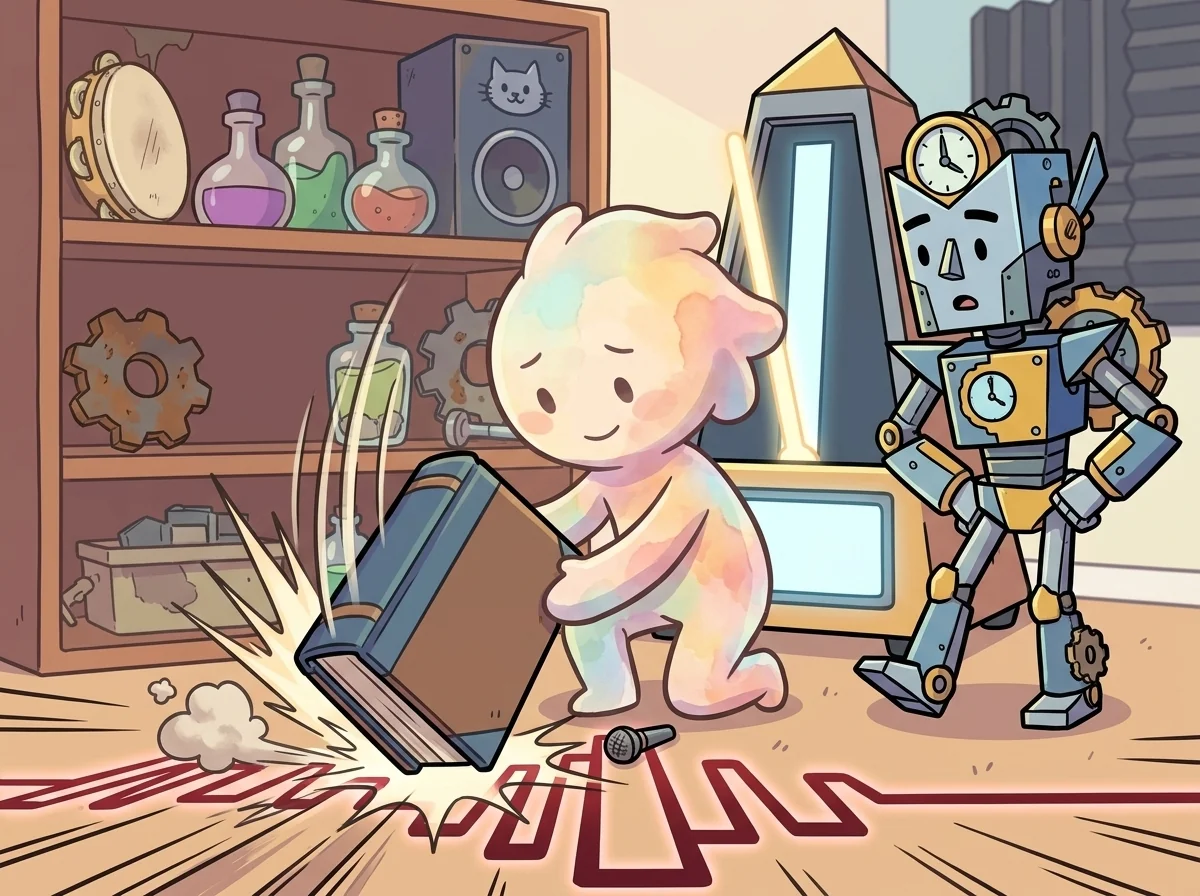
Tone drifted over to their wall of wonders, their gaze sweeping across the shelves. They completely ignored the drum machine icon on your screen. Instead, they picked up a large, heavy book from a low shelf, its cover worn and faded. “A kick drum should have weight. It should move the air,” they explained. They held a small microphone near the book, then let it fall flat onto the floor with a surprising force.
THWUMP.
With a gentle wave of their hand, the sound replaced your old kick drum. You played the beat again. THWUMP-snap. THWUMP-THWUMP-snap. Whoa. It sounded bigger, more real, like something solid had actually hit the ground.
“Better,” Tone whispered, their voice a soft caress. “Now, the snare.” They scanned the shelves again, their eyes passing over the bottles and gears, before landing on a small, unlabeled speaker tucked away behind a stack of sheet music. “That polite little snap isn't cutting it. We need something with more attitude.” They tapped the speaker, and a sharp, sizzling CRACKLE-POP, exactly like bacon in a hot pan, jumped out. Tone smiled, a subtle shift in their shimmering form, and swapped the sound.
You hit play. THWUMP-CRACKLE. THWUMP-THWUMP-CRACKLE. It was weird, and surprising, and a thousand times more interesting than before. The bacon sizzle felt rebellious, almost cheeky. “See?” Tone said softly, their voice like a gentle melody. “The sounds are the clothes the rhythm wears. You can dress it up to be serious, or silly, or anything in between. The *tone* gives the beat its personality.” You realized then that the sounds weren't just noise; they were characters, each with their own distinct voice.
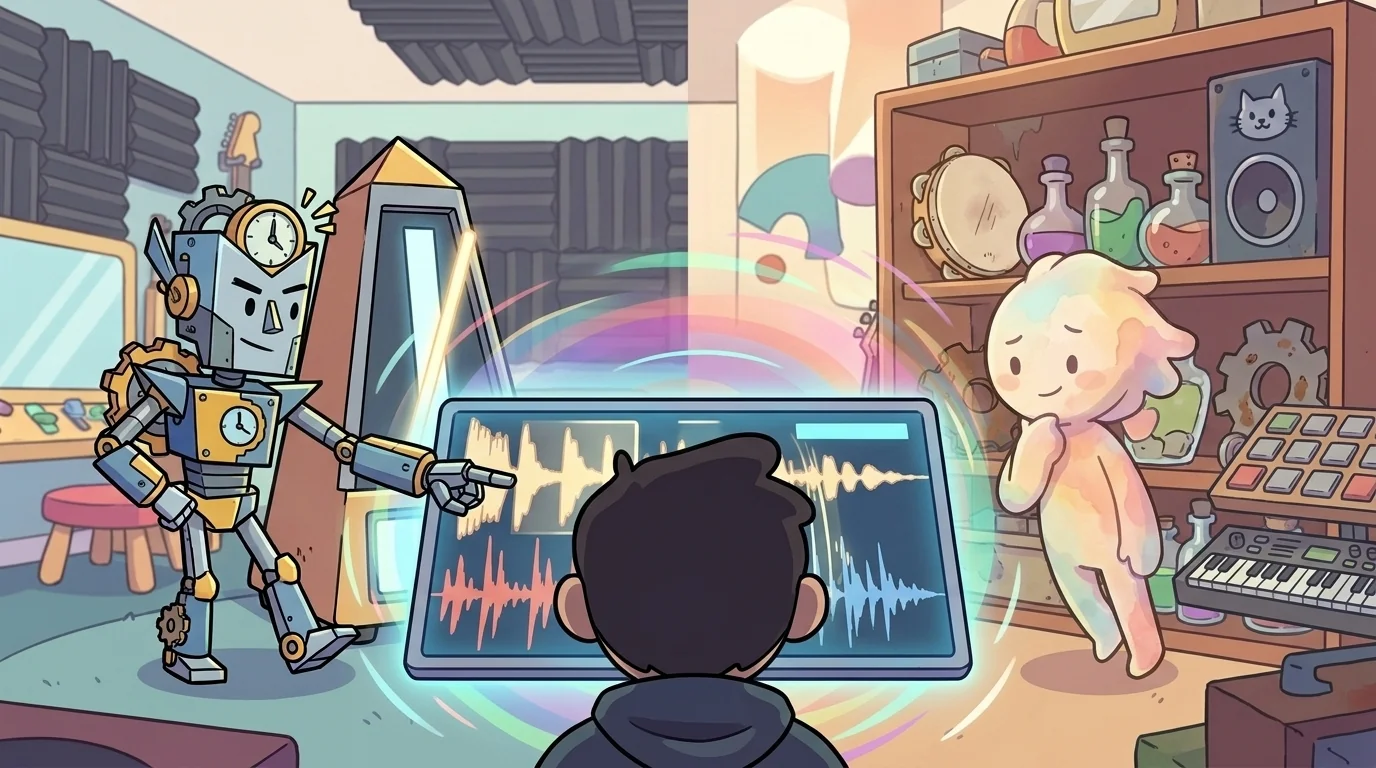
Your beat was undeniably better now. The heavy book-slam kick and the sharp bacon-sizzle snare, all at 110 BPM. You played it loud, letting the new personality fill the room, but you still frowned. Something was still a little… off. The sounds felt like they were tripping over each other, not quite gelling.
“Ah,” Tempo said, their clockwork head clicking almost imperceptibly as it analyzed the rhythm. “I see the issue. The what and the when are fighting.” They pointed to the screen, where the waveform of the kick drum was a thick, blocky shape. “That wonderful THWUMP is a big, heavy sound. It needs a split-second more room to breathe before the next sound happens. And that bacon-sizzle is quick and sharp, but our beat is still marching like a little soldier.”
Tone drifted closer, a soft, knowing nod rippling through their form. “The sounds have their own rhythm,” they explained, their voice a quiet murmur. “A big splash needs more time to resonate than a tiny drip.”
This was the tricky part, the subtle dance between elements. Tempo nudged the timing of the kick drum back just a tiny bit, so it landed a fraction of a second later, a little heavier, like a deliberate stomp. It was a change so small you could barely see it on the screen, but you could feel it. It gave the beat a lazy, powerful groove, a confident swagger. Then, they took the bacon-sizzle snare and pushed it a fraction of a second earlier.
“It needs to lead the charge,” Tempo stated, their voice firm.
“It gives it that impatient, exciting feel,” Tone added, a hint of playful mischief in their tone.
They weren't just changing the speed or the sounds anymore. They were making them dance with each other, fitting the shape of the sound to the flow of time, like two perfectly matched partners. It was a kind of magic you hadn't known existed.
You pressed play, holding your breath.
THWUMP… CRACKLE. THWUMP-THWUMP… CRACKLE.
It was perfect. The heavy book-slam had its space, making it feel powerful and grounded. The bacon-sizzle snare was sharp and edgy, pushing the beat forward with an almost urgent energy. The speed felt just right for the sounds, and the sounds felt like they were born to live at that exact speed. It was a real groove now. It had a personality, a story unfolding with every loop. It wasn't gray cardboard anymore; it was alive.
Tempo stood with their arms crossed, a rare, small smile gracing their precise features. The giant metronome pulsed in perfect time with your beat, its light a steady, reassuring beacon. “There it is,” Tempo said, their voice carrying a note of satisfaction. “The pulse is strong.”
Tone swayed gently, a rainbow of colors swirling and blending within their translucent form. “And it has a beautiful voice,” they hummed, their eyes sparkling.
“You see,” Tempo began, looking at you, their gaze direct and clear.
“You can’t have one without the other,” Tone finished, their voices overlapping for just a moment, a perfect harmony of thought. “A beat needs a heart. And it needs a voice to sing. The how-fast and the what-it-sounds-like are a team. Now, you’re the one leading it.”
The BeatForge ensemble
Tempo and Tone is part of BeatForge's distributed-narrative cast. Each character embodies a different curricular primitive; together they teach the full subject.
-

Throb
The steady pulse — the underlying clock every other rhythm hangs from
-

Snap
Subdivision — splitting a beat into equal smaller parts (eighths, sixteenths, triplets)
-

Hammer
Accent — emphasis on specific beats (the downbeat, the backbeat, polyrhythmic emphasis)
-
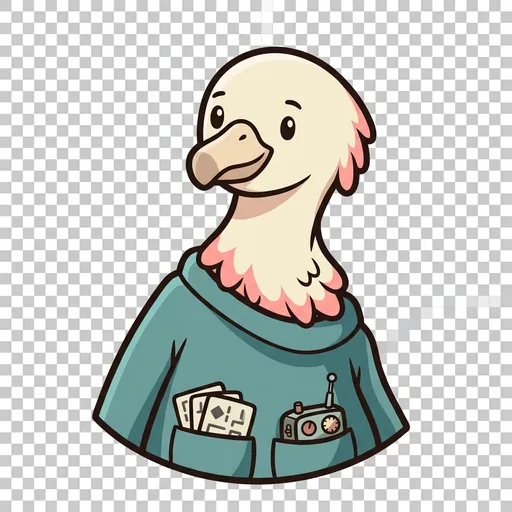
Tilt
Syncopation — placing weight off the expected beat to create pull and forward motion
-

Spin
Groove — the looping pattern that emerges when pulse + subdivision + accent + syncopation cohere; the thing that makes a beat feel like a particular genre
-
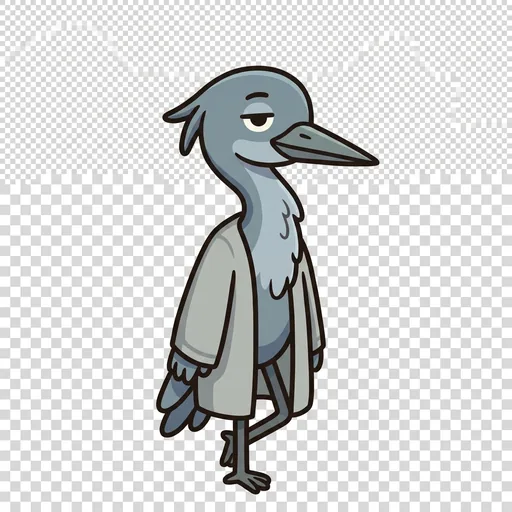
Lull
The rest — the beat you leave empty on purpose; silence counted as part of the music, so the next sound lands bigger
-

Crest
Dynamics — how loud or soft the music is, swelling louder and easing softer to give a song its waves
-

Rush
Tempo — how fast the pulse runs, and speeding up or slowing down to steer the whole mood of a song
-

Volley
Call-and-response — one player calls a phrase and the others answer it back; music as a conversation traded around a circle
-
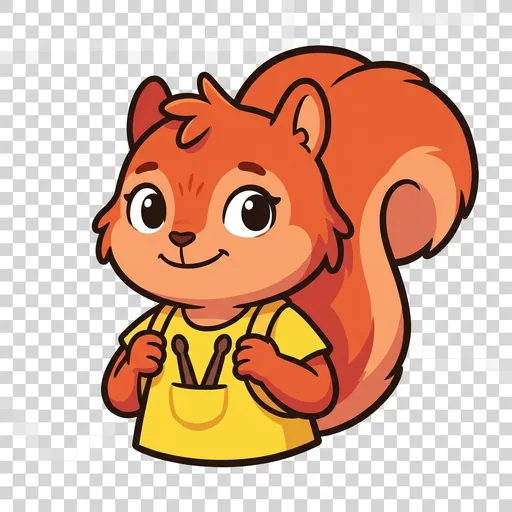
Flurry
The fill — the quick burst of drum notes that carries a song across the turn from one section into the next
-
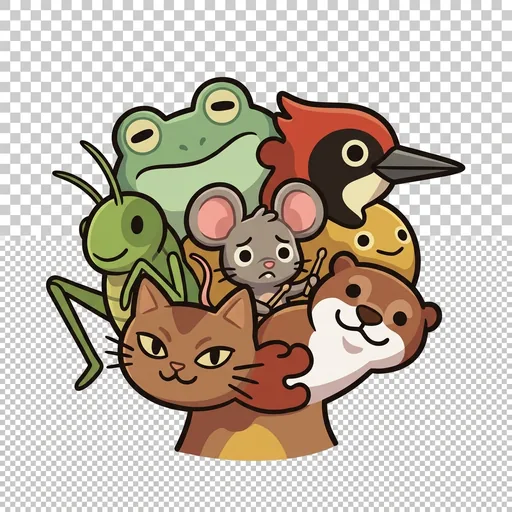
The Jam
The whole rhythm section playing together — how pulse, subdivision, accent, and syncopation lock into one groove that lifts everybody up at once