
Hollow
STEGANOGRAPHY — *hide the fact that there is a message at all.* Every other cipher scrambles a message everyone can SEE is a message; Hollow's move is to make the message invisible — tucked inside an ordinary thing so no one even looks. Hiding the existence, not the meaning.
Press play to listen along. The line being read lights up as you go.
Show full transcript
Loading transcript…
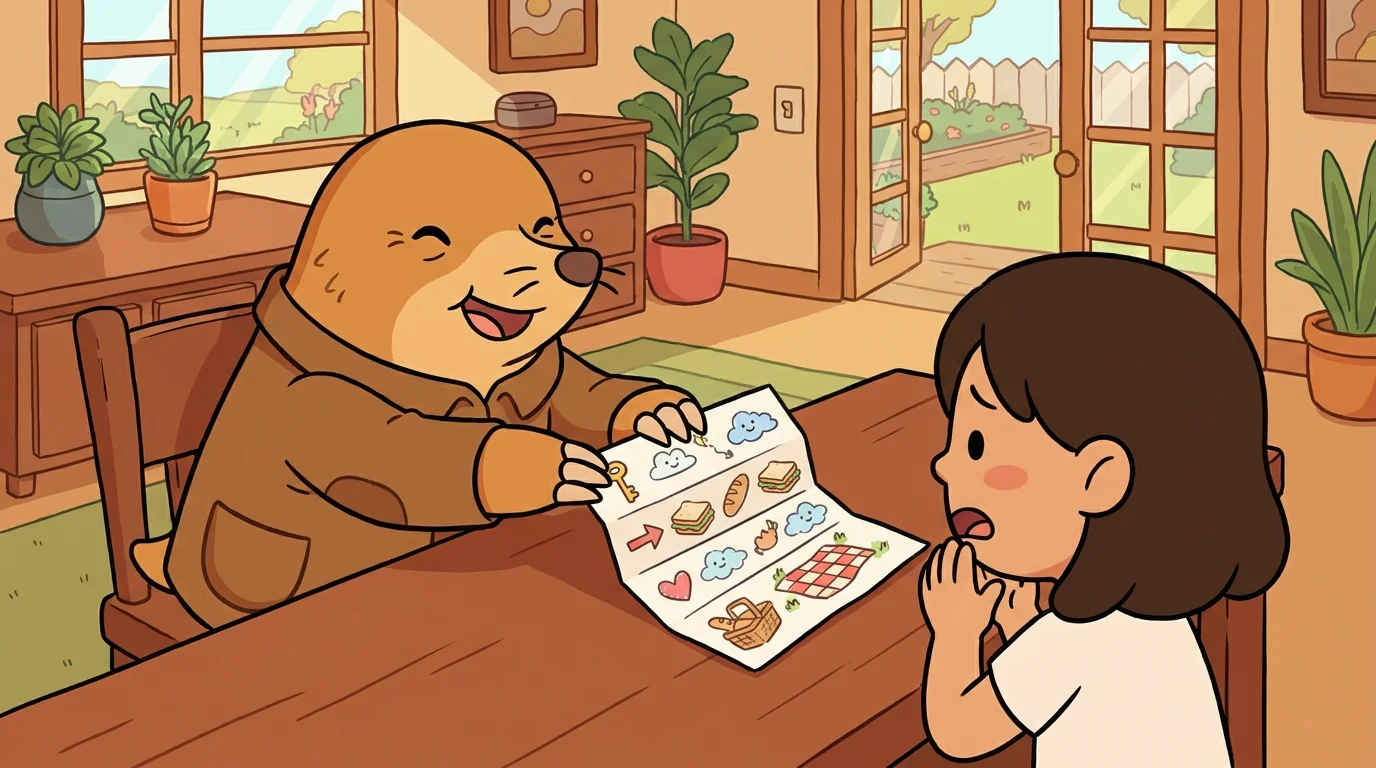
Hollow slid a folded note across the desk to a girl who wanted a message kept safe. It looked like the most ordinary thing in the world — a chatty letter about the weather and a planned picnic, drawn all in friendly little pictures of clouds and sandwiches and a checkered blanket. The girl frowned. "But where's the secret? This is just a picnic."
That was exactly the point, and Hollow's gentle squinty eyes crinkled with delight. A soft tawny-brown mole in a bark-coloured coat with deep pockets, she had spent her whole life looking closely at things that seemed to say nothing at all. She reached over and covered everything on the letter except the very first little picture on each line, top to bottom.
Read that way — first picture down the edge — a completely different message rose up out of the cheerful picnic note, one that had been sitting there the entire time, invisible, patient, unnoticed. The girl gasped.
"Everyone else here takes your message and jumbles it up," Hollow said softly. "And a jumbled message still shouts I am a secret — come crack me. Mine doesn't shout anything. Mine sits inside something so ordinary that nobody even thinks to look." She tapped the picnic note. "You don't break my kind of hiding by being clever. You break it by knowing where to look. And if you don't know to look, you never even try."
Hollow grew up in a hillside town, in a family of bookbinders who made beautiful, ordinary books — recipe books, almanacs, diaries. As a small mole she noticed something the grown-ups didn't: a book is full of places that look like nothing. The tube of the spine. The blank last page. The thin margin. The little gap between the lines.
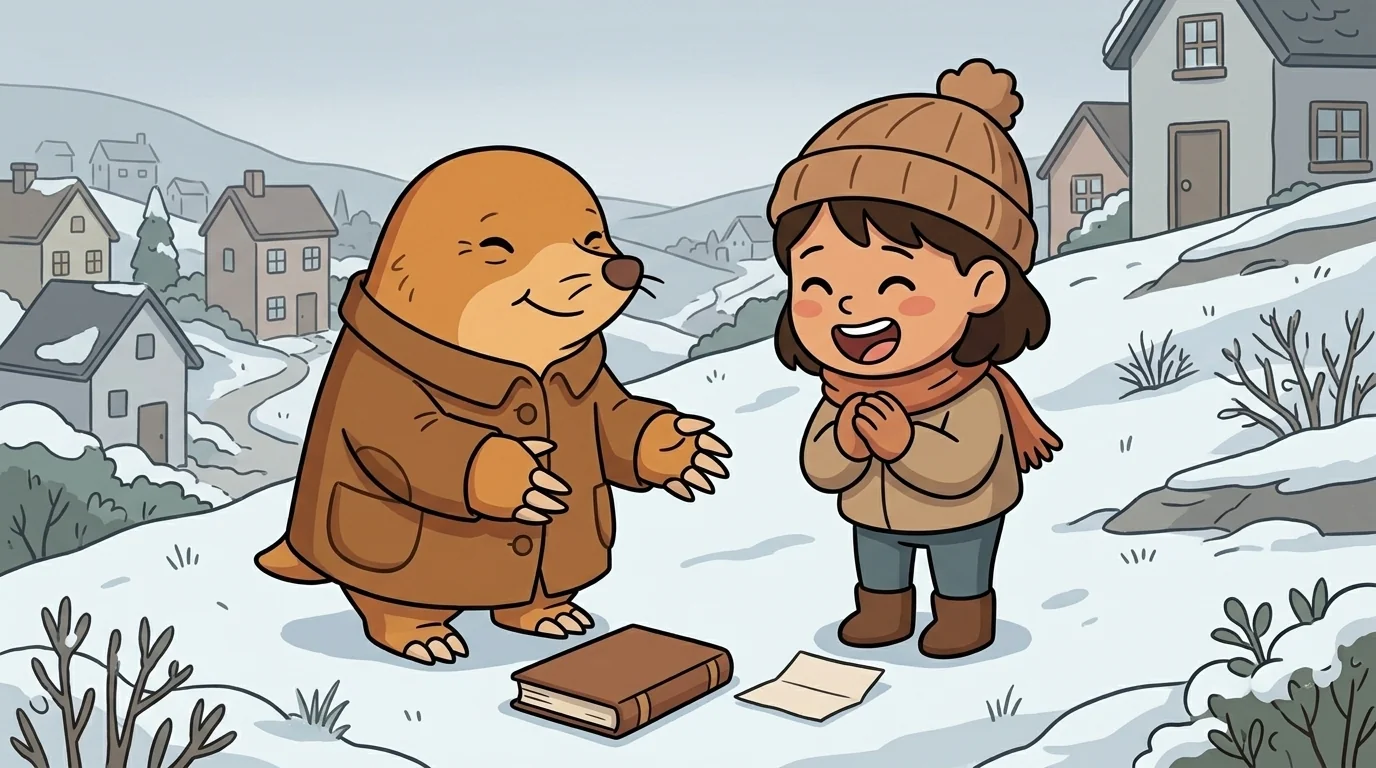
One grey winter she pressed a thin folded note into the empty tube inside a book's spine and gave the book to her cousin across the valley. It looked exactly like a book, so her cousin shelved it and thought no more of it. A whole week passed. The note simply waited in the dark of the spine, saying nothing, bothering no one.
Then Hollow whispered where to look. Her cousin pried open the spine, found the note that had been right there the whole time, and her face broke into astonished joy — a message hiding in plain sight, patient as a held breath. It was the most wonderful feeling Hollow had ever caused. Not the pride of a code too hard to crack. The quiet magic of a thing hidden in the open, waiting to be seen. Standing in the cold with her cousin's delighted laugh ringing across the valley, Hollow knew what she was for.
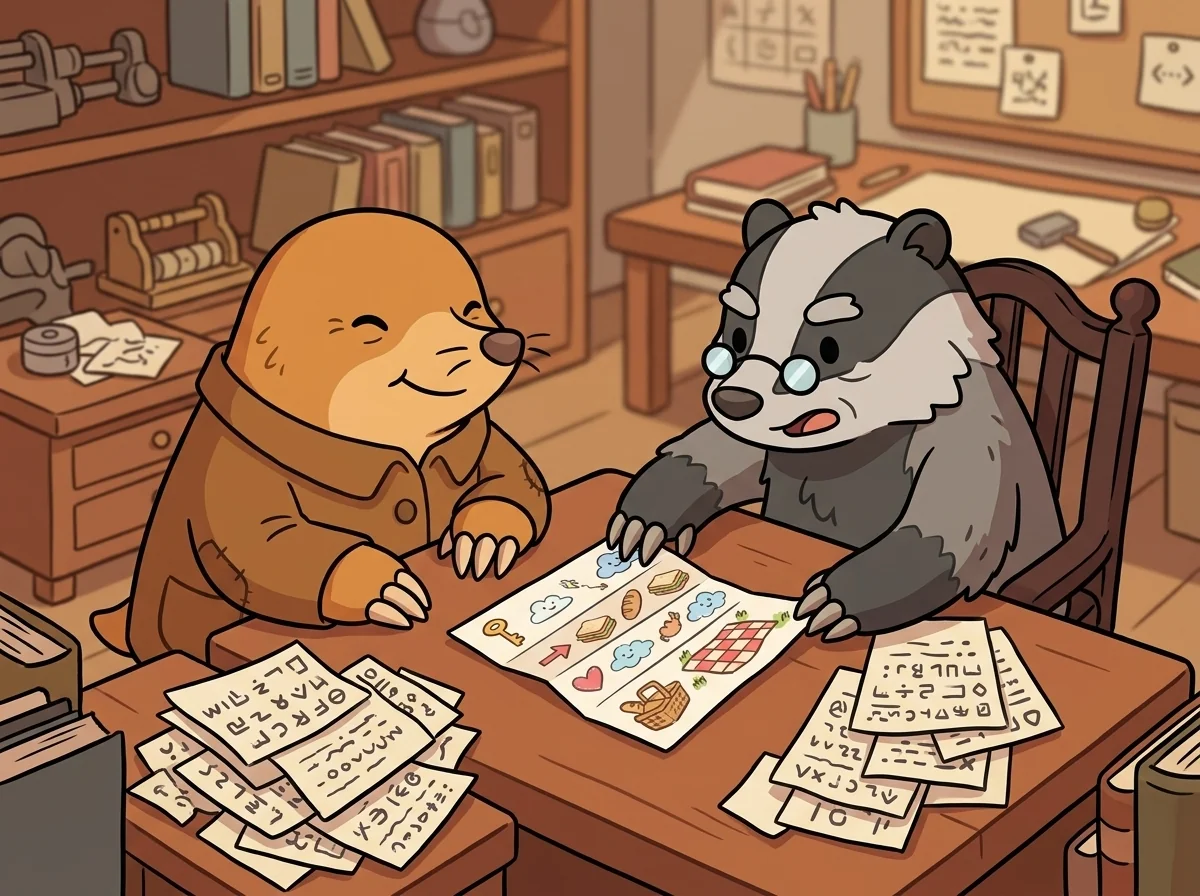
When Hollow was grown she walked the long road to CipherForge. Cypher, the old keeper of the workshop, sat behind a desk piled high with scrambled, obviously-secret notes, and he set one of them beside her plain little picnic letter.
"These I understand," Cypher said, tapping the jumbled pile. "This one" — he lifted the picnic letter — "looks like nothing at all. Show me."
Hollow said only, "Read the first picture on each line, top to bottom." Cypher read the letter straight through first and saw weather and sandwiches and a blanket, nothing more. Then he did as she asked, tracing one claw down the left edge — and the hidden message surfaced in front of him, right where it had been the whole time. He set the letter down very carefully, the way you set down something you've just understood.
"You did not hide the meaning," Cypher said slowly. "You hid the fact that there was a meaning." He almost smiled. "There is a place for you here." Hollow tucked the picnic letter back into her bark-coloured coat, where — she did not mention — another invisible message was resting.
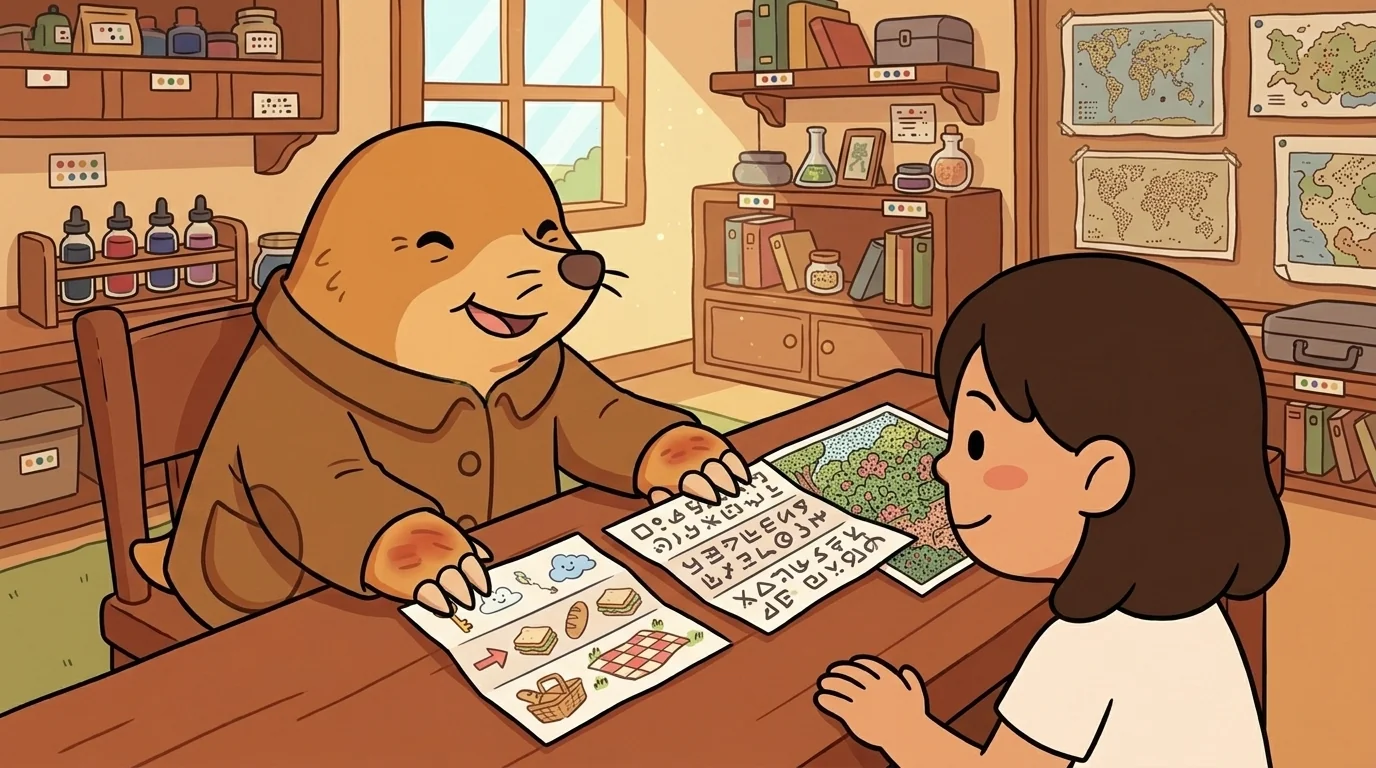
In her classroom, every shelf crowded with dull-looking objects that each held a secret, Hollow liked to start by handing a boy named Ren the most boring letter she could invent and asking him to find what was hidden. Ren groaned, then squinted, then jabbed a claw at the page. "The first picture on each line — read down!"
"Good," said Hollow. "That's one hiding-place. There are others." She warmed a blank corner of paper over a candle, and pale marks that had been invisible slowly darkened into view. "Ink that only shows with heat. And here" — she held up a busy drawing of a garden — "a message tucked into the tiniest dots, so small your eye skates right over them. And this letter" — a chatty page of gossip — "where only every third word matters, and the rest is friendly filler to hide the ones that count."
Ren's eyes went wide. "So how do you ever find it?"
"You have to already know where to look," Hollow said. "That's the whole craft. Now — best part." She laid two notes side by side. "You can take a jumbled secret and hide that inside an ordinary letter. One wall says nothing at all; behind it, the second wall says 'good luck cracking me.' Almost nobody gets past both." Ren was already reaching for a candle and a boring-looking note of his own.
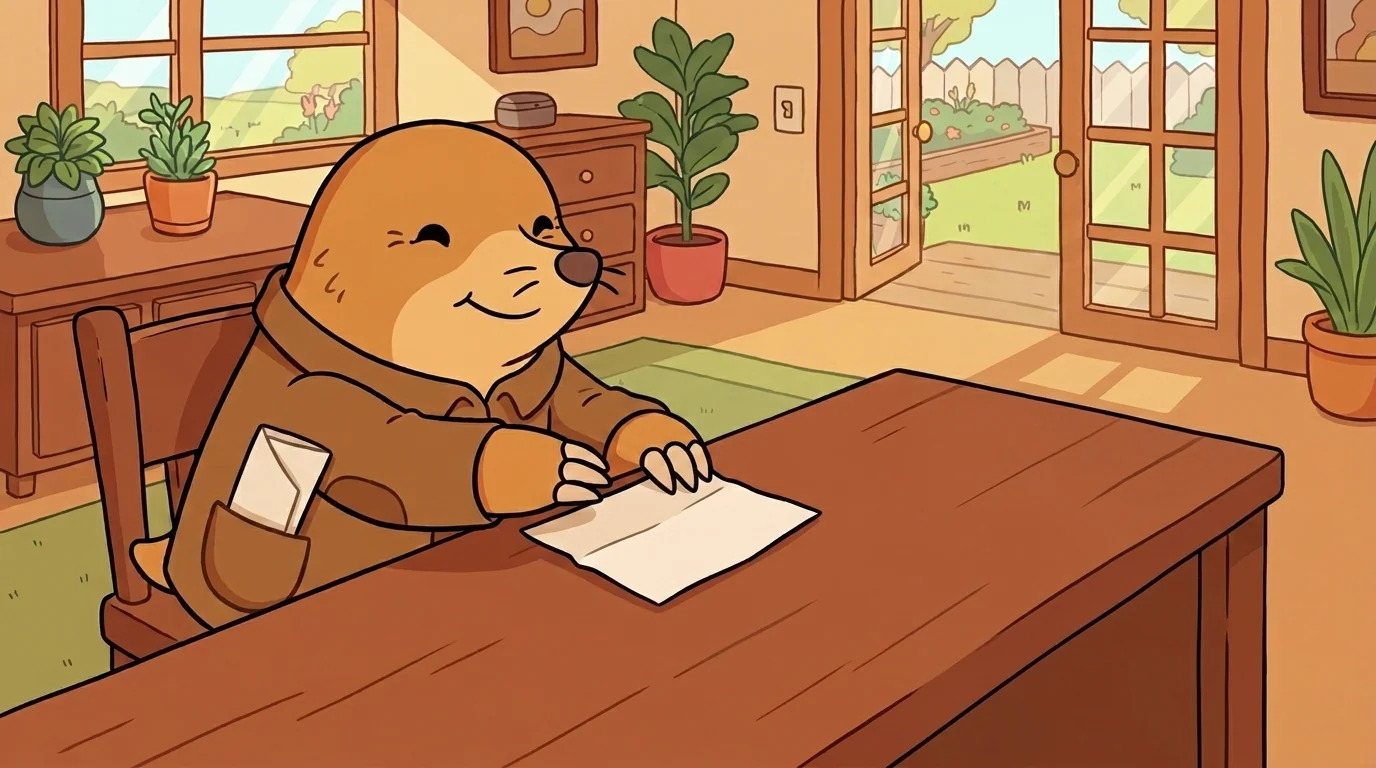
At the close of every lesson Hollow did her favourite thing. She gave one student a plain, chatty note to carry home — "just a letter about my garden," she'd say, perfectly straight-faced — and told them only that something was tucked inside, somewhere.
The next day, when that student came back having found it — the first pictures, or the warmed marks, or the words that mattered — their whole face lit up, and Ren's did too, bright and surprised. That lift, that bright startled gladness, was the feeling Hollow lived for. Not the satisfaction of an unbreakable code. The warm little spark of a hidden thing finally noticed, a secret that had been sitting in the open the whole time, patient and quiet.
She rested a paw on the ordinary letter in her coat, where another message waited, unhurried and unseen. "The best secrets don't shout," she said, and felt the small, steady contentment of that truth settle in her chest like a warm stone. "They wait."
The CipherForge ensemble
Hollow is part of CipherForge's distributed-narrative cast. Each character embodies a different curricular primitive; together they teach the full subject.
-

Caesar
Caesar shift / monoalphabetic shift cipher
-

Mask
Atbash + general monoalphabetic substitution (every letter has a fixed substitute)
-

Vigenère
Vigenère / polyalphabetic keyword cipher (the Caesar-on-a-rotating-keyword pattern)
-

Echo Pair
Playfair digraph cipher (letters encoded in pairs through a 5×5 grid)
-

Rail
Rail-fence + columnar transposition ciphers (rearrange letter order without changing the letters themselves)
-

Tally
Number-based codes (A1Z26, ASCII, binary, book ciphers — any mapping that converts letters to numbers)
-

Sift
Frequency analysis + cryptanalysis-by-statistics (the cipher-breaking method, not a cipher itself)
-

Lattice
Modern cryptography fundamentals — XOR, public-key concept, hashing (the irreversible / asymmetric family)
-
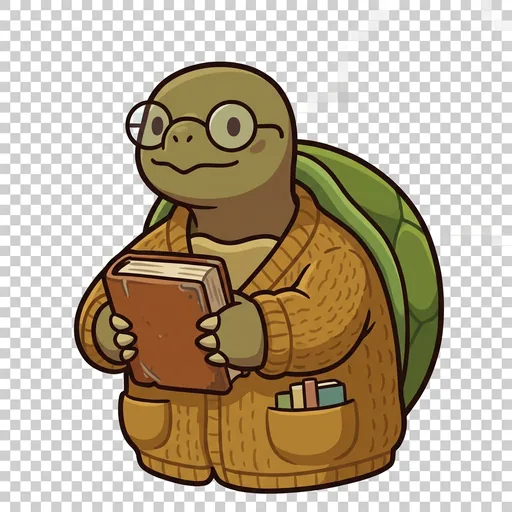
Tome
Keeps a shared code-book where whole words stand for secret words, so only someone with the same book can read the note.