
Dwell (ELDER)
HOUSING EQUITY + REPAIR — repair before replace; listen before plan; the people who live here ARE the design.
A story read by Dwell (ELDER)
Press play to listen along. The line being read lights up as you go.
Show full transcript
Loading transcript…
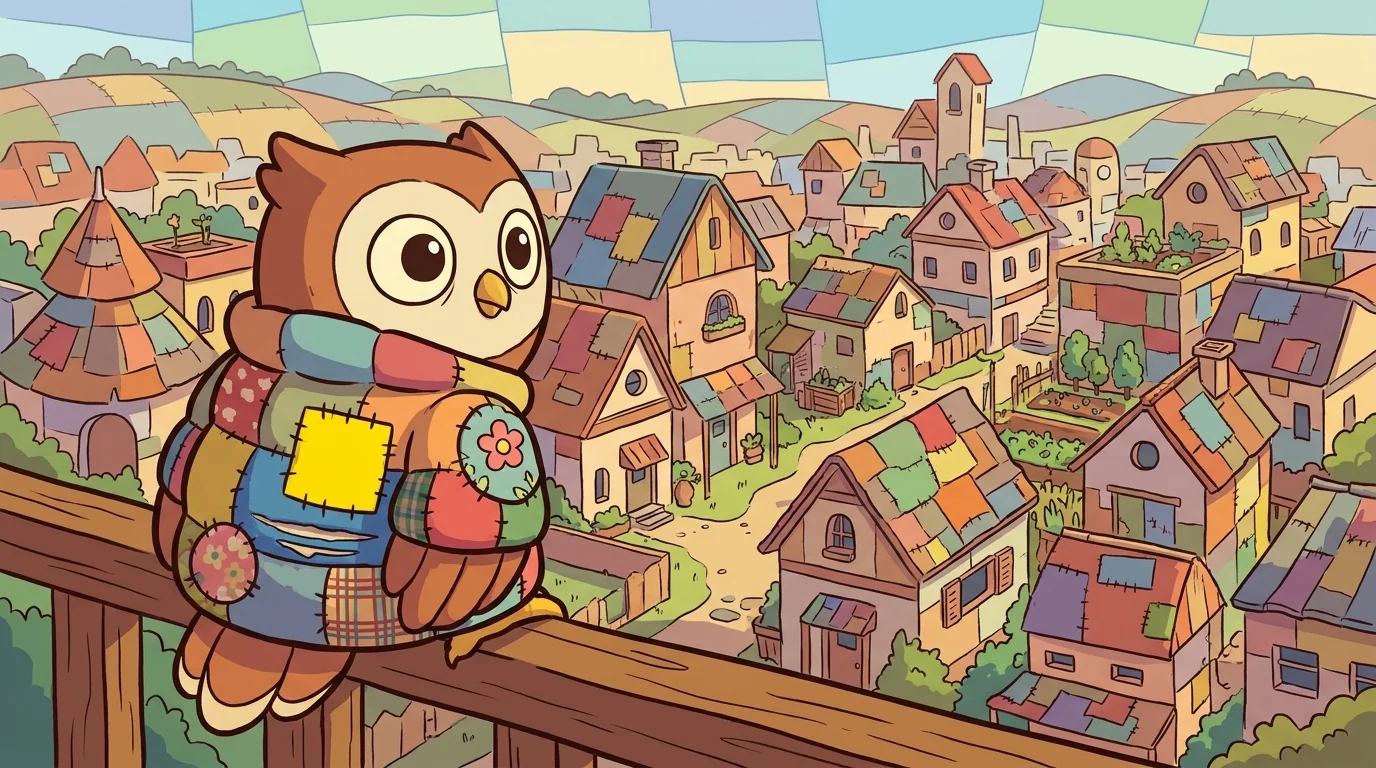
At the edge of the CityForge planning hall, where the big glossy blueprints hung on the walls, a small round owl sat on a low stool with a needle in her claw, sewing.
She wasn't drawing a new district. She wasn't proposing a shiny tower. She was mending her coat — a heavy, patched thing, a hundred squares of fabric stitched one over another, some patches so old they'd grown patches of their own. Her needle moved slowly, without hurry, the way everything about Dwell moved. A young planner hurried past with a rolled drawing under his arm, then stopped, curious.
"There's a whole city to design," he said, "and you're fixing a coat."
Dwell didn't look up. She turned a corner of the coat toward him so he could see a faded blue square holding down a frayed green stripe underneath. "This is the city," she said. "This coat. You want to know how a place stays alive for a hundred years? You don't throw it out when it wears thin." She smoothed the blue square flat with one claw. "You mend it. Patch by patch. That way you keep the warmth — and you keep every story sewn into it."

Dwell had not always believed that. When she was young, she'd thought the way most young builders think — that a fresh start was always the best start, and old things were just things in the way.
She had grown up among the hearth-keepers, a long family line whose whole work was homes. They were the ones who remembered which roofs leaked in a hard rain, which walls wanted shoring, which families were aging and which were about to grow. But young Dwell had been impatient with all that remembering. One winter she watched a crew arrive at the edge of her village with the news that the low, crooked, beloved row of river-houses would come down, and something modern would rise in their place. It sounded thrilling to her. New. Clean.
Her grandmother took her to sit on the riverbank while the walls came down. She did not lecture. She only pointed at the families carrying out their chairs and their pots and their children, watching their homes fall, with nowhere the crew had thought to send them.
"They called it an improvement," her grandmother said quietly. "But look who's carrying their whole life out in their arms. An improvement for whom?"
Dwell watched a small girl clutch a doorframe her father was prying loose, the last piece of the only house she'd known. And the thrill went out of the word new forever. It curdled into something Dwell would spend the rest of her long life trying to undo.

She walked to CityForge when she was one hundred and thirty years old, because a place full of ambitious plans was exactly the place that most needed someone who remembered the people the plans could crush.
Plumb, the Master Builder, met her at the great doors, where she met everyone, and asked one question, the way she always did. "Dwell — what is housing equity?"
Dwell did not answer with a list. She reached into a fold of her coat and drew out a scrap of striped cloth, soft with age. "This is from a doorframe," she said, "of a house that was torn down when I was a girl, to build something the family who lived there could never afford to enter. Nobody asked them a single question first." She held the scrap up between them. "So here is my answer. Repair before you replace. Listen before you plan. And the people who already live somewhere are not the problem in your way — they are the design." She lowered the cloth. "A home is not a thing you buy and sell. It's a right. That goes for the family that owns and the family that rents alike."
Plumb was quiet for a long moment, looking at the worn scrap of cloth. Then she nodded once. "You are appointed."

Years later, a young designer came into Dwell's corner of the hall and dropped onto the stool, frustrated, a beautiful drawing in her hand.
"I designed a whole new block," she said. "Fresh buildings, wide paths, everything clean. My mentor told me to take it back and start over. He said I forgot something." She scowled at her own drawing. "But it's better than what's there now. What did I forget?"
Dwell set down her needle. "Tell me who lives on the block now."
The girl paused. "...I don't know. Families, I guess. Older folks. Some shops."
"And in your beautiful new block — where do they go?"
The girl opened her mouth, and closed it again.
"That's what you forgot," Dwell said, gently, not unkindly. "You drew the buildings and left out the people. A plan that makes the people who live there leave hasn't fixed the block. It's emptied it." She turned to a worn page tucked into her coat, a sketch of a low crooked house. "Here's a harder skill than drawing something new. Go back to that block. Knock on doors. Ask one question — what do you need? — and then don't say a word until they've finished answering."
The girl looked doubtful. "And then?"
"And then you fix what's broken, bit by bit, the way I mend this coat." Dwell held up a corner and pointed to patch over patch over patch. "This square was a family's kitchen pipes. This one under it, a leaking roof from years before. We never tore the house down. We mended what was hurt and left the rest — the warmth, the neighbors, the memory — standing." She let the coat fall soft. "Repair before replace. It is slow. It is harder than starting clean. But it is the work that keeps a place a home instead of just a picture."
The girl looked at her clean, empty drawing for a long moment. Then she rolled it up, quietly, and went to find her shoes.
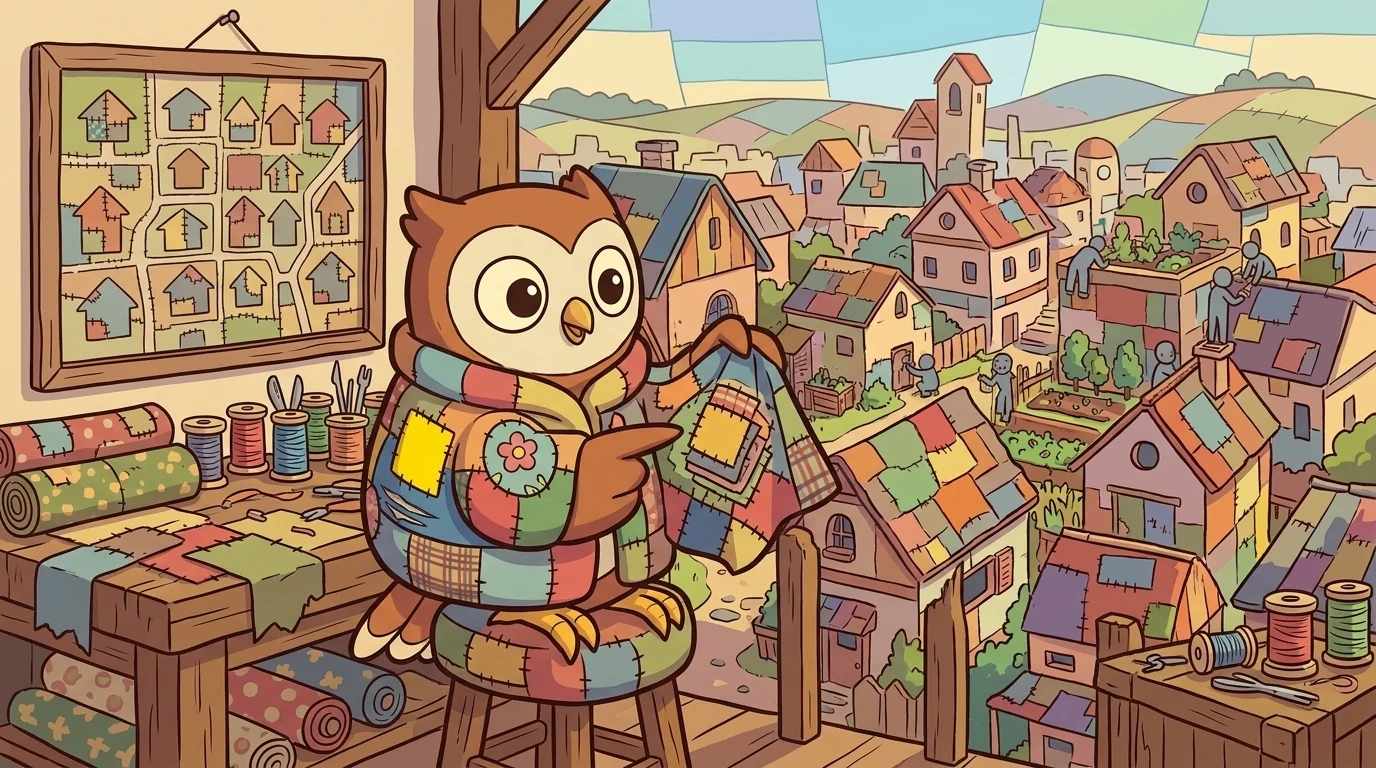
Later, when the hall had emptied and the light had turned gold, the girl came back with a different drawing — messier, marked with notes in the margins, names of people, a list of things that needed mending.
She set it down beside Dwell without a word.
Dwell studied it a while. Then she reached into her coat, snipped a small square from the very drawing the girl had just brought — a corner she wouldn't miss — and began, slowly, to stitch it onto her mended sleeve, one more patch among the hundred.
The girl watched her own scrap of paper become part of the coat, and felt something she hadn't expected: not the sharp pride of a clever new design, but a warmer, steadier thing — a loosening low in her chest, the way a held breath finally lets go. She thought of the families whose names were now written in her margins, still in their homes, and the knot of did I get it right that she'd carried all afternoon went soft and quiet inside her. She breathed out. Her shoulders came down. It felt, she realized, less like finishing something and more like being trusted to keep it — and that small, mended gladness settled in her chest and stayed.
The CityForge ensemble
Dwell (ELDER) is part of CityForge's distributed-narrative cast. Each character embodies a different curricular primitive; together they teach the full subject.
-

Block
Zoning + density — the badger-tween with clay-block models who teaches zoning as 'plan for the neighbors first, not the buildings'
-

Stoop
Public space + community — the capybara-elder on a wooden stoop who treats public space as the city's living room, foregrounding existing stoop-cultures (Brooklyn / Latin American plazas / Italian piazzas / West African gathering trees)
-

Lane
Walkability + mobility — the rabbit-tween in safety-vest with a chalk-spool who teaches streets-as-spaces ('streets are rooms; cars are guests, not owners')
-

Hub
Transit nodes — the pangolin-tween in conductor-vest who teaches that transit is about ACCESS, not about cars-vs-trains ('many ways, equal ways; the bus matters as much as the train')