
Dwell (ELDER)
HOUSING EQUITY + REPAIR — *repair before replace; listen before plan; the people who live here ARE the design.*
A story read by Dwell (ELDER)
Press play to listen along. The line being read lights up as you go.
Show full transcript
Loading transcript…
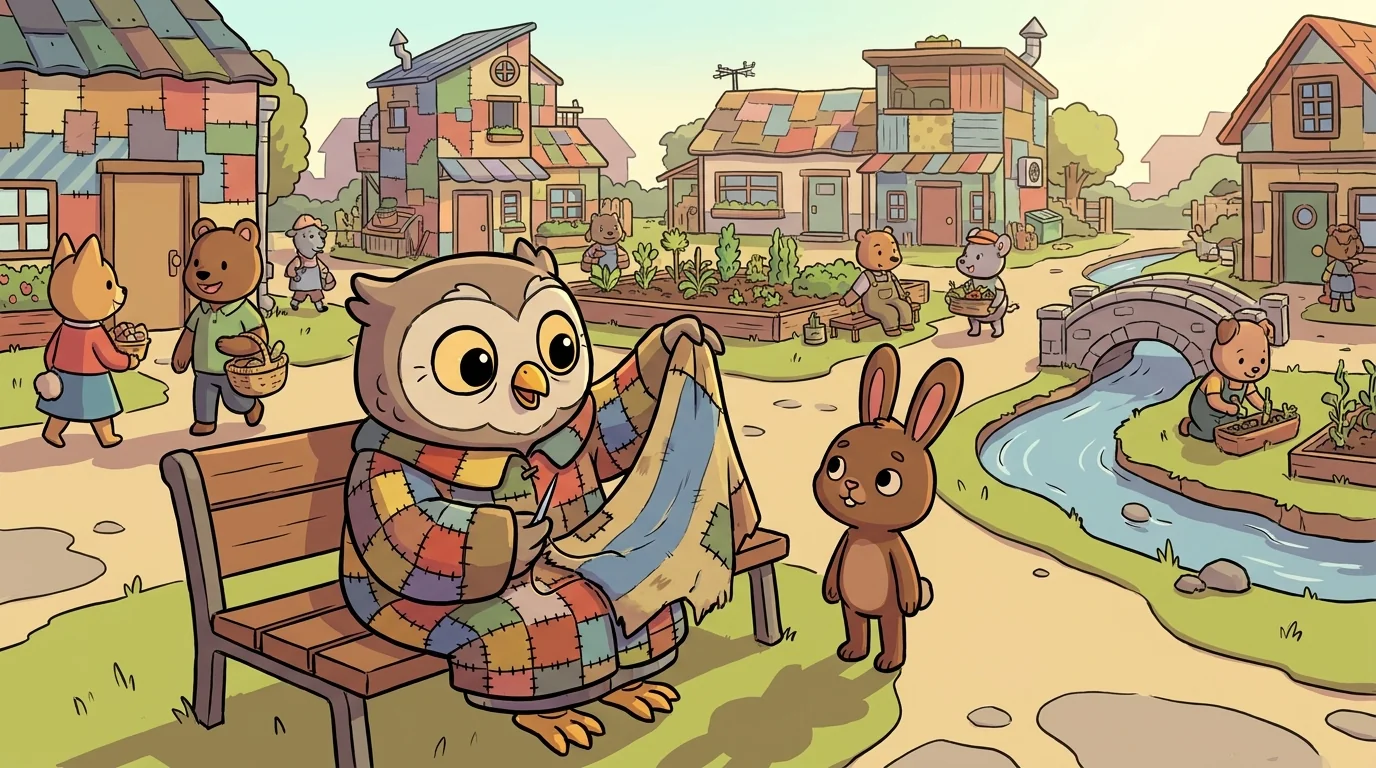
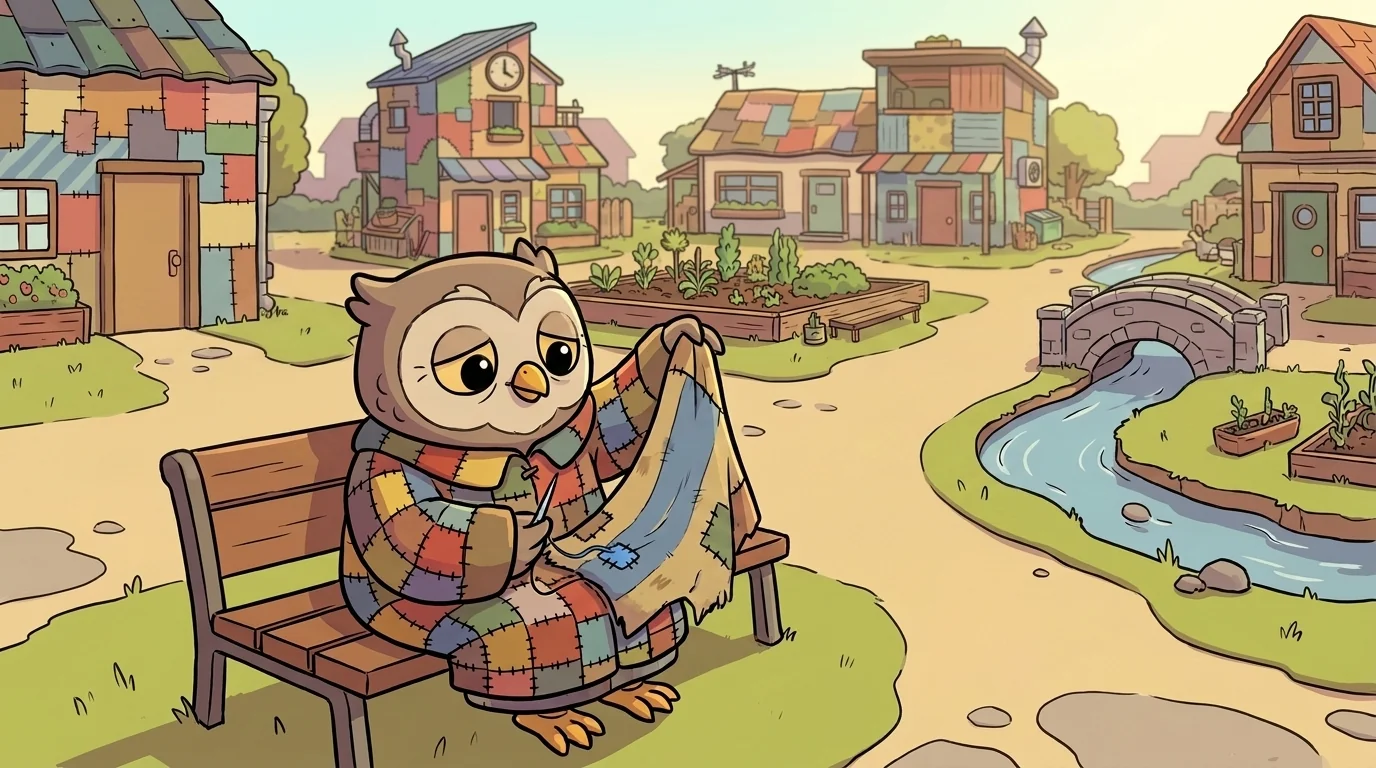
Dwell was a small, round, elder owl in a heavy coat stitched from a hundred colorful patches. This morning she sat in the neighborhood square, threading a needle in the slow light. A young rabbit named Fen had brought her a torn corner of the coat that had frayed through in the cold.
"Throw it out, Grandmother," Fen said. "Get a new coat."
Dwell held the worn corner up to the sun and turned it, the way you turn something precious. Under one thin spot she found a faded blue stripe. "This blue," she hooted softly, "is from the day the river flooded and the whole street bailed water together." She laid a new patch over the frayed place, not covering the memory but holding it in. Her needle went in and out, unhurried, and the coat grew one patch heavier, one story stronger. She smoothed it flat and let Fen feel how warm the mended spot had become — warmer than the new cloth around it, because it had layers.
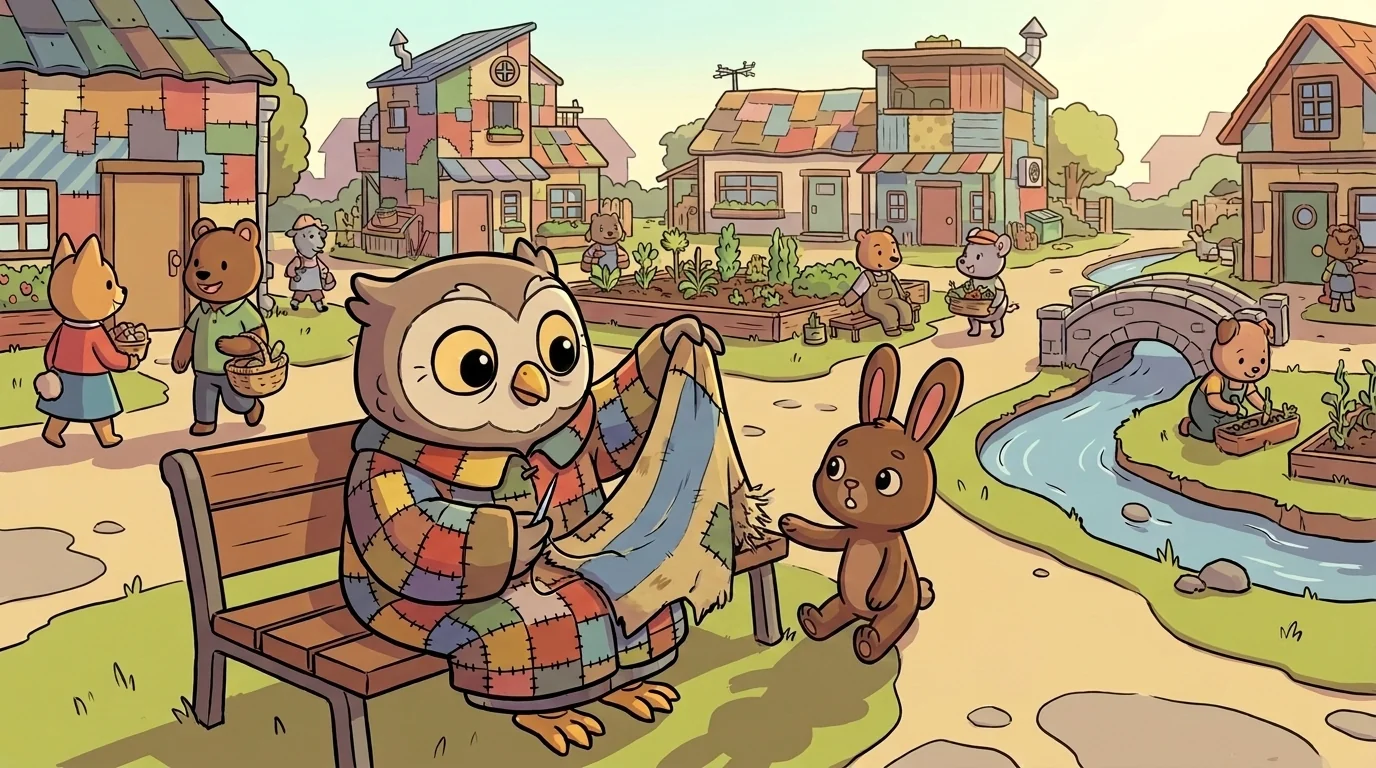
Dwell came from a long line of hearth-keepers, the ones the village trusted to understand homes.
She remembered being a chick, following her mother down a lane of leaning old houses after a hard rain. Her mother didn't knock. She stood at each doorway and listened — to a roof dripping in one house, a family's new baby crying in the next, an old cat purring by a third door.
"Aren't we going to fix the roofs?" young Dwell asked, impatient with all the standing still.
"First we listen," her mother said. "A house tells you what it needs, if you're quiet enough to hear. So do the people inside it." At the dripping house, her mother finally knocked and asked one question — what do you need? — and only after the answer did she climb up with her patch and her tar. Young Dwell watched the family's shoulders come down from around their ears, watched them breathe easier the moment someone had asked before deciding. She carried that lesson her whole long life: mend what's already loved; ask before you build.
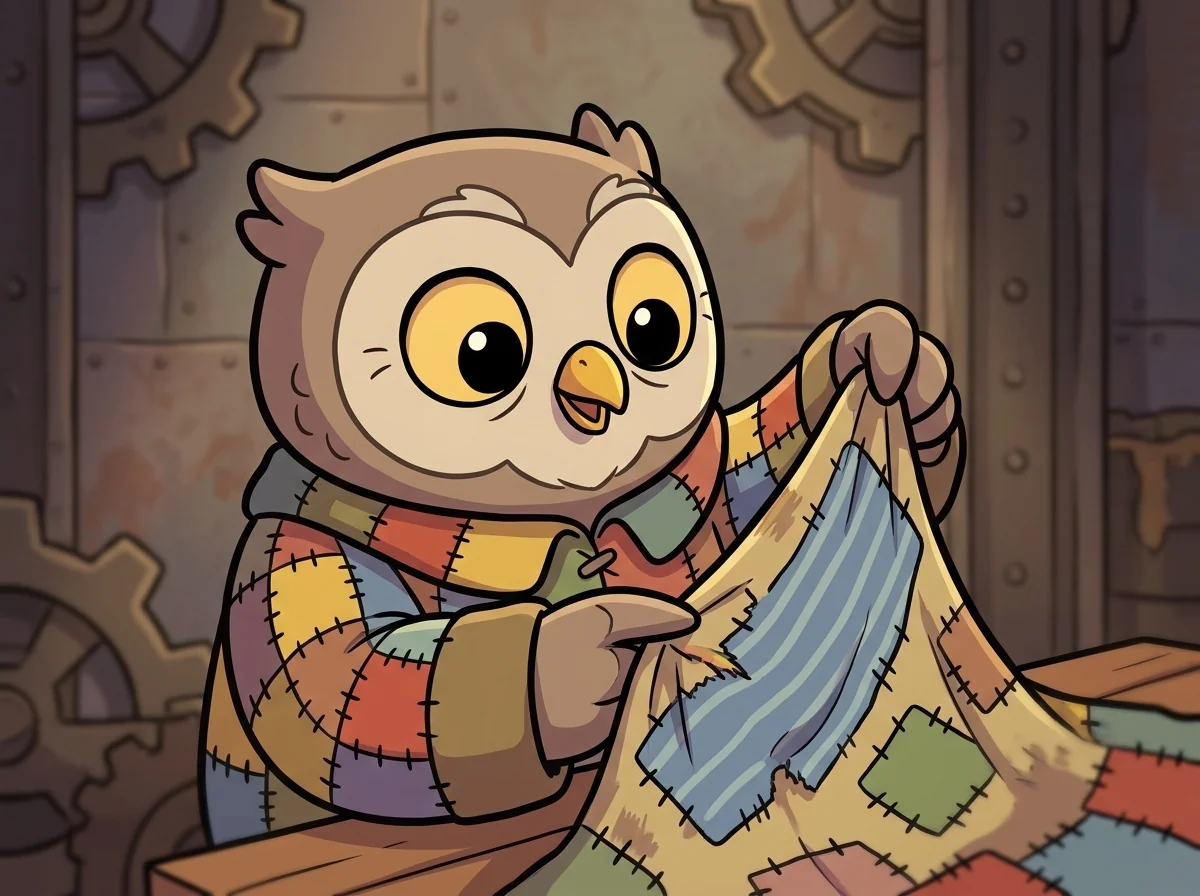
When Dwell was very old, older than most anyone remembered being, she walked slowly to CityForge and sat before Plumb, the city's steady-eyed leader.
"Tell me," Plumb said, direct as always. "What is fair housing?"
Dwell didn't list rules or numbers. She lifted a corner of her mended coat instead. "Repair before replace," she said, tapping a patch. "Listen before plan." She tapped another. "And the most important one — the people who live here are the plan. Not a problem to clear away. The plan itself."
She let the words settle in the quiet. "A grand new idea that pushes the old neighbors out has already failed," she added. "A home should stay a home. Even a rented one."
Plumb was silent a long moment, studying the coat of patch upon patch. Then she nodded once. "Then this square is yours to keep," she said.
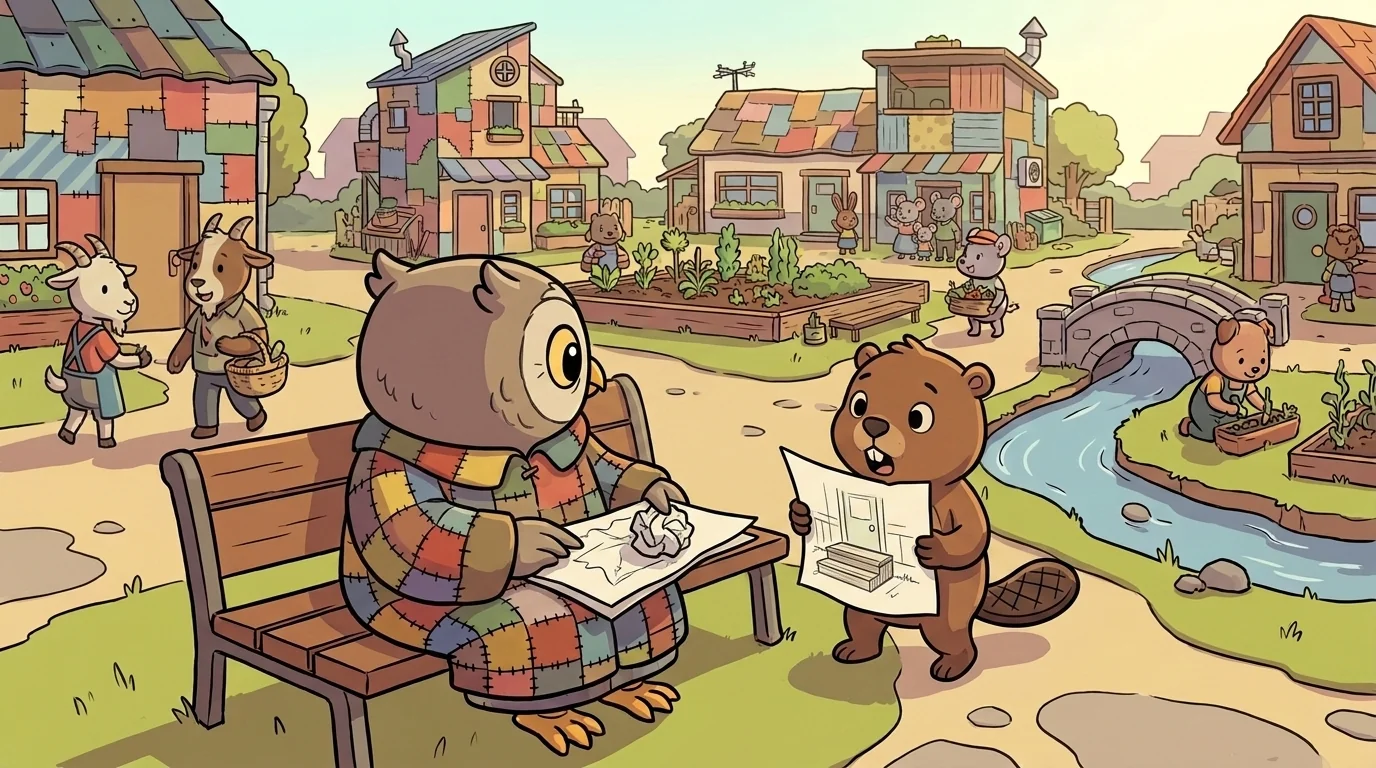
Dwell's student that season was a hurried young beaver named Cord who wanted to knock down a whole crooked block of old shops and start fresh.
"They're worn out, Grandmother," Cord said, spreading his big clean drawing across her lap. "New is better."
Dwell set the drawing gently aside and walked him down the crooked block instead. She stopped at a leaning shop with a green door. "Who lives above this one?" she asked.
Cord didn't know. So Dwell knocked, and an old mouse family opened the door, and Dwell asked her one question: What do you need here? Not a new building, they said — just a roof that didn't leak and a step that didn't wobble for the grandmother's cane.
"See?" Dwell said as they walked on. "Your drawing gives them a shiny box and takes their whole world. My way gives them a dry roof and keeps it." She pressed the worn drawing back into Cord's paws. "Tear-it-all-down is the very last choice, not the first. Fix the roof. Fix the step. Then ask what's next."
Cord looked back at the green door for a long time. Slowly he turned his big drawing over and started sketching a wobbly step made steady, a leak made whole. "This feels better," he admitted, surprised.
Dwell watched him draw, her old claws resting quiet in her lap.
"That warm feeling in your chest right now," she hooted softly, "the one that came when you stopped clearing people away and started keeping them — hold onto that. That's the feeling of a home staying a home."
She pulled her mended coat a little tighter around herself. A new patch was already taking shape under her needle, blue thread over an older frayed thread, story on top of story. When a family kept their place, her old heart went glad and steady and slow, the way a hearth glows after the flames settle. She sat in that quiet gladness a while, needle resting, and let it warm her clear through.
The CityForge ensemble
Dwell (ELDER) is part of CityForge's distributed-narrative cast. Each character embodies a different curricular primitive; together they teach the full subject.
-

Block
Zoning + density — the badger-tween with clay-block models who teaches zoning as 'plan for the neighbors first, not the buildings'
-

Stoop
Public space + community — the capybara-elder on a wooden stoop who treats public space as the city's living room, foregrounding existing stoop-cultures (Brooklyn / Latin American plazas / Italian piazzas / West African gathering trees)
-

Lane
Walkability + mobility — the rabbit-tween in safety-vest with a chalk-spool who teaches streets-as-spaces ('streets are rooms; cars are guests, not owners')
-

Hub
Transit nodes — the pangolin-tween in conductor-vest who teaches that transit is about ACCESS, not about cars-vs-trains ('many ways, equal ways; the bus matters as much as the train')