
Stoop (ELDER)
PUBLIC SPACE + COMMUNITY — *the city's living room is the stoop.* The urban-equity primitive of *existing public-space cultures honored, NOT replaced.*
A story read by Stoop (ELDER)
Press play to listen along. The line being read lights up as you go.
Show full transcript
Loading transcript…
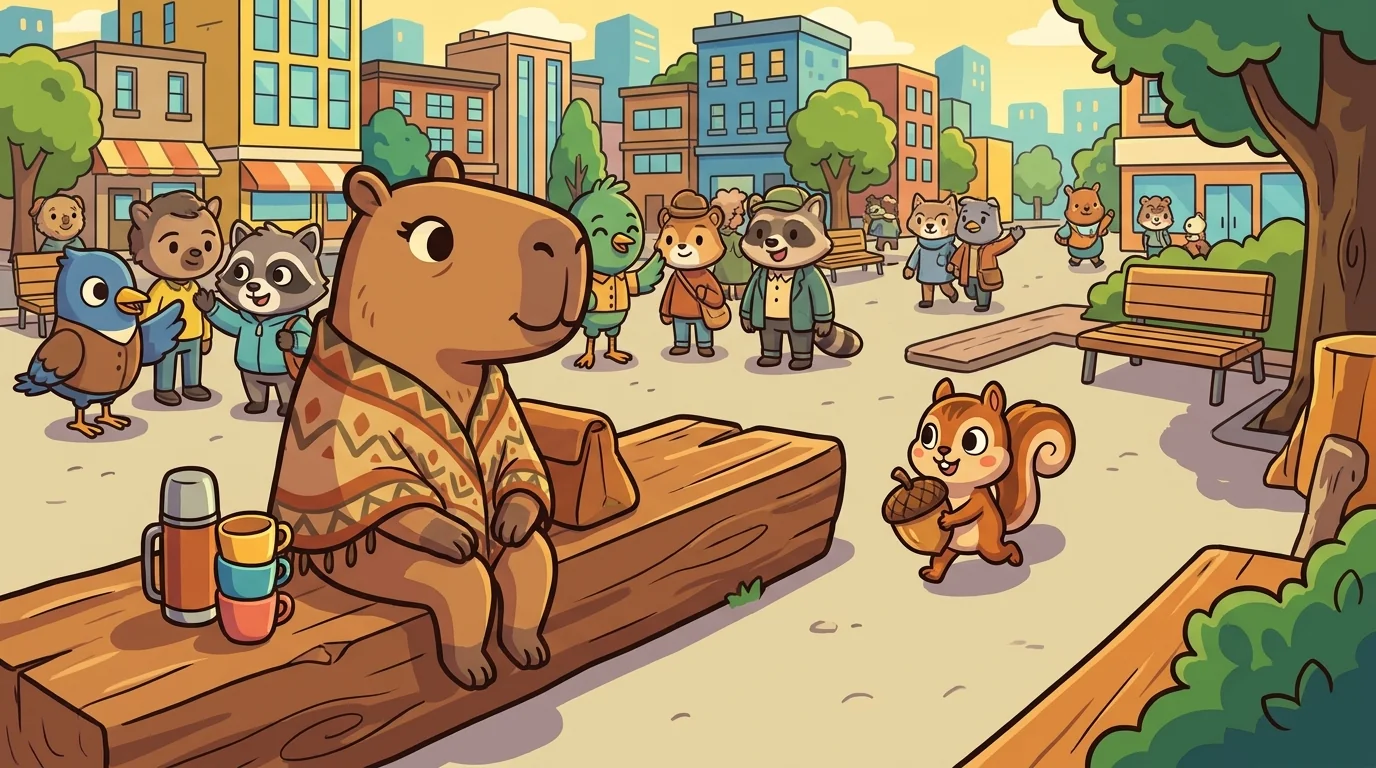
The wooden stoop wasn't attached to anything. It sat where the sidewalk met the row of brick buildings, a wide ledge worn smooth and pale by decades of people, and Stoop the capybara sat on it the way she sat on it every day — shawl around her round shoulders, quiet eyes moving from face to face as the street went past. She wasn't waiting for anyone in particular. She was waiting for everyone, which is a different kind of waiting, and one she was very good at.
A man carrying groceries slowed, set his bags down on the ledge beside her without asking, and told her his sister was moving back to the neighborhood. Stoop nodded and said that was good news, and the man picked his bags up again and went. A few minutes later two children argued about a game three feet from her knee and then made up, all without noticing she was there.
That was the whole of it. Nobody had been invited. Nobody paid. The stoop belonged to no one, which was exactly why it belonged to all of them. Stoop had a name for a place like that. She called it the city's living room, and she believed a city that lost its living rooms lost something it could not build back.
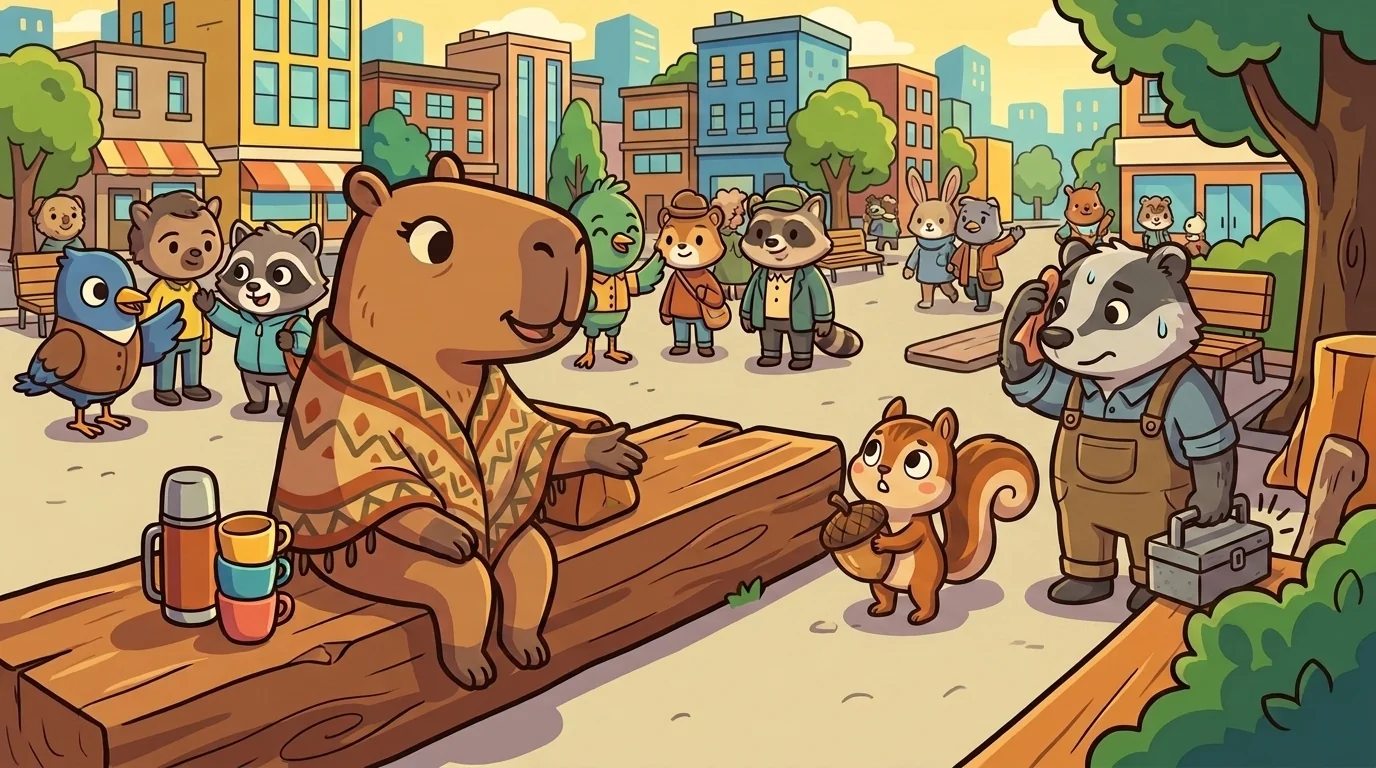
She had not been born believing it. She had learned it, slowly, the way you learn most things that turn out to matter.
Her family were travelers — stoop-sitters, they called themselves, though the word meant more than furniture. Wherever they stopped, they found the place where neighbors already gathered and simply sat in it, listening, until the neighborhood folded them in. Stoop had grown up in the shade of a gathering tree in one town and beside a splashing piazza fountain in another, and each place had a shape that came from the people who used it, not from anyone who designed it.
Then, when she was young, she watched a town she loved get improved. The people in charge had good intentions. They tore out the old plaza — the cracked one, the one with the crooked benches where the elders played cards — and built a new one, wide and clean and paved in pale stone, with a fountain that ran on a timer.
It was beautiful. Nobody used it.
Stoop remembered standing at its empty edge and feeling something go hollow in her chest. The old plaza had been ugly and it had been full. The new one was lovely and it was a photograph of a place, not a place. "They asked the wrong question," her grandmother had told her, watching the same emptiness. "They asked what looks like a public space. They should have asked where people already gather — and protected that." Stoop had carried the ache and the lesson together ever since, because with her they had always been the same thing.
She walked through the gates of CityForge when she was one hundred and twenty years old, because a place busy remaking a city was exactly the place most in danger of forgetting this.
Plumb, the lead mentor, met her at the square and asked the question mentors here always asked. "What is public space?"
Stoop did not give a definition. She looked at the bustling square around them — the vendors, the bench-sitters, the child chasing a pigeon — and then back at Plumb. "The city's living room," she said. "You didn't build this. You inherited it. Somebody's grandmother sat here first." She settled deeper into her shawl. "My work is simple. Old places, not new ones, when we can. The ones already here, honored — not replaced with something shinier that nobody asked for."
Plumb was quiet a moment, the way people are when a small true thing lands. "You are appointed," he said.
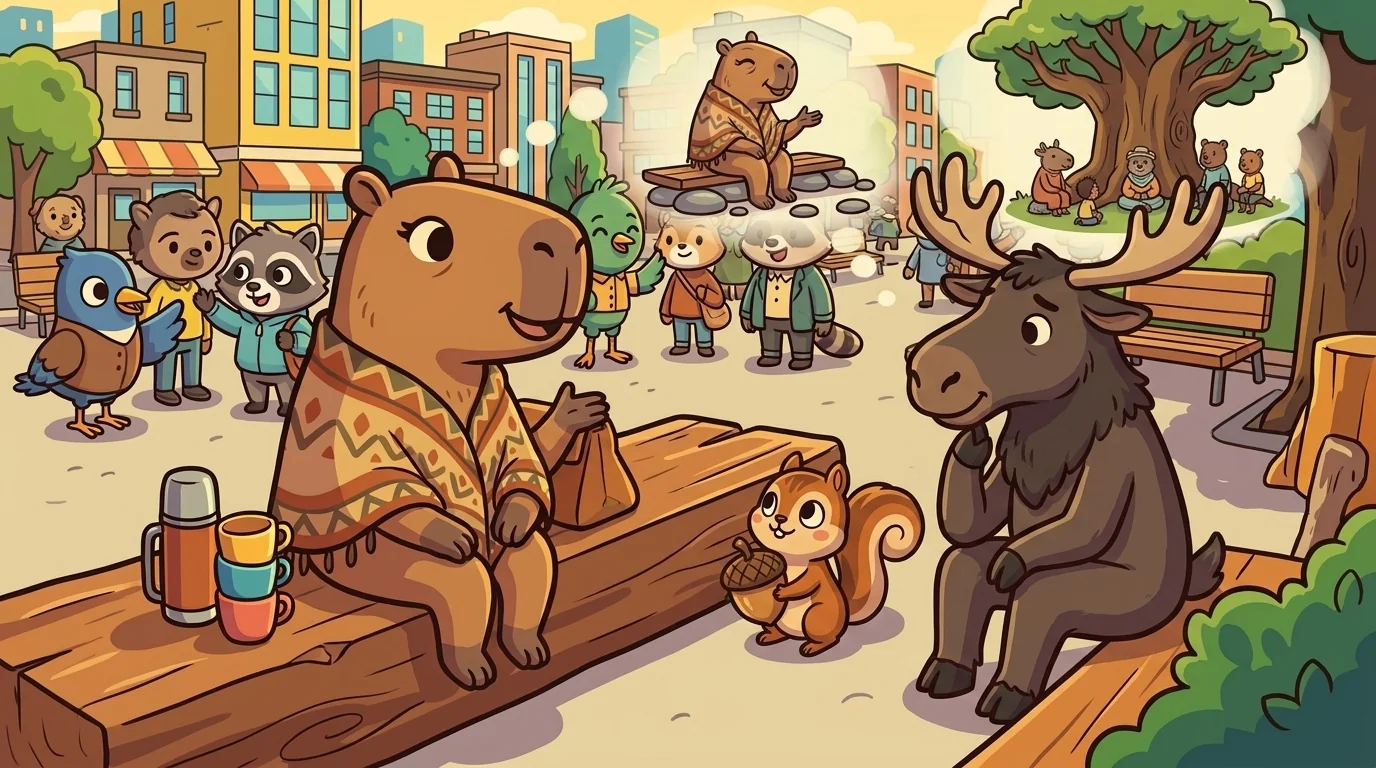
Her corner of CityForge was just her wooden stoop, some worn floor cushions, and whoever wandered over. One afternoon it was a young beaver named Coop, an eager builder, who dropped down cross-legged in front of her with a rolled-up drawing.
"I designed a plaza," Coop said, spreading it out. Fountains, planters, a curved pergola. "For the corner by the market. It's going to be amazing."
"It's lovely," Stoop said honestly. Then: "What's on that corner now?"
Coop shrugged. "Nothing much. Just some old steps. People sit on them and eat lunch and stuff."
"Ah." Stoop let the word sit. "So there's already a public space there. People chose it themselves. And your plan is to knock it down and build one you chose for them."
Coop opened his mouth, then slowly closed it and looked at his own drawing differently.
"A public space isn't fancy," Stoop went on, tapping the ledge under her. "This is a plank. That's the point. It has to be present, not pretty. It has to be free — no ticket, no 'buy a drink to sit here.' A bus stop counts. A sidewalk counts. Those old steps by the market count." She smoothed her shawl. "New plazas fail so often because the people who use them didn't design them. You'd have built a beautiful empty room, and the lunch crowd would've kept sitting on the steps you took away — if you'd left them any."
"So I..." Coop looked at the steps in his mind. "I fix the steps. Make them better. Keep the corner theirs."
"Now you're listening," Stoop said, and it was clearly the highest praise she had.
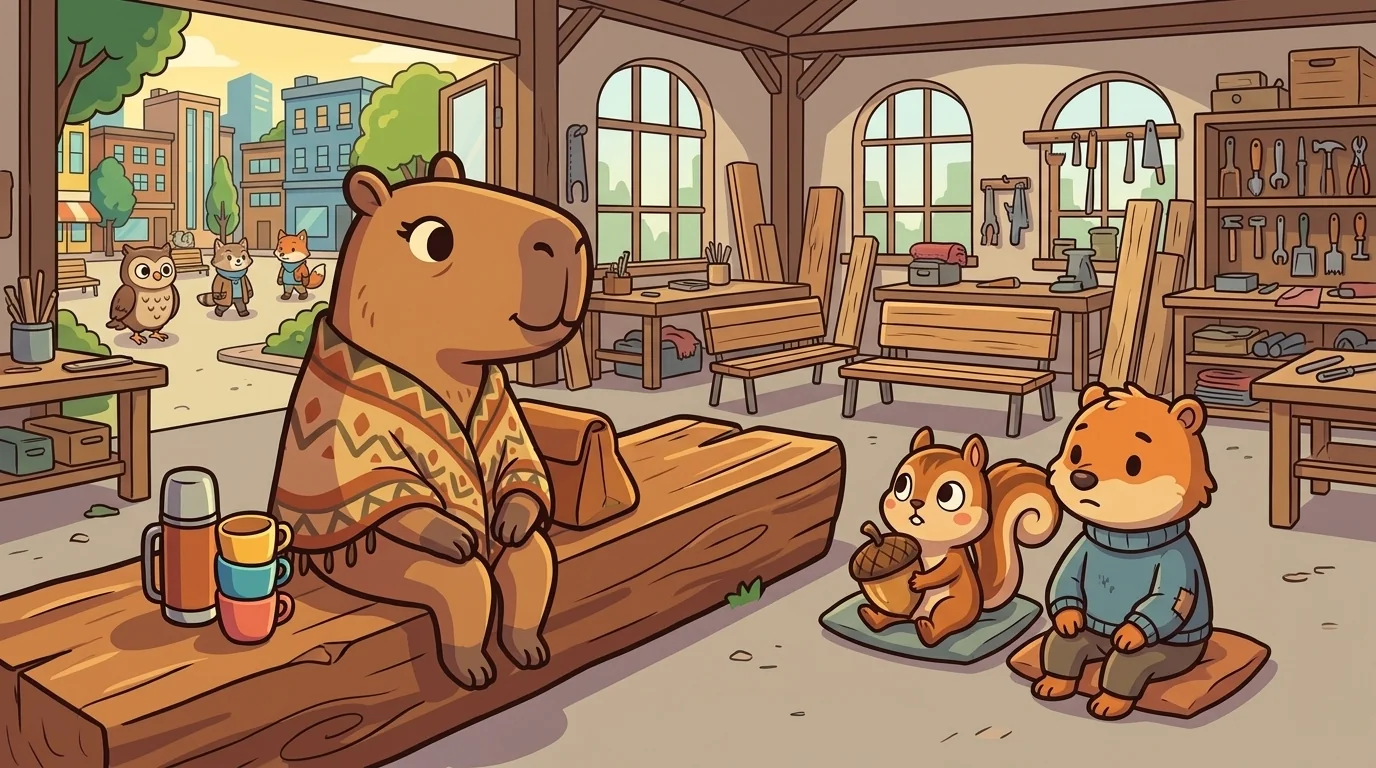
The workshop emptied toward evening, the light going gold across the square, and Coop came back with a quieter question, the way people do when the first answer has opened a second.
"But when a place is just steps," he said, "and nobody famous made it, and it's not on any map — how do you know it matters? How do you argue for it? There's nothing to point at."
Stoop looked out at the square she hadn't built and had promised to protect. "You don't point at the thing," she said. "You point at the people in it. That man who set his groceries down and told me his news — he did that because he knew this ledge would hold him and hold his story. That's not nothing. That's the whole city, small enough to see." She rested one paw flat on the worn wood beside her. "A place matters when people can just be there, together, for free, without being sold anything. If it does that, protect it, even if it's ugly. Especially if it's ugly."
Coop sat with that, and Stoop watched the tight, clever, planning look ease out of his face and something softer take its place. He wasn't thinking about fountains anymore. He was thinking about the man with the groceries, and about a corner of steps he'd almost erased without knowing it was already a living room.
The quiet settled over the two of them. Coop felt his shoulders come down from where they'd been hitched up all afternoon, and a slow warmth rose in his chest — the steady gladness of having almost gotten something wrong and, this time, caught it. He hadn't lost his beautiful plaza. He'd traded it for something he liked far better: a neighborhood he'd been about to disappoint, and hadn't. He leaned back against the front of the old stoop, and for a long while neither of them said anything at all, and the not-saying-anything felt exactly like belonging somewhere.
The CityForge ensemble
Stoop (ELDER) is part of CityForge's distributed-narrative cast. Each character embodies a different curricular primitive; together they teach the full subject.
-

Block
Zoning + density — the badger-tween with clay-block models who teaches zoning as 'plan for the neighbors first, not the buildings'
-
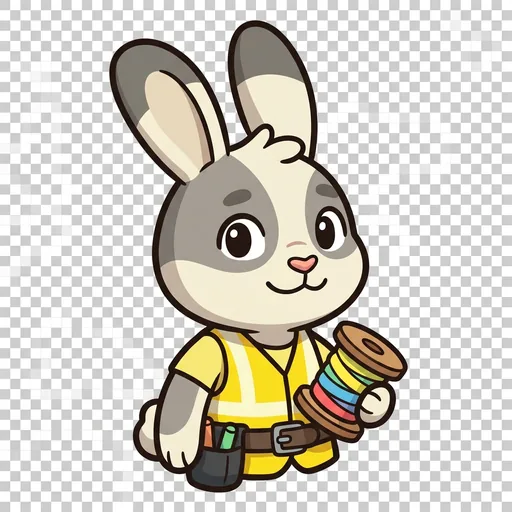
Lane
Walkability + mobility — the rabbit-tween in safety-vest with a chalk-spool who teaches streets-as-spaces ('streets are rooms; cars are guests, not owners')
-

Hub
Transit nodes — the pangolin-tween in conductor-vest who teaches that transit is about ACCESS, not about cars-vs-trains ('many ways, equal ways; the bus matters as much as the train')
-

Dwell
Housing equity + repair — the owl-elder in a mended quilted-coat who teaches anti-displacement, repair-not-replace urbanism ('repair before replace; listen before plan; the people who live here ARE the design')