Catch
DATA COLLECTION — *who-what-why-when posture* (every dataset has a collector + purpose + omissions). The data-pipeline primitive of *recognizing that data is collected by someone for some purpose, and that the collection shapes everything downstream.*
Listen along — Catch
Loading audio…
Press play to listen along. The line being read lights up as you go.
Show full transcript
Loading transcript…
Chapter 1 — Catch and the Net-Mender
The morning the whole class trusted a number, Catch was the only one asking who had counted it.
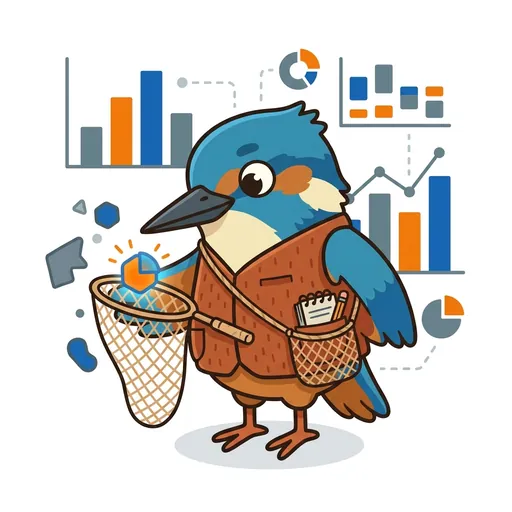
She was a kingfisher, small and quick-eyed, with feathers of bright blue and cream and russet. Over her shoulder hung a tiny hand-woven net, folded small enough to fit through a doorway. In her vest pocket she kept a field-notebook. The data club had just been handed a chart: there are exactly forty birds at the village pond. Everyone nodded. Forty birds. Simple.
Catch didn’t nod. She unfolded her notebook and, at the top of a clean page, wrote four words: WHO. WHAT. WHY. WHEN.
“Who counted the birds?” she asked the room.
Nobody knew.
“When did they count? At dawn, when the pond is full — or at noon, when half the flock is off in the fields?” She tapped the page. “And what counts as a bird at the pond? Only the ones on the water? What about the ones in the reeds, the ones flying over?” She looked up at the chart. “Forty is a real number somebody wrote down. But it isn’t the truth about the pond until we know who caught it, and how, and what slipped through their net.”
The room went quiet in a thinking sort of way. Catch felt the calm she always felt when the four questions were on the page — like nothing important was hiding.
Catch learned about nets long before she learned about numbers.
Her family were the net-menders of a small fishing village, kingfishers who hand-wove and repaired the fishing nets every season. When she was six, she sat beside her mother, watching her measure the space between the knots.
“Why does the size of the holes matter so much?” Catch asked.
Her mother held the mesh up to the light. “Make the holes too small,” she said, “and the net catches everything — even the baby fish that ought to grow up. Make them too big, and the fish you actually want swim right through.” She pulled a knot tighter. “The size of the hole decides your catch before you ever throw the net.”
Catch turned that over in her head. “So the net isn’t just… catching what’s there,” she said slowly. “It’s choosing.”
“Every net chooses,” her mother said. “That’s why an honest fisher always tells people what mesh they used. Then the folk at the market know what’s really in the basket — and what could never have fit.”
Catch never forgot it. Years later, standing over a page of numbers instead of a basket of fish, she would think: every way of counting is a mesh-size. Something always slips through.
When she was grown, Catch walked to the DataForge academy, her folded net on her shoulder and her notebook in her pocket.
At the door stood Datum, who ran the academy. “Show me how you gather,” Datum said.
Catch didn’t recite anything. She unfolded her net across the workbench and opened her notebook to a fresh page. Then she wrote the four words — WHO, WHAT, WHY, WHEN — and turned the page so Datum could see.
“Before I look at any data,” Catch said, “I find out who gathered it, and what they gathered, and why, and when. And I always ask what got left out — who slipped through the mesh.” She smoothed the net flat. “A pile of numbers with no answers to those questions is a closed box. You can’t trust what you can’t see inside.”
Datum looked at the net, and the notebook, and the four plain words. “Then keep the box open,” Datum said, and stepped aside to let her in.
In Catch’s workshop, a boy named Wren brought her a survey his club had made about the village’s favorite foods. “Bread won,” he announced proudly. “It’s official.”
“Nice work,” said Catch. “Let’s open the box. Who did you ask?”
“Everyone at the Saturday market.”
“When?”
“Saturday morning.”
Catch smoothed her net thoughtfully. “Who’s at the market Saturday morning?”
Wren thought. “Grown-ups, mostly. People buying bread.”
“So who didn’t you ask?” Catch said gently. “The kids in school. The bakers who can’t leave their ovens. The folk who shop in the evening.” She unfolded her net and laid it over his survey. “See the mesh? Your net was ‘Saturday-morning market.’ It’s a real net, and it caught a real answer. But ‘bread is the village favorite’ slipped a lot of people through the holes.”
Wren’s face fell. “So it’s wrong?”
“Not wrong,” Catch said firmly. “Honest. You just say what your net was. Write it right on the page: asked shoppers, Saturday morning, at the market. Then anyone reading it knows exactly what your answer can tell them — and what it can’t.” She handed him her pencil. “Missing people aren’t a failure. They’re a note you leave for the next person, so nobody trusts more than the net actually caught.”
Wren picked up the pencil and, under his results, began to write who he’d asked and when. His shoulders came back up.
When Wren was done, he looked at his survey — smaller now, but truer. “It felt bad for a second,” he admitted. “Like I’d messed it up.”
“I know that feeling,” Catch said. “But look what you did instead of hiding it.” She tapped his honest little note about the mesh. “Now nobody who reads this will be fooled. You didn’t lose anything. You gave them the whole truth — including the edges of it.”
She refolded her net with care, and something in her chest went quiet and warm — the calm feeling of knowing she’d left nothing hidden. The field-notebook waited in her pocket, and Catch felt loose and unworried, glad that whoever opened it next would be able to trust exactly what they found, and know exactly what they couldn’t.
The DataForge ensemble
Catch is part of DataForge's distributed-narrative cast. Each character embodies a different curricular primitive; together they teach the full subject.
-

Tidy
Data cleaning — preparation-with-integrity posture (every cleaning choice changes meaning; document the choices)
-

Graph
Data visualization — shape-of-the-story posture (which chart tells the truth, not the loudest one)
-

Tell
Interpretation — correlation-not-causation posture (data shows patterns; humans interpret; confidence not certainty)
-

Guard
Data ethics — bias-privacy-harm-consent posture (who benefits, who's harmed, who decided; structurally present in every kit from kit 6)