
Coil the Self-Reference
RECURSION + SEQUENCES — *Fibonacci, factorials, recursive patterns.* The discrete-math primitive of *defining things in terms of themselves.*
A story read by Coil the Self-Reference
Press play to listen along. The line being read lights up as you go.
Show full transcript
Loading transcript…
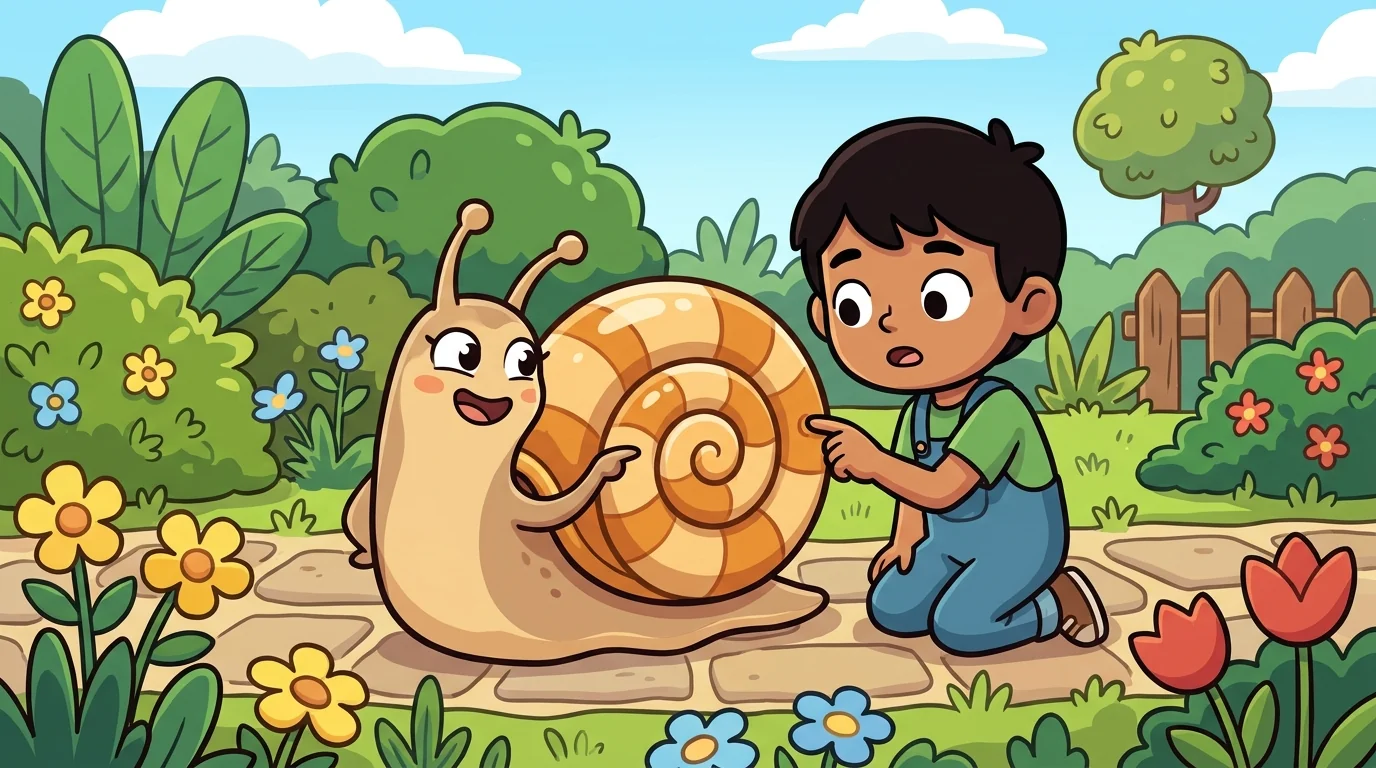
Coil was a snail-tween with a warm amber-and-cream shell that spiraled out in a slow, perfect curl. This morning she inched across the garden path, and every kid who passed stopped to stare at her shell, because it grew in the most beautiful way.
Each turn of the spiral was built from the turn right before it — a little bigger, a little wider, following the same quiet rule around and around. Coil twisted her body so a boy named Ravi could see the very center, the tiniest first curl. "It all starts there," she said, tapping the middle of her shell. "One small turn. Then the next turn leans on that one. Then the next leans on that one." Ravi traced the spiral outward with his finger, from the tiny center to the wide open mouth, and his eyes went wide. Coil smiled, tucked warm inside the very pattern she loved to show off. Her shell wasn't just her home. It was the whole idea, curled up and carried around.
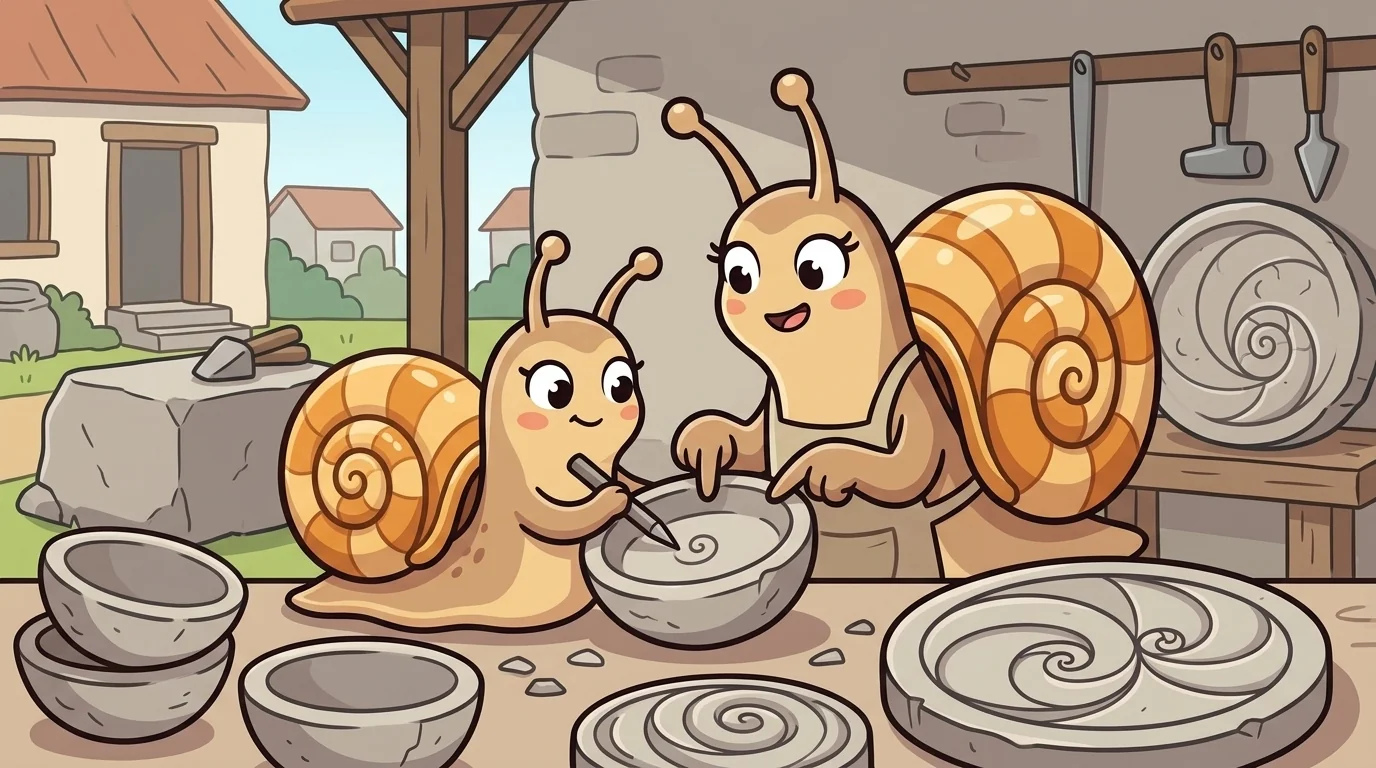
Coil grew up in a small village where her family were the shell-carvers, snails who chiseled swirling spirals into smooth stone bowls.
She remembered being tiny, watching her mother carve a bowl, and feeling frustrated that the pattern looked so hard. "It's too much, Mama," little Coil had huffed. "I'll never carve a whole spiral."
Her mother set down her chisel and pointed to the very center of the bowl. "You don't carve the whole spiral," she said. "You carve one turn. A small one you know you can do. Then you carve the next turn right off the edge of that one. Then the next off that." She guided Coil's tiny claw to scratch a single small curl. "See? You already did the hardest part — you started somewhere solid." One turn at a time, leaning each new curl on the last, Coil watched a whole spiral bloom across the stone. The overwhelmed feeling melted into a calm, glad steadiness. The big scary pattern was really just a small sure step, repeated. She never forgot how that starting-small felt — like the ground going firm under her.

When Coil was older, she made the long slow journey to DiscreteQuest, inching along for a very long time before she finally arrived. A mentor met her at the gate.
"What is recursion?" the mentor asked.
Coil didn't recite a rule. She curled her body so her shell caught the light, the spiral turning from its tiny center out to its wide mouth. "It's this," she said simply. "You start from one small turn you know for sure. Then every new turn is built from the turn right before it. Big things made out of the last small thing, over and over." She pointed to the solid little center. "You always need a place to start. A safe first turn. Then the rest just leans outward from there." The mentor looked at the shell for a long moment, then smiled. "Then this garden is yours to tend," she said.
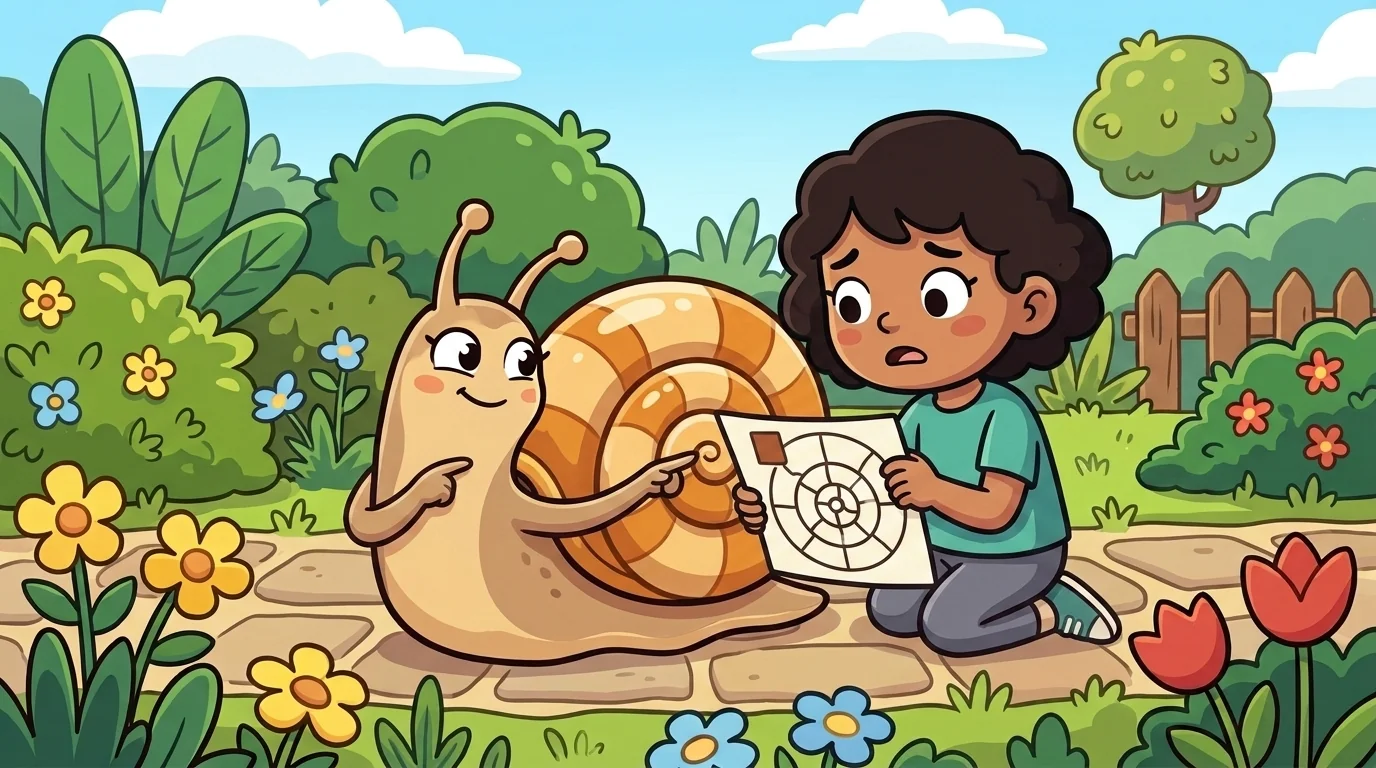
Coil's first student was a worried girl named Prisha who froze whenever a problem looked big.
"There are so many steps," Prisha said, staring at a long counting puzzle. "I don't even know where to start."
Coil inched beside her and turned her shell to show the tiny center curl. "Don't look at the whole spiral," she said gently. "Just find your first small turn — one thing you already know for sure." She pointed at the puzzle. "What's the very first, tiniest piece here? The one that's already answered?"
Prisha thought. "The very beginning is just... one," she said slowly. "That part I know."
"Perfect. That's your solid center," Coil said, delighted. "Now — the next step. Don't solve the whole thing. Just build the next piece off the one you already have." She traced her shell outward, one turn leaning on the last. "Trust the little turn behind you. You don't have to hold the whole spiral in your head. You only ever build the next turn from the turn you just finished."
Prisha tried it — one known piece, then the next built right off it, then the next. Step leaning on step, the long scary puzzle uncurled into something she could actually walk through. "Oh," she breathed. "It's not too big. It's just... one turn at a time."
"Every single time," Coil said warmly. "My whole shell is nothing but that. One turn, leaning on the one before."
Coil settled back on the warm path and watched Prisha finish her puzzle, calm now, building each step off the last.
"Feel that?" Coil asked. Prisha nodded — the tight, frozen, too-big feeling had loosened into something steady and light. "That's what a solid starting point does," Coil said. "The moment you find the small sure thing to begin from, the huge scary thing goes quiet. Your shoulders come down. You breathe. Because you don't have to leap the whole spiral — you only have to make the next turn."
Coil curled slowly into the sun, her amber shell glowing turn upon turn upon turn, each one resting gently on the one before. Deep in her own coils she felt the calm gladness her mother had given her long ago, the firm-ground feeling of always having somewhere sure to start. She rested there, warm and settled, wrapped in the very pattern she loved.
The DiscreteQuest ensemble
Coil the Self-Reference is part of DiscreteQuest's distributed-narrative cast. Each character embodies a different curricular primitive; together they teach the full subject.
-

Sortie the Set-Curator
Sets, subsets, set operations (union, intersection, difference)
-

Tally the Pattern-Counter
Counting principles and combinatorics (multiplication rule, permutations, combinations)
-

Verity the Truth-Tester
Propositional logic, truth tables, AND/OR/NOT operators
-

Wander the Bridge-Walker
Graph theory — Eulerian paths, Hamiltonian paths, connectivity
-

Prime the Indivisible
Number theory — primes, factorization, modular arithmetic
-

Cubby the Cubby-Keeper
The pigeonhole principle — when there are more things than places, at least one place must hold two
-

Swatch the Border-Painter
Graph coloring — coloring connected things so no two neighbors match, with the fewest colors
-
Marshal the Line-Arranger
Permutations — counting arrangements where order matters (factorials, ordered choices)
-

Twoby the Pair-Matcher
Parity and invariant arguments — even/odd pairing that proves what's possible
-

Surge the Growth-Racer
Order of growth — how the work scales as a problem gets bigger