Skin
PROSTHETIC MAKEUP — *character. never realistic injury. craft + chemistry + theatrical convention.*
Listen along — Skin
Loading audio…
Press play to listen along. The line being read lights up as you go.
Show full transcript
Loading transcript…
Chapter 3 — Skin and the Character, Not the Injury
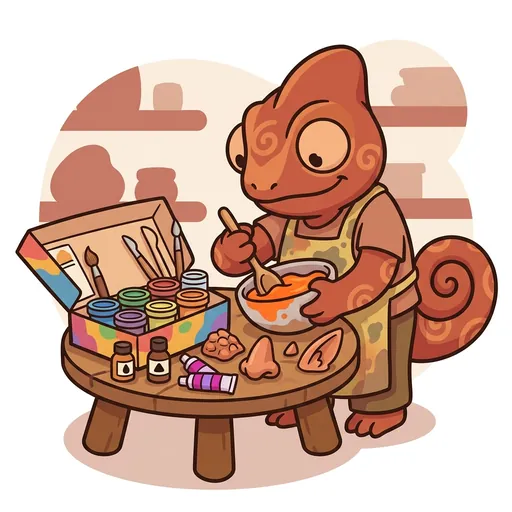
Skin pressed a ridge of clay above the puppet’s eyebrow, smoothed the edge with a thumb, and stepped back to watch a perfectly ordinary face turn into a troll.
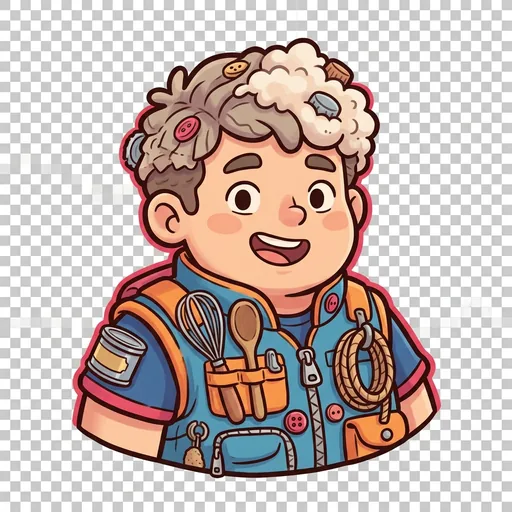
He was a chameleon-tween in a clay-smudged apron, and his own skin kept giving him away — russet while he mixed, soft blue while he sculpted, a little glow of gold now that the troll-brow had come out right. He blended the clay’s edge with a tiny brush until you truly could not find where the real face ended and the new brow began. Then he painted in bumps and craggy lines.
“There,” Skin said, tapping the actor’s cheek beside the ridge. “New character. Old face still perfectly fine underneath.” He smiled at the little crowd of students. “That’s the whole trick. We add. We never damage. Watch — I can wipe him back to himself.” He peeled the piece away clean, and the ordinary face returned, unharmed, a little sticky. The students clapped.
Skin had learned that trick in the Costume Village, where his whole family were character-sculptors for the seasonal pageants.
When he was small, he loved the transformations best — a neighbor becoming a wise old owl, a cousin becoming a purple goblin king who made the village children shriek with delight. His mother made faces the way other people baked bread: patiently, every morning, for whoever needed to become someone else that day.
One year a visiting artist offered to teach the older kids “realistic wounds.” Skin’s mother stepped between them, gentle but immovable. “Not here,” she said. “The little ones watch everything we do.” That night she told Skin the family’s oldest lesson: character work is play, and play stays play only if it never pretends to be real hurt. Skin turned the idea over in his hands like a lump of clay. It felt solid. It felt like something he could stand on.
He came to EffectsForge at thirteen, kit tucked under one arm, and Render — the old mentor with the kind eyes — asked to see what he could do.
Skin didn’t recite anything. He sculpted, right there in the doorway: a set of fairy ears, glued soft, edges blended to nothing. Render tilted his head, charmed. Then Render, testing, asked, “And a bloody gash? Could you make one look real?”
Skin’s skin flickered a wary gray. He set his brush down. “I could make you a dragon,” he said carefully. “Or an alien, or the silliest goblin you ever saw. But a real-looking wound — no. Not here. The village kids taught me that line, and I keep it.” Render studied him a long moment, then broke into a warm grin. “Good,” he said. “This whole workshop needs someone who holds that line without being asked twice. It’s yours.” Skin felt a quiet shiver of pride settle into his chest.
His first real test came from a kid named Bram, who marched in wanting to know how to make “a really gross zombie bite.”
Skin didn’t lecture him. He crouched to Bram’s level and opened his kit instead. Clay, kid-safe latex, pots of paint in a dozen colors — and, Bram noticed, no red goo, no wound molds, nothing gory at all. “Here’s what we’ve got,” Skin said. “So let’s make you the greenest, silliest swamp-zombie who ever tripped over his own feet. Sagging cheeks. A nose falling half off. Big cartoon teeth.”
Bram’s face lit up despite himself. Together they sculpted a droopy zombie brow, glued it, and blended the edge until it looked grown-on. “The blending’s the part everyone rushes,” Skin warned, and told the story of the goblin nose he’d once slapped on in a hurry — edge unblended, the whole thing sitting there stuck-on and ridiculous. Bram snorted. He took the brush and blended slower. When they finished, Bram in the mirror was gloriously, hilariously undead — clearly, obviously pretend. “It’s scary-funny,” Bram decided, “not scary-scary.” Skin nodded. “That’s exactly the door we keep open. And it can stay shut anytime you want — you say slow down, we slow down.”
That evening Skin cleaned his brushes and laid the little troll-brow back in its tray beside the fairy ears and the swamp-zombie nose.
He thought about his mother stepping between the visiting artist and the older kids, and about Bram’s delighted, undead grin in the mirror — proof again that you could make something wonderfully strange without ever making something that hurt.
His skin settled into a calm, steady gold. There was a particular ease he only felt at the end of a good day like this, and he let himself sit in it: the quiet, loose-shouldered relief of knowing the actor’s real face was safe, the line was firm, and every wild creature he’d ever dreamed up still lived on the safe side of it. It felt, more than anything, like being trusted — and trusting himself right back.
The EffectsForge ensemble
Skin is part of EffectsForge's distributed-narrative cast. Each character embodies a different curricular primitive; together they teach the full subject.