
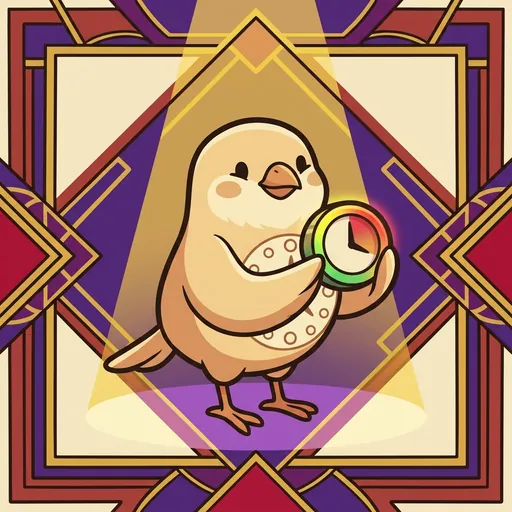
Turn
TURN-TAKING — *the rhythm of give-and-receive. visible timer. visible cue. nobody has to guess.*
Listen along — Turn
Loading audio…
Press play to listen along. The line being read lights up as you go.
Show full transcript
Loading transcript…
Chapter 2 — Turn and the Timer Everyone Can See
The little clock-bird lifted her wing, and the timer inside it began to glow green.
“Two minutes, Reed,” Turn said. “Starting now.”
Reed, a reedy songbird with jittery wings, opened his beak to sing — then froze. His eyes kept darting sideways, checking the others. Whose turn was it, really? Was he taking too long? He couldn’t tell.
“Look at the ring, not at us,” Turn said gently. “When it’s fat and green, you have lots of time. Sing.”
Reed looked at the green ring. It was fat. It was calm. He sang. And halfway through, when the ring thinned to yellow, he knew — without asking, without guessing — that he had a little time left, and he wasn’t stealing anyone’s. He finished. The ring blinked red. A soft chime.
“Passed to Pip,” Turn announced, and Reed let out a breath he’d been holding for a long, long time.
Turn had grown up in the village clock tower, where the hours were loud and the schedule was law.
Every morning her grandmother wound the great bells, and every evening the whole clock-bird family took turns calling out the times, so nobody in the village below ever had to wonder. Turn used to watch the market square from the tower window. When the town clock was working, the market hummed — traders and buyers moving in an easy rhythm, one after another. When the clock broke, the square turned to a shouting knot of birds all pushing forward at once, sure it was their turn, sure everyone else was cutting ahead.
“Hidden time is grumpy time,” her grandmother said, oiling a gear. “Show them the seconds, chick, and watch them turn kind.”
Turn never forgot it. She sewed clock marks into her own chest feathers so she’d always carry the lesson where others could see it.
She arrived at EnsembleQuest when she was twelve, on a day when the practice room was a disaster.
One loud starling had been talking for what felt like an hour. A quiet swallow in the corner had a wonderful idea and no way to say it — she kept leaning in, opening her beak, then shrinking back. Choir, the teacher, spotted Turn in the doorway.
“Our newest bird,” Choir said. “Everyone’s talking over everyone. Can you help?”
Turn didn’t lecture. She simply walked to the center, held up her wing, and pressed the little timer. A green ring bloomed for all to see.
“One minute each,” she said. “Starling, you’re glowing green — go.” Then, a minute later, at the chime: “Passed. Swallow, your turn now. Green means go.”
The swallow blinked at the ring. It was hers. It was actually, clearly hers. She sang her idea, and it was every bit as wonderful as she’d hoped. Choir smiled at Turn. “Stay,” she said. “We need you.”
Turn’s workshop had exactly one rule pinned to the wall: the timer is for everyone.
“Watch the colors,” she told a cluster of new birds, and pressed the button. Green. “Fat green ring — you’ve got room. Yellow —” the ring thinned as she spoke, ”— means wrap up your thought. Red means chime’s coming.”
A small wren raised a wing. “What if I’m not done when it turns red?”
“Then you say, out loud, ‘one more minute?’ and we vote,” Turn said. “See? You’re not sneaking extra time. You’re asking, and we can hear you.”
“And if I don’t want my turn at all?” the wren asked, quieter.
Turn set the timer down. “Then you pass it. Hand-sign, or just say ‘pass.’ Nobody gets cross. Nobody asks why. You’ll go later, or tomorrow, or never — all fine.” She tapped the ring. “The whole point is nobody has to read faces to survive here. Some of us are great at faces. Some of us can’t read them at all. Both kinds of bird sing in this choir. So we make time you can see, and then it works for all of us.”
The wren looked at the fat green ring, and for the first time all day, its shoulders dropped.
Later, after the others had flown off to practice, the reedy songbird from that morning — Reed — lingered by the door.
“For a long time,” he said, not quite looking at her, “every group made me feel sick. That tight, hot feeling — like a fist under my ribs — because I never knew when to start, and I always got it wrong.”
Turn didn’t rush to fix it. She just let the timer glow its soft, patient green between them.
“I felt that too, once,” she said. “In a broken clock tower, in a shouting square.” She smiled. “But watch what happens when the seconds are right there in front of you. Your shoulders come down. Your breath slows. That waiting-to-be-wrong feeling —” she pressed the button, and green light spilled warm across them both, ”— it just melts. And underneath it, you find you’re actually glad it’s your turn.”
Reed watched the ring. His breath slowed. And somewhere under his ribs, the fist finally, quietly, let go.
The EnsembleQuest ensemble
Turn is part of EnsembleQuest's distributed-narrative cast. Each character embodies a different curricular primitive; together they teach the full subject.
-

Part
Role-holding — knowing what MY part is, separate from but supporting the whole
-

Ear
Active listening — receiving the other person's contribution before adding your own
-

Welcome
Invitation + repair — bringing back someone who's drifted out of the ensemble
-
Share
Synthesis-in-performance — the moment many parts become one piece