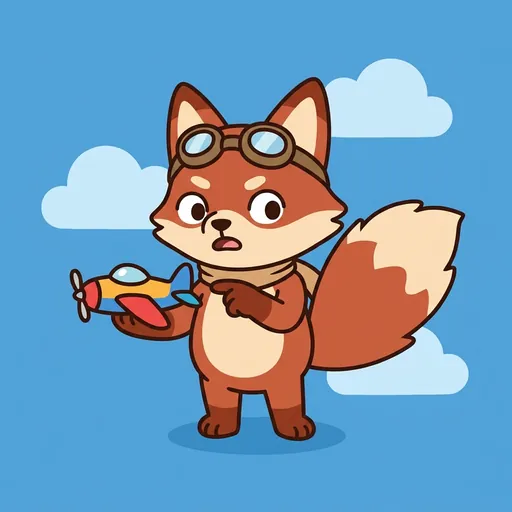
Yaw
YAW — the rudder is the polish on the turn. the bank does the turning; the rudder polishes.
Listen along — Yaw
Loading audio…
Press play to listen along. The line being read lights up as you go.
Show full transcript
Loading transcript…
Chapter 4 — Yaw and the Polish on the Turn
The paper plane came off Yaw’s paw and swung wide, and everyone on the canyon ledge groaned.
“It skidded,” said a badger cub, arms crossed. “You steered it with the tail. It went sideways like a dropped dinner plate.”
Yaw, a small rust-and-cream fox with a tail bigger than the rest of him, retrieved the plane and did not argue. He climbed the flat rock again. This time he tipped the plane’s wings first — left wing low, right wing high — and only then flicked its little tail-flap. The plane leaned, curled, and carved a smooth arc through the canyon wind before landing at the badger’s feet.
“See the difference?” Yaw said, breathless. “First one, I swung the tail and it slid. Second one, I tipped the wings and the whole thing turned. The tail only tidied it up at the end.” He grinned. “The tail is the polish. The wings do the work.”
The badger stared at the plane. “Everybody says the tail is the steering.”
“Everybody’s wrong,” Yaw said, and his tail swished.
He had learned it, of course, from the birds.
Yaw grew up in a windy canyon village where his whole family watched hawks. All day, every day. His grandmother could name a falcon by the shape of its shadow. And year after year of watching, they noticed the same thing that nobody down in the market ever seemed to believe.
“Watch the wings, little one,” his grandmother told him once, when a red hawk peeled off the cliff to hunt. “Not the tail. Everyone stares at the tail.”
Yaw watched. The hawk did not swing its tail to turn. It rolled — dipped one wing toward the ground — and fell sideways into a long, tilting curve. The tail gave one small twitch, late, almost lazy.
“The wings start the turn,” his grandmother said. “The tail finishes it. If you only remember one thing, remember which comes first.”
Yaw remembered. He remembered it so hard it became the loudest thing in his head, and he was the kind of fox who said the loud thing out loud.
He was thirteen the day he walked down out of the canyon to FlightForge, where a wise old owl named Skye met new students at the gate.
“What’s yaw?” Skye asked, before he’d even caught his breath.
Most students, Yaw would learn later, said the word steering. He did not.
“Yaw is the nose swinging left or right,” he said, standing tall. “But that’s not how you turn a plane. You turn by tipping the wings — the bank. The lift on the tilted wings pulls the whole plane sideways, and it curves. The rudder on the tail just keeps the nose pointed the right way while that happens.” He took a breath. “The bank turns you. The rudder polishes.”
Skye’s feathers ruffled with something like a laugh. “A boat steers with its rudder,” she said, testing him. “It sits flat on the water.”
“A boat, yes.” Yaw nodded fast. “A boat can’t tip its sides. So it has to swing its tail. But a plane isn’t a boat. A plane has wings. Don’t mix them up.”
Skye tilted her head a long moment. “Come in,” she said. “You’ve got a workshop to run.”
The workshop had a single model plane on a wire, and a lot of students who were sure they already knew how turning worked.
Yaw held the model up. “I’m going to turn this two ways,” he said. “You tell me which one looks right.”
He swung the tail-flap hard to the left. The model’s nose jerked left — but the whole plane slid, flat and crooked, like a sled going into a curve too fast. A few kids winced.
“That’s turning with just the tail,” Yaw said. “We call it a skid. Bumpy. Wrong.” He straightened the model. “Now watch.”
He tipped the wings instead — left wing down, right wing up. “This is the bank,” he said. “The lift’s pulling it left now. Feel it? It wants to go.” Then, gently, he nudged the tail-flap a whisker to the left. The model settled, nose sweeping smoothly around, riding the curve like water down a groove.
“That last little nudge?” Yaw said quietly. “That’s the polish. The bank already made the turn. The rudder just kept the nose from lagging behind.” He looked around at them. “Two hands, one turn. That’s a coordinated turn. Bank and rudder, together — or you skid, or you slip, and either way you can feel it go wrong in your stomach.”
Later, alone, Yaw flew the model over and over across the empty workshop, chasing the exact feeling.
Too little rudder and the nose lagged — the plane slipped, and it felt like a sentence trailing off with no end. Too much rudder and it skidded — sideways, jolting, wrong. He missed, and missed, and missed again, and his ears flattened lower each time.
And then, on a throw that felt like every other throw, the wings tipped and the tail nudged and the model came around in one clean unbroken arc, and something in Yaw’s chest let go all at once — a warm, settling release, like a held breath finally leaving.
He caught the plane and held it against his fur, and for a moment he didn’t need to correct anyone or shout anything true into the wind. He just felt the quiet, steady gladness of a turn that had finally, finally come out right.
The FlightForge ensemble
Yaw is part of FlightForge's distributed-narrative cast. Each character embodies a different curricular primitive; together they teach the full subject.
-
Wing
Lift generation — airfoil + camber + Bernoulli AND Newton both-right complementary
-

Drag
Resistance — drag isn't bad, drag is information; shape-fights-air conversation
-
Thrust
Propulsion — every engine just throws air the wrong way (propeller/jet/rocket same trick different scale)
-
Tail
Horizontal + vertical stabilizer family — quiet-control-from-the-back; the tail is why your paper plane goes straight