
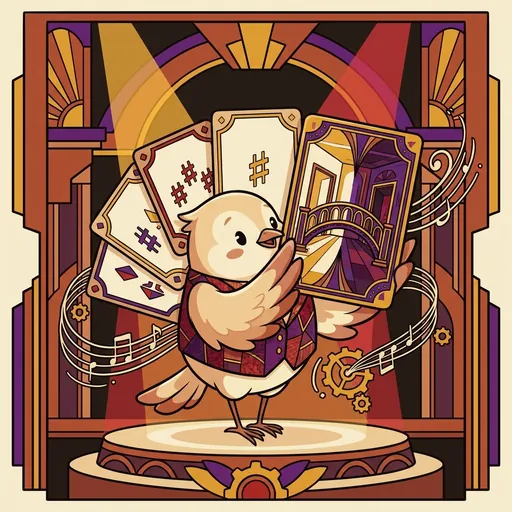
Shift
SHIFT — *changing keys mid-piece. the moment a song moves to a different room.*
Listen along — Shift
Loading audio…
Press play to listen along. The line being read lights up as you go.
Show full transcript
Loading transcript…
Chapter 5 — Shift and the Different Room the Song Moves To
Shift was halfway through a little tune when she did the thing that always made students gasp. She was playing something bright and sunny, and then — without stopping, without a bump — the whole song lifted. Same melody, but higher, warmer, like a window had opened somewhere.
“Wait,” a student said. “How did you do that? It’s the same song but it feels different.”
Shift lowered her wings from the chime-keys and grinned, warm cream feathers puffed with pleasure. “The song walked into a different room,” she said. “That’s all a key change is. Same singer. New room.”
She was a small migrating songbird with russet-tipped wings, and she’d flown a very long way to learn that a room could change how a voice sounds.
Shift grew up along the migration path, in a family her village called the long-journey-singers. Every autumn they flew south, and every place they landed, their songs came out a little different.
She remembered being small and confused about it. “Grandpa, why does your song sound sadder here than it did back home?” she’d asked one cold morning in a new valley.
Her grandfather had ruffled up against the wind. “Same song,” he said. “Different room. A song in the pine valley isn’t the song in the reed marsh, even if the notes are the notes. The place changes the feeling.” He nudged her with a wing. “One day you’ll learn to change the room on purpose.”
Shift hadn’t understood, not really. But she’d tucked it away, and on the long flights she started listening for it — how the flock’s song brightened over open water and darkened under heavy trees. The tune held. The room changed. And the feeling followed the room.
When Shift turned twelve she flew all the way to HarmonyForge with her key cards bundled at her side. Refrain met her at the gate.
“Songs live somewhere,” Refrain said. “What happens when one moves?”
Shift thought about the pine valley and the reed marsh. “It’s like walking into a new room,” she said. “The song can pick itself up and move to a different key partway through. Same singer — but the light’s different in the new room, so the feeling’s different too.”
Refrain considered this. “Show me a door,” she said, “not just a wall.”
Shift played a bright little phrase, then reached for one chord that felt like it belonged to two places at once, and stepped through it into a new, cozier key without a single bump. Refrain’s feathers settled.
“That’s a door,” Refrain said. “Come in. You’ll be teaching the ones who think a song has to stay in one room its whole life.”
In the workshop, Shift lined up her key cards and waved the students close.
“Home first,” she said, and played a warm phrase. “This is C major. Bright, sunny, easy.” She held up a card. “Now watch me find a door.” She played a soft, in-between chord. “This chord’s sneaky — it feels at home in this room and in the room next door. It’s a hinge.” She leaned on it, then pushed the tune gently forward, and the whole thing settled a step over into G major. “There. New room. Same singer. Feel how it got a touch cozier?” A student nodded slowly, wings still.
“Now here’s the loud way.” Shift played the bright phrase again — and then just jumped, straight up, half a step higher, into a whole new key with no hinge at all. The music surged up like a tide. A couple of birds sat up straight. “Pop songs love that one for the last chorus,” she said, laughing. “No door — they kick the wall down. Makes the ending feel enormous.”
She looked around at their wide eyes. “Smooth door, or kicked-down wall. Either way, you’ve moved the song somewhere new.”
The student who’d gasped at the start raised a wing. “So a song can go anywhere? It doesn’t have to stay home?”
Shift settled onto her perch. She thought about her grandfather in the cold valley, about a song that could carry its notes into any room and come out feeling new.
“It doesn’t have to stay anywhere,” she said gently. “You build the rooms. When a song’s getting sleepy, you open a door and let it walk somewhere brighter, and everybody following along gets to feel the light change.”
She played one last phrase and let it lift into the new key, and let it settle into the warm air of the workshop.
A student took a slow breath, and her shoulders eased, like she’d just stepped into a sunnier room.
“That little glow in your chest when a song opens a new door,” Shift said softly, watching her, “that soft, lifted, ohh, we moved feeling — that’s why I love changing rooms. It never stops surprising me.”
The HarmonyForge ensemble
Shift is part of HarmonyForge's distributed-narrative cast. Each character embodies a different curricular primitive; together they teach the full subject.
-

Triad
Chord-stacking — three tones in vertical alignment (root + third + fifth = the foundation of harmony)
-
Lean
Voice-leading — smooth stepwise motion between chord tones (the smallest possible movements between consecutive chords)
-
Pull
Tension — dissonant intervals (the leading-tone, the suspended 4th, the diminished chord) that *want* to resolve
-

Land
Resolution — the consonant arrival when tension releases (root return; cadence; the V→I gesture)