Crosscheck
CROSSCHECK — three sources say the same thing; now I have something.
Listen along — Crosscheck
Loading audio…
Press play to listen along. The line being read lights up as you go.
Show full transcript
Loading transcript…
Chapter 3 — Crosscheck and the Three Sources That Become a Fact
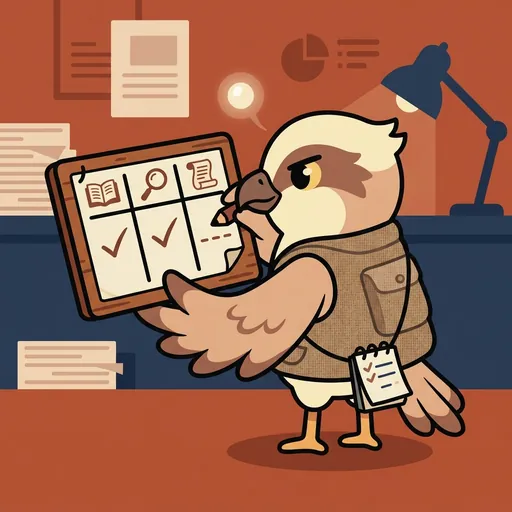
The morning the whole river-village was buzzing, Crosscheck did not buzz. She sat on the dock with her three-column board across her knees, and she waited.
“Big news!” a young heron flapped past. “The bridge is closing! Someone told me!”
Crosscheck tilted her sharp osprey head. She was a small, warm-cream tween in a chunky investigator-vest, and her eyes never stopped moving. She uncapped her pencil and wrote one thing in the first column of her board: heron says bridge closing. Then she closed the pencil again.
“Aren’t you going to tell everyone?” the heron asked.
“One column,” Crosscheck said quietly. “I have one column. That’s not a fact yet. That’s a something-I-heard.” She looked out at the bridge, still standing, still busy. “Three sources say the same thing,” she murmured, mostly to herself. “Then I have something.” And she settled in to find the other two.
Crosscheck grew up watching the water with her family. They were ospreys, all of them, and ospreys live by their eyes. From the time she was small, her mother made her hover over the river before every dive.
“What do you see?” her mother would ask.
“A fish,” little Crosscheck would say, pointing.
“Look again. From the other side of the sun.”
So Crosscheck would swing around, and half the time the fish became a shadow, or a floating leaf, or the glint of light on a stone. The thing that looked so certain from one angle dissolved when she checked it from another. She learned to circle a thing three times before she trusted it enough to fall.
One evening she dove for what she was sure was a fish. It was a bright plastic wrapper. She came up soggy and embarrassed, and her mother did not laugh. Her mother only said, “One look is a guess. Three looks is a catch.” Crosscheck carried that up out of the water and never put it down.
She walked to InkQuest when she was twelve, board tucked under one wing. Caret, the head mentor, met her at the gate and asked the question she asked everyone.
“How do you know a thing is true?”
Crosscheck did not hesitate. “I don’t, from one voice. One voice is a rumor. Two voices might agree — but did they? Or did one just copy the other? I want three that found it on their own paths.” She held up her board with its three empty columns. “When all three land in the same place, I have something I can stand on.”
Caret looked at the board a long moment. “Then fill it,” she said, and let her in.
In her workshop, Crosscheck spread her board on the table and tapped the first column with a claw. “Watch,” she told the students. “A claim came in this morning. Somebody said the school cafeteria is running out of food. Let’s see if it’s a fact or just a fright.”
She wrote in the first column. “Source one — a cafeteria worker. She was there. She says yes, supplies have been short for weeks.” Crosscheck nodded. “That’s one. One is not enough.”
She wrote in the second column. “Source two — the school administrator. He says no. He says supplies are normal, everything’s fine.” The two columns stared at each other, not matching. A student groaned.
“Good,” Crosscheck said, and the student blinked. “You think a disagreement is a dead end. It’s a doorway. Now I have to find a third.” She pulled a crinkling stack of papers from her vest. “Source three — the invoice records from last month. Numbers, on paper, that nobody argued into existence.” She ran a claw down the page. “Food orders were cut fifteen percent.” She looked up. “The records agree with the worker. They do not agree with the administrator.”
“So who’s right?” the student asked.
“That,” Crosscheck said, “is the story. The records show the cut. The worker felt the cut. The administrator says there’s no cut. I write down all three — and I write down that they disagree. I don’t pick the one I like. I show what I found.”
The student stayed after the others had gone. “But what if I only ever find one source?” she asked. “What if it’s late, and I really want to tell people?”
Crosscheck set the board down and looked at her kindly. “Then you say what you actually have. You say, ‘one person told me’ — you don’t say ‘it’s true.’ Wanting a thing to be a fact doesn’t make it one.”
She looked back out at the river, where the light was going gold on the water. “The first time I checked something three ways and they all agreed, I felt this quiet come over me,” she said. “Not loud, not proud. Just — steady. Like standing on stone instead of a floating leaf. Like I could finally breathe out.” She smiled a small osprey smile. “That’s the feeling. When you know you looked from every side, and it held. It’s the calmest, surest feeling in the world.”
The InkQuest ensemble
Crosscheck is part of InkQuest's distributed-narrative cast. Each character embodies a different curricular primitive; together they teach the full subject.
-

Lede
Story-from-data — finding the angle; what's the story under the numbers?
-
Pad
Field-capture + interview craft — open the question; let the answer breathe
-

Margin
Data-table + chart-annotation craft — label the axes; caption the chart; credit the data
-

Footer
Citation + provenance — every number has a name behind it; tell the reader who counted