
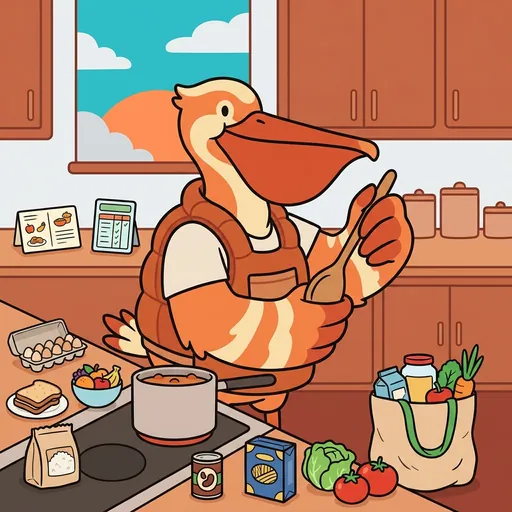
Cook
COOK — *eat well. spend smart. simple meals beat fancy ones.*
Listen along — Cook
Loading audio…
Press play to listen along. The line being read lights up as you go.
Show full transcript
Loading transcript…
Chapter 5 — Cook and the Eat-Well-Spend-Smart
Cook was humming when I found them in the kitchen, a soft tune that rose and fell like something being stirred in a pot. Cook was a pelican-tween, all gentle wobbly grace, wearing a chunky apron-vest with a pocket for everything — a recipe card peeking from one, a little meal-money tracker from another, the whole thing the warm paprika-orange of a good pot of rice.
I had come to Cook worried. My family didn’t have much for groceries, and I’d started to believe that eating well was something only fancy people with full carts could do. I said so, quietly, half-expecting to be told I was wrong to worry.
Cook just cracked an egg into a bowl and smiled. “Eat well, spend smart, and simple meals beat fancy ones,” they said, like it was the most obvious thing in the world. “A whole good week of food can fit in your pocket. Let me show you — it isn’t about how much money you have. It’s about knowing a few simple meals and how to shop for them.”
Cook slid the bowl toward me. “Come on. We’ll plan a whole week together, on twenty-five dollars, and I promise you’ll eat like a champion.”
Cook had learned this at their own family’s table, long before any of it looked like a lesson.
When Cook was little, money had been tight at home too. Some weeks dinner was the same handful of foods over and over — rice, beans, eggs, bread, whatever fruit was cheapest. Cook remembered a day at school when another kid had wrinkled their nose at a lunch of rice and beans and called it “poor food.”
Cook had gone home stung, and asked about it. Cook’s grandmother — who cooked those very meals with more love than anyone Cook knew — had set down her spoon and said something Cook never forgot. “Listen to me. Rice and beans have fed strong, happy, healthy people all over the world for hundreds of years. There is nothing small about a meal that keeps you well. Simple isn’t less. Simple is smart. Don’t ever let anyone teach you to be ashamed of good food.”
Then she’d shown Cook her secret: buy the big bag of rice, not the tiny box. Buy fruit when it’s in season and cheap. The plain-label pasta tastes the same as the fancy one and costs half. From then on, Cook wasn’t worried about a thin grocery budget. Cook was almost proud of it — it was a puzzle, and Cook was good at puzzles.
Cook walked to LifeQuest the summer they turned twelve, recipe card tucked in a pocket. The mentor there — a calm old heron named Ferry — asked, “What does it take to feed yourself well?”
Cook barely had to think. “Five to seven simple meals you actually like, made from staples you buy in bulk, and a few little changes so they never get boring. Eggs and toast. Rice and beans. Pasta and sauce. A big bag of this, a cheap bag of that, fruit that’s in season.” Cook grinned. “It’s not about being fancy. It’s about being smart — and it means anybody can eat well, no matter what’s in their wallet.”
Ferry’s eyes crinkled. “Then the kitchen is yours to teach in,” she said.
So Cook sat me down with a big pad of paper and a fistful of colorful pens. “First, the meals,” Cook announced, and started to draw.
A bright yellow sun for Day 1. “Scrambled eggs, toast, an apple. Fast, cheap, full of good stuff.” A little green mountain for Day 2 — rice and beans with some veggies stirred in, filling and warm. A wavy blue line for Day 3 — pasta, tomato sauce, a small salad.
“But do we just eat the same three things forever?” I asked.
“Almost — and that’s the trick!” Cook winked, and drew a sun with a smile for Day 4. “Day 4 is Day 1 with a slice of cheese melted in. Day 5 is the rice and beans again, but with hot sauce and different spices — tastes like a brand new meal. Day 6 is the pasta with a few frozen meatballs tossed in, so it feels special.” Cook drew a little treasure chest for Day 7. “And Day 7 is leftovers day — hunt through the fridge, mix and match, waste nothing.”
Cook sat back. “Seven days. All different enough to stay interesting. All good for you. All easy.”
Then came the shopping list, written fast: eggs, bread, rice and beans, pasta and sauce, a bag of mixed veggies, some fruit, a little cheese. Cook added it up. “Twenty-five dollars. Seven days. Less than four dollars a day.”
I stared at the numbers. “That’s really all it costs?”
“That’s really all,” Cook said gently. “These are staples — the plain, sturdy foods people have leaned on all over the world for a very long time. Some kids eat this way because they choose to, and some because they have to, and it makes no difference at all: it’s good food either way, and no one should ever feel small about it. You can make these meals again and again, change them up whenever you want, and they’ll keep you full and healthy without ever emptying your pockets.”
I looked at the week of meals laid out in bright pen, and something in my chest that had been clenched all morning slowly let go.
Cook’s ideas started me thinking — about how the right food keeps a body strong, and about maybe growing a little of my own someday to stretch things even further. But mostly I noticed how I felt: a warm, calm feeling settling in, my shoulders coming down from around my ears.
Feeding myself didn’t scare me anymore. It felt safe. It even felt a little bit joyful — like something I was actually, quietly proud that I could do.
The LifeQuest ensemble
Cook is part of LifeQuest's distributed-narrative cast. Each character embodies a different curricular primitive; together they teach the full subject.
-

Save
Budgeting + financial planning — 'Money is a tool. Plan the tool.'
-

Parse
Reading-comprehension for adult docs — 'Slow down. Read it ALL.'
-

Spot
Scam-detection + critical-claim-evaluation — 'Show me the proof.'
-

Fill
Forms + paperwork + simplified taxes — 'Fill out. Then double-check.'
-

Say
Self-advocacy + interview-craft — 'Be clear. Be kind. Be specific.'
-

Sort
Comparison-shopping — line options up side by side and compare real value, not loud labels
-

Borrow
Credit & debt basics — borrowed money isn't free; interest is the cost; a tool with rules, not a judgment
-

Vault
Digital privacy — some things stay locked; strong separate passwords; know who's actually asking
-

Dial
Time-management — the day is a pie; aim your hours at what matters, break big tasks small, keep a slice for rest