
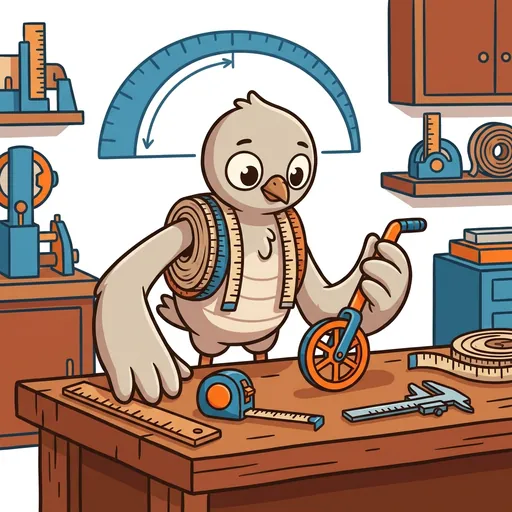
Rod
LINEAR MEASUREMENT — *1D extent. length, perimeter, distance. one number along a line.*
Listen along — Rod
Loading audio…
Press play to listen along. The line being read lights up as you go.
Show full transcript
Loading transcript…
Chapter 1 — Rod and the One Number Along a Line
The little wooden fence in Rod’s workshop was making a student furious.
He’d measured one plank with a ruler and gotten 9.5 centimeters. Then he’d tried to measure the whole fence with the same ruler, flipping it end over end, losing count somewhere around the fourteenth flip, and now the number in his notebook was almost certainly wrong and he knew it.
Rod padded over on his long skinny legs. He was a heron, tween-aged, a bit chunky in the middle, wearing a vest so covered in tape measures it clinked when he walked. He looked at the ruler, and then at the fence, the way you’d look at someone trying to eat soup with a fork.
“You’ve got the right craft and the wrong tool,” he said mildly. “That ruler is telling the truth about the plank and lying about the fence. Not its fault. You brought a fingernail-measurer to a fence-measuring job.” He tugged a long tape measure out of a vest pocket. “Length is just one number along a line. But the line here is longer than your ruler can honestly reach.”
Rod had grown up learning exactly how far a tool could honestly reach.
His village, MeasureQuest, sat by the sea, and his family were the village’s measurers — herons with long legs, which the village decided made them natural surveyors. They marked out foundations before a house went up. They pegged straight rows before the planting. They walked the boundary lines when two families argued about where one field stopped and the next began.
When Rod was small he’d watched his mother settle one of those arguments. Both families were shouting about a stretch of ground “about thirty steps” wide — except one man’s steps were long and one man’s were short, and thirty of one wasn’t thirty of the other. His mother didn’t shout. She unspooled a marked line, laid it flat, walked it heel to toe, and read off a single honest number that belonged to nobody’s legs. The shouting stopped.
“They weren’t lying to each other,” his mother told him after. “They were both measuring in a tool that only fit themselves. A real unit fits everybody the same.” Rod had held that: the number has to be true for anyone who checks it, or it isn’t a measurement — it’s an opinion.
He walked into MeasureQuest at twelve, tape measures already clinking in his vest. Yard, the old mentor, was mending a net by the wall and didn’t look up right away.
Instead of a quiz, Yard pointed his chin at three things: a coin on the wall, the length of the low wall itself, and the distance from the wall down to the shoreline. “Tell me how long each one is,” he said. “And tell me why you picked what you picked.”
Rod didn’t rush. He held his ruler to the coin — “small thing, small tool” — and read off the width. He stretched his tape along the wall, because a ruler flipped end over end would drift and lie. And for the shoreline he unhooked the trundle-wheel from his back and rolled it, click-click-click, counting the clicks. Three numbers, three tools, one honest answer each.
Yard finally looked up. “Most kids grab the smallest unit they own and feel precise,” he said. “You matched the tool to the line. Sit down. You’ve got the craft.”
Weeks later, Pip stood in front of that same little fence, notebook out, watching Rod work.
“Same fence,” Rod chirped, pleased, as if the fence were an old friend. He picked up the ruler and laid it against a single plank. “Watch me read it — I start at the zero mark, not the metal end, and I look straight down, not from the side. Side-eye bends the number.” He read it off. “Plank-width: nine and a half centimeters.”
He set the ruler down and drew out the tape, stretching it the full run of the fence, pinning the hook at one post and pulling taut. “Fence-length: twelve point three meters. Same craft — I’m still reading one number along one line. But a ruler flipped a dozen times drops crumbs of error at every flip. The tape does it in one honest pull.”
Then he unhooked the trundle-wheel and rolled it from the fence to his front step. Click. Click. Click. Pip counted along under her breath. “Fence-to-house: forty-seven and a half meters.”
“There,” Rod said. “Three tools. Not because I’m showing off. Because each one fits the length it’s telling the truth about.” He caught Pip reaching, out of habit, for the ruler to check the forty-seven meters, and he gently stopped her hoof. “Don’t. If you measure the walk to my house in millimeters, you’ll spend all day and the number won’t be any truer — just fussier. Match the precision to the job. The plank doesn’t need kilometers. The walk doesn’t need fingernails.”
Pip lowered the ruler slowly. “So being careful isn’t the same as being tiny.”
“Now you’ve got it,” Rod said. “Careful is picking on purpose. Tiny for tiny’s sake is just being scared of the number.”
Pip measured the fence-to-house distance again with the trundle-wheel, on her own, and got forty-seven and a half. The same number. Anybody who checked would get it too. She looked up, and there was a small settled feeling in her chest she couldn’t name.
Rod tucked the ruler back into his vest, and a warm, contented smile spread across his heron face. He didn’t lecture. He just breathed out, slow, the way he always did when a thing had been done right without hurry — like the whole world had quietly settled into the place it belonged. Somewhere in the memory of it, two men stopped shouting over a field.
“One number along a line,” he said softly. “Chosen on purpose, true for anyone. That’s the calm part. That’s the part worth slowing down for.”
The MeasureQuest ensemble
Rod is part of MeasureQuest's distributed-narrative cast. Each character embodies a different curricular primitive; together they teach the full subject.