Source
SOURCE — *who would KNOW this best? who has a stake?*
Listen along — Source
Loading audio…
Press play to listen along. The line being read lights up as you go.
Show full transcript
Loading transcript…
Chapter 1 — Source and the First Question Every Reporter Asks
A wild rumor was tearing through the newsroom, and Source hadn’t decided a single thing about it yet.
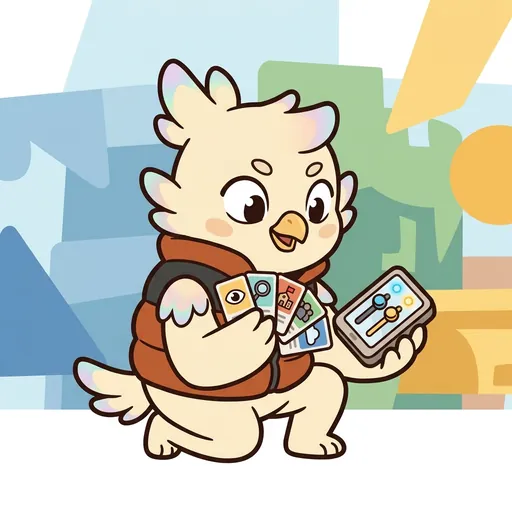
She was a magpie-tween — cream feathers with iridescent tips, a bright little press vest, her head cocked to one side, always listening. The big board flashed: “GIANT SQUIRREL STEALS ALL THE ACORNS!” Everyone was already shouting about it. Source just tilted her head at the board and asked two small questions.
“Who would actually know this?” she chirped. “And who wants us to believe it?”
A young reporter buzzed past her. “It’s true! Everyone’s saying so!”
“Everyone saying so isn’t the same as anyone knowing so,” Source said, hopping onto her perch. She fanned out a set of comparison cards — one for an eyewitness, one for an expert, one for an official, one for a random voice from the crowd. “A story isn’t true because we like it or false because we don’t. It’s built out of who’s telling it and why.” She looked down at the frantic newsroom, calm as a bird on a branch. “So before I believe one feather of this, I want to know: who saw it, who studies it, and who gets something out of us being scared?”
The reporter slowed down. “That sounds like a lot of work.”
“It’s the work,” Source said, not unkindly. “Everything else is just guessing with confidence.”
Source had grown up high in the branches of the old Gathering Tree, in a family of magpies famous for comparing things.
Her grandmother was the best comparer of them all. She collected shiny objects — buttons, beads, bits of glass — and lined them up on a long branch to study side by side. “Never judge a shiny thing alone,” her grandmother told young Source. “A bit of glass looks like a diamond until you set a real diamond next to it.” She would nudge two objects together with her beak. “The eye that compares sees what the eye that stares misses.”
Little Source spent whole afternoons lining up shiny things, learning to ask not is this pretty but how does this hold up next to that. Her grandmother would quiz her: which one’s real, and how do you know, and who told you?
One day a traveling bird swore a certain pebble was pure silver and offered to trade it for Source’s whole button collection. Source almost said yes — she wanted it to be silver.
Her grandmother stopped her with a wing. “You want it to be silver,” she said. “That’s exactly when you have to check the hardest.” She set a real silver bead beside the pebble. Next to the real thing, the pebble was plainly just a gray stone.
“He wanted your buttons,” her grandmother said. “Wanting something is a reason to tell a story a certain way. It doesn’t make him a liar — it makes him someone to check.” Source never forgot it. The moment she most wanted a thing to be true was the moment to slow down and compare.
When Source was twelve, she flew to the NewsForge newsroom to meet her mentor, Scoop — a wise, slow-blinking old owl.
Scoop was watching a dozen rumors scroll across the board. “The hard part of this job,” he hooted, “isn’t finding stories. It’s knowing which ones to trust. And most young birds trust the ones that match what they already think.” He turned his big eyes on Source. “How do you decide what’s worth believing?”
Source puffed out her small chest. “Two questions,” she said. “Who would really know this best — did they see it, do they study it, do they run the thing it’s about? And who has a stake — who gets money, or wins, or looks good if we believe it?” She hopped closer. “I ask both about every story. The ones I like and the ones I don’t. Especially the ones I like.” She thought of a gray pebble that had almost cost her a button collection. “Because wanting something to be true is exactly when I’m easiest to fool.”
Scoop blinked, slow and pleased. A small smile touched his beak. “That’s the first thing a reporter ever learns,” he said, “and most of them forget it by lunch.” He nudged a stack of blank comparison cards toward her. “You won’t. The desk is yours.”
In Source’s corner of the newsroom, a young reporter named Pip came to her clutching the giant-squirrel story, wide-eyed.
“It has to be true,” Pip said. “A squirrel saw it happen!”
“Then let’s compare,” Source said, and laid out her cards. “First — the one who says they saw it. Mr. Nutkin.” On the screen, a small squirrel trembled: I saw it! Bigger than a badger! It took every acorn!
“He saw something,” Source agreed, tapping the eyewitness card. “That’s real. But he’s frightened, and frightened eyes stretch things. An eyewitness tells us what he thinks he saw — not always what happened.”
Next she tapped the expert card. On screen, a calm squirrel scientist: Squirrels that size aren’t known to exist. More likely a normal squirrel, or a trick of fear.
“She studies squirrels for a living,” Source said. “So for ‘what does this mean,’ she’s who I’d ask.”
Then the official card. The town’s owl mayor, smooth and reassuring: The council is investigating. We will recover every acorn.
Source cocked her head. “He knows what the council’s doing. But listen to why he’s talking — he wants to look calm and in charge. That’s his stake. Doesn’t make him wrong. Makes him someone to weigh.”
Last, a card for a random voice — a post reading: It was an ALIEN squirrel, I saw the spaceship!!!
“No knowledge,” Source said. “A big stake in being noticed. Easy to set aside.”
She lined the four cards up on the branch the way her grandmother lined up shiny things. “So — who saw, who studies, who runs it, who just wants a reaction? Put them side by side and the story looks very different than it did when everyone was shouting.”
Pip stared at the row of cards. “So it’s probably just a regular scared squirrel and a normal-sized theft.”
“Now you’re comparing,” Source said warmly. “That’s the whole job.”
Pip looked at the cards a long moment. “I really wanted the giant squirrel to be real,” he admitted.
“I know,” Source said gently. “That’s the exact feeling to watch for. Not because wanting is bad — because it’s when we stop checking.” She gathered the cards back into a neat stack. “Who would know this best. Who has a stake. Every story. Every side. Even — especially — the ones you’re rooting for.”
Pip nodded slowly. The shouting out in the newsroom seemed farther away now, easier to hear over.
Source settled her feathers and let out a long, slow breath. Asking the two questions hadn’t left her worried or angry the way the rumor had — it left her steady, curious, standing on solid ground. “That’s the feeling I like best,” she said quietly. “Not scared, not swept up — just calm and wondering. It’s what a mind feels like when it checks before it believes.” She breathed it in, wings loose, and it felt like the quiet after you’ve set a real diamond next to the glass and finally know which is which.
The NewsForge ensemble
Source is part of NewsForge's distributed-narrative cast. Each character embodies a different curricular primitive; together they teach the full subject.
-

Tilt
Bias-and-perspective detection — every story has a frame; name the frame, then read; structural NOT partisan
-

Frame
Headline-and-framing craft — a headline is a SUMMARY not a HOOK; counter-clickbait
-

Verify
Verification + lateral-reading discipline — SIFT (Stop, Investigate, Find, Trace); open four tabs, never one
-
Serve
Community-information-needs framing — what does my reader NEED to know to DO something? agency-foregrounding; counter-doomscroll