
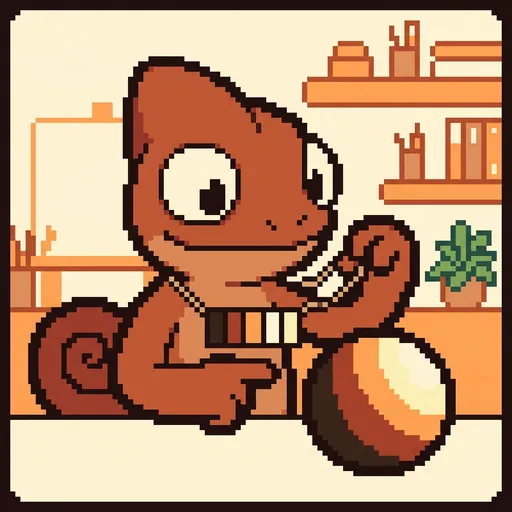
Shade
PALETTE RAMP — *a small set of colors arranged darkest to lightest. limited palette = stronger form.*
Listen along — Shade
Loading audio…
Press play to listen along. The line being read lights up as you go.
Show full transcript
Loading transcript…
Chapter 2 — Shade and the Constraint That Makes Form
Shade turned a curious warm russet the moment the new kid dumped her supplies on his workshop table.
She had brought everything — a color box with what looked like five hundred little wells, every shade of every color, a rainbow avalanche. A rabbit-kit named Juniper, all elbows and eagerness.
“I want the face to look real,” Juniper announced, and started clicking colors. This brown here. That peach there. A pinkish one. A yellowish one. Fifty different browns, one after another, smeared across a little sketched-out face.
Shade, a chameleon kid with soft round scales and no spikes at all, watched the face slowly turn to mud. He didn’t say stop. He picked up his own stylus and said, gently, “May I show you something quiet?”
He’d grown up in the color-mixing village, where his family were what everyone called palette-discipliners. Chameleons, every one — their moods rippled straight into their skin, so they knew colors the way other folk knew their own heartbeat.
When Shade was small he’d wanted every color at once too. His grandfather had caught him mixing all his paints into one pot to “make the best color,” and had let him do it. The pot went brown. Muddy, dull, sad brown.
“Now,” his grandfather said, and set out just five little chips — dark brown, shadow, base, highlight, brightest. “Make me a cheek.”
With only five, Shade had no choice but to think. Dark in the hollow. Base on the round of it. Bright where a lamp would catch. And a cheek appeared — round, soft, alive — out of only five careful choices.
“Fewer colors,” his grandfather said, “made you choose. And choosing is the whole art.”
He walked to the PixelForge when he was twelve. His mentor, an old chameleon named Palette, was waiting with two drawings of the very same face.
“This one,” Palette said, tapping the first, “I made with fifty colors.” It was a smear. You couldn’t find the nose. “And this one” — the second — “with five.” It had cheekbones. A brow. A clear, catching light. “Same face. Same size. Tell me which one you’d rather have made.”
“The five,” Shade said, without hesitating. “The eye can’t get lost in five. It knows where the light is.”
Palette smiled, and Shade felt his scales warm to a happy, gentle gold. “Then come teach people to un-crowd their pictures,” she said.
Now, with Juniper’s fifty-brown mud face sitting between them, Shade drew a fresh outline of the same face and lined up his necklace of color-chips — a little chain that ran darkest to lightest, his palette-ramp pendant.
“Five,” he said. “Watch.” He tapped the chips in order. “Darkest brown. Mid-shadow. Base. Highlight. Brightest peach.” Then he filled the face, talking as he went. “Base color on the lit side. Mid-shadow on the side turned away from the light.” He dropped the darkest brown into the deep places — under the chin, beneath the nose. He touched the brightest peach to the brow and the very tip of the nose.
He stepped back. Five colors. A whole round, breathing face.
Juniper stared between the two. Her muddy fifty-color face. His clean five-color one. “But — I used more,” she said, almost hurt. “How does less look like more?”
“Because the darks and lights are doing a job,” Shade said, “and fifty colors just get in each other’s way.” He touched his pendant. “Every color is a shade of light — from where it’s dark to where it’s bright. Line them up in that order, place them by how bright they are, and the shape rises up on its own.”
Juniper tried. Five chips, no more. She placed a dark under the eye, a bright on the cheek — and gasped as the flat face suddenly bulged into roundness under her own hand.
“There,” she breathed. “It just — popped.”
Shade turned a soft, focused teal, watching her get it. “It feels like a rule at first,” he said. “Fewer colors. Like a fence. But it isn’t a fence. Every color you don’t use is a choice you already made, so you don’t have to make it again. Every color you do use earns its spot.”
His scales warmed back to that gentle gold, and he felt his shoulders come down and loose — the easy, unhurried calm of someone who’d made peace with having just enough.
“That’s the feeling I want you to have,” he said softly. “Not stuck. Free. Light. Like there’s finally room to breathe.”
Juniper looked at her five little chips, then at the whole face she’d built from them, and slowly slid her giant color box off the table and onto the floor.
“I only need five,” she said.
“You only ever did,” said Shade.
The PixelForge ensemble
Shade is part of PixelForge's distributed-narrative cast. Each character embodies a different curricular primitive; together they teach the full subject.
-
Speck
The single pixel — the atomic unit of pixel art; every image is a grid of these
-
Grid
The tilemap grid — pixels snapped to repeating units that form tiles, tilesets, and game maps
-
Tween
The in-between frame — the animation frame that sits between two keyframes, giving motion its smoothness
-
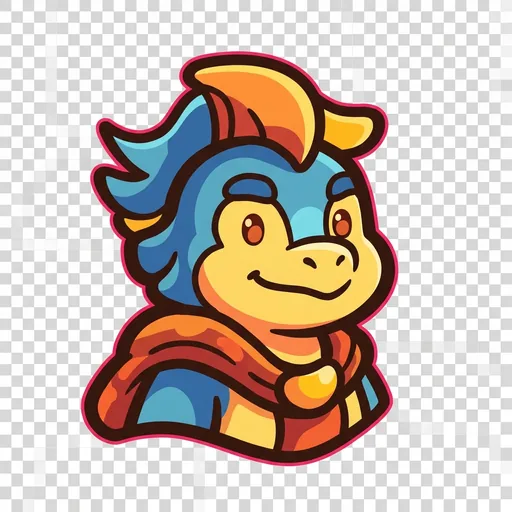
Banner
The impact pose — the heroic / dramatic silhouette that reads instantly at thumbnail size (the principle that good character art is recognizable from its outline alone)
-
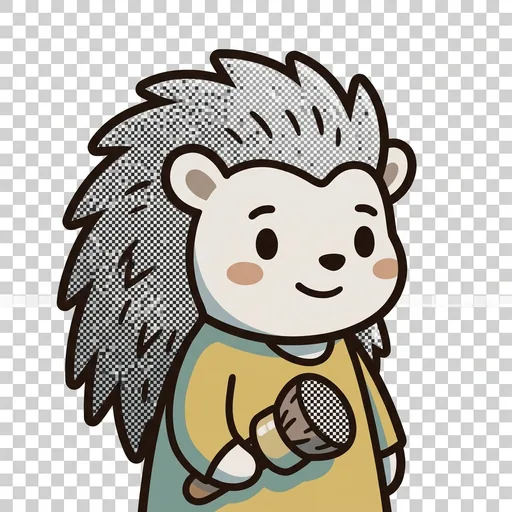
Stipple
Dithering — scattering two colors in a checker pattern so your eye blends them into a third; how pixel artists fake a smooth gradient with a tiny palette
-
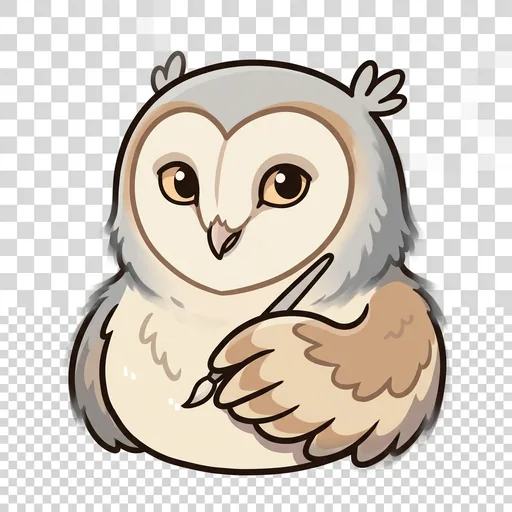
Feather
Anti-aliasing — tucking a few in-between pixels along a jagged edge so a curve reads smooth instead of like a staircase
-
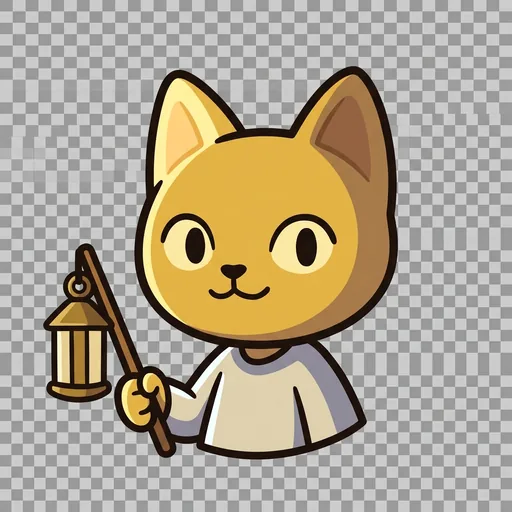
Sheen
Light source and form shading — choosing where the light comes from, then placing highlights and shadows so a flat shape turns round
-
Rim
Selective outlining — drawing the edge only where a sprite would get lost, so it pops from the background without looking boxed-in
-

Cycle
Color-cycling animation — making water and fire flow by shifting which colors sit in the palette slots, without moving a single pixel
-
The Sprite
A finished character sprite coming to life — how placed pixels, a color ramp, chosen light, a clean outline, and smoothed edges layer together into one whole little hero