
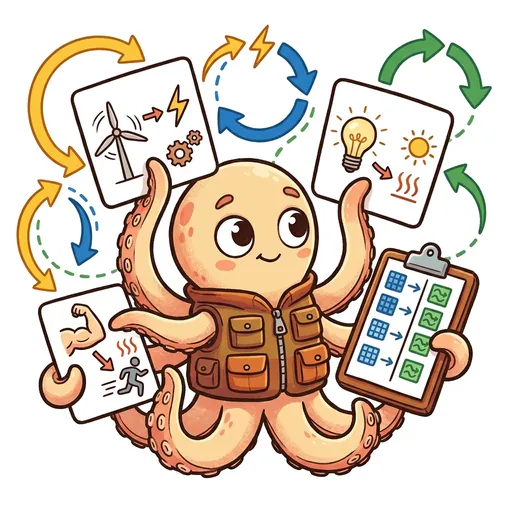
Trade
TRADE — *one form becomes another. nothing made; nothing lost.*
Listen along — Trade
Loading audio…
Press play to listen along. The line being read lights up as you go.
Show full transcript
Loading transcript…
Chapter 3 — Trade and the Conversion of Energy
The hand-crank squeaked under Trade’s grip, and the little bulb wired to it bloomed gold.
Trade was a small octopus, and right now three of his arms were cranking while a fourth held the bulb up to his eye. His chunky pocket-vest slid sideways off one shoulder. He didn’t fix it. He was too busy watching the coil of wire spin a magnet, and the magnet wake the wire, and the wire push a shiver of brightness out into the glass.
“There you are,” he breathed, as if greeting a friend who’d arrived by a strange road.
He let the crank slow. The bulb dimmed to an ember, then to nothing. But Trade wasn’t fooled by the dark. He pressed the button on the small tally counter clipped to his vest — click — and his coral spots flickered a satisfied orange. The light hadn’t ended. It had simply gone somewhere he couldn’t yet follow: into the warm air near his arm, into the faint heat still in the wire. Movement had become brightness had become warmth, and not one crumb of it had been thrown away.
Trade had learned to watch for that the way other kids learned to whistle — near the deep shelves, from his own family.
They were shape-shifters, all of them, the whole octopus household. When his aunt was startled she went from smooth to pebbled skin in a blink. When his cousin hid, he poured his whole shape into a jar-sized gap and back out again. Nobody in the family thought anything vanished when a color left them; the color had only turned into a different color, the shape into a different shape.
His grandmother taught him the family saying while they hunted for shells one grey morning. She caught a scuttling crab, and the crab’s frantic movement went still in her arms, and the stillness would later become a warm afternoon of the two of them.
“Little one,” she said, spreading an arm the color of dawn, “a body has many forms. So does the world. The whole trick of living cleverly is knowing how one turns into the next.” Trade never forgot it. He carried it up out of the deep like a shell he meant to keep.
When he was twelve he brought that shell to PowerForge, and it nearly slipped through his arms.
The workshop was enormous and clanging, all belts and dynamos and the smell of hot copper. At its center hunched Volt, an old mentor grown half of gears, watching Trade with two bright, patient eyes.
Volt said nothing for a long moment. Then he reached out one wire-wound arm and, quite deliberately, blew out the candle burning on his workbench.
“Gone?” Volt asked.
Trade’s arms went still — every last one of them, which for Trade was rare. He looked at the thread of smoke curling up, and the warmth spreading off the wick, and the smell reaching his nose.
“Not gone,” Trade said slowly. “It became smoke. And heat. And a smell I can follow.” He pointed a hesitant arm-tip at the rising curl. “One form became another. Nothing was made. Nothing was lost.”
A small spark jumped between two of Volt’s gears — a smile. “Then you belong here,” the old mentor said, and Trade felt the shell settle safely back into place.
His own workshop, once he had one, became the loudest happy place in PowerForge.
“Watch,” he told a knot of students one afternoon, and cranked the hand-generator until his breakfast — the clams from that morning — became the flex of his arms, became the spin of the crank, became a jolt down the wire, became a bulb glowing warm in his palm. He held it up, counting on his arm-tips.
“Food to movement, movement to electricity, electricity to light — and heat, feel it — that’s four turns of the same energy, and every scrap is still here.”
A girl at the front frowned. “But when my flashlight dies, the energy’s used up. It’s finished.”
Trade’s spots dimmed, not with disappointment but with the careful gentleness he saved for exactly this. He unclipped a spent battery from a drawer and set it in her hand.
“Try it,” he said softly. “Not used up. Try where did it go.”
She turned the little battery over. ”…It made light. And the flashlight got warm. And it glowed for hours.” Her frown loosened. “So the light went out into the room. And the warmth went into the flashlight.”
“And the room is a hair warmer for it, forever,” Trade said, and his coral spots came up pink. “Some of it turned to light you wanted. Some turned to heat you didn’t ask for. But the total that came out equals exactly what went in. It always does. Every machine you’ll ever meet just swaps one form for another — and none of them can cheat that.”
The students drifted out, and Trade stayed to crank the little generator one more time, alone, just to watch the bulb wake.
Movement became brightness became warmth became the faint, ordinary heat of a room at dusk. He followed each turn with his eyes and let the tally click once more.
He thought of the girl’s face loosening — the moment used up turned into where did it go — and something in his chest changed form too: a worry becoming a quiet, spreading gladness, the kind that made all eight arms feel light. Nothing she’d learned was lost, either. It had only moved into her, and would surface again someday when her own flashlight went dim and she smiled instead of sighing.
The bulb faded. Trade watched the dark and felt, warm and sure and glad all through him, that the light hadn’t left at all.
The PowerForge ensemble
Trade is part of PowerForge's distributed-narrative cast. Each character embodies a different curricular primitive; together they teach the full subject.