
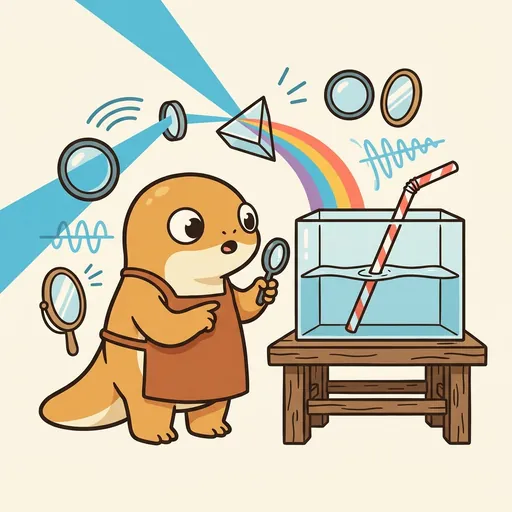
Bend
REFRACTION — *light slows in denser media — and slowing means bending. that's why a straw looks broken in water.*
Listen along — Bend
Loading audio…
Press play to listen along. The line being read lights up as you go.
Show full transcript
Loading transcript…
Chapter 2 — Bend and the Straw That Looks Broken
The tank on Bend’s workbench was clear glass, half-full of water, and a striped straw leaned into it. Bend — a small mudpuppy salamander, chunky and warm amber with a cream belly, not slimy at all — crouched so his eyes were level with the waterline.
“Watch this,” he said, mostly to himself, and tilted his head.
Above the water, the straw was straight. Below it, the straw hung a fingerwidth to the left, as if someone had snapped it at the surface and nudged the bottom half over. Bend grinned at the little jolt in his chest — the same jolt every single time. He reached in and pulled the straw out. Straight. Whole. He dropped it back. Broken again.
“You’re not broken,” he told the straw. “I know exactly what you’re doing.”
He had known since he was very small, in the cave-stream village where his family had always been the water-watchers. They hunted underwater, and a mudpuppy who trusted his eyes underwater went hungry.
His grandmother taught him at the edge of the black pool. She dropped a pale stone and pointed at it. “Grab it,” she said.
Bend plunged his hand where the stone looked to be. His fingers closed on nothing. The stone sat deeper, and off to the side.
“The water lies?” he asked, shaking off the cold.
“No,” she said. “The water is honest. It just slows the light down, and slow light turns. Your eyes follow the light back in a straight line, so they draw the stone where it never was.” She made him grab a hundred stones that day, until his hand learned to aim past the lie. “Slowing means bending,” she said. “Learn that, and the water can’t fool you.”
He walked to PrismForge when he was twelve, dripping and certain, carrying his grandmother’s glass tank wrapped in cloth. Optic, the head of the school, met him at the gate and asked one thing.
“Show me why the straw looks broken.”
Bend didn’t answer with words. He filled the tank, leaned the straw in, and turned it so Optic stood at the waterline. Optic watched the straw snap and shift.
“Light travels fastest in air,” Bend said, “slower in water, slower still in glass. When it crosses into the water at an angle, the near edge of the beam slows before the far edge, so the whole beam pivots. My eye follows it back in a straight line and paints the straw where the light seems to start.” He shrugged. “The straw’s fine. The light took a turn.”
Optic looked a long moment at the boy who’d explained refraction with a stick and a fishtank. “Come in,” he said.
His workshop filled fast on lesson days. Today a knot of students crowded the tank while Bend set a small red laser on a stand.
“Everyone see the straw bend?” he asked. Nods. “Good. Now stop trusting your eyes and trust this.” He clicked the laser on and aimed the thin red line down at the water’s surface, at a slant.
The beam hit the water — and kinked. It travelled straight through the air, bent sharply at the surface, then travelled straight again beneath, angled closer to straight-down than before.
A girl near the front breathed out. “It turned.”
“It slowed, so it turned,” Bend said. “Same thing that happens to the light coming off the straw.” He slid a card behind the tank so they could trace both lines. “Steeper into thicker stuff, more bending. That’s the whole trick behind fish looking shallow, pools looking closer to the bottom than they are, even sunsets going squashed and red as light crawls through thick low air.”
He let the laser rest and looked at them. “The straw isn’t broken. The light is. Once you know it’s bending, you can aim past where things look — and grab the stone every time.”
The students drifted out. One boy stayed, still staring into the tank at the little broken straw.
“It bugged me for years,” he admitted. “It felt like my eyes were lying to me.”
Bend sat down beside him. “It bugged me too. I used to feel it right here” — he tapped his chest — “this squirm, like the world couldn’t be trusted.”
“And now?”
Bend watched the straw hang there, split and calm. The squirm was gone; something steadier had grown in its place — not the thrill of a trick, but the quiet relief of a friend who’d finally explained themselves. “Now it feels like the water was never trying to fool me,” he said. “It was just being water. And I finally understand it.” He smiled, and the boy felt his own knot loosen and settle warm.
The PrismForge ensemble
Bend is part of PrismForge's distributed-narrative cast. Each character embodies a different curricular primitive; together they teach the full subject.