
Whole
WHOLE — *beginning. middle. end. the parts make ONE thing.*
Listen along — Whole
Loading audio…
Press play to listen along. The line being read lights up as you go.
Show full transcript
Loading transcript…
Chapter 6 — Whole and the Beginning-Middle-End
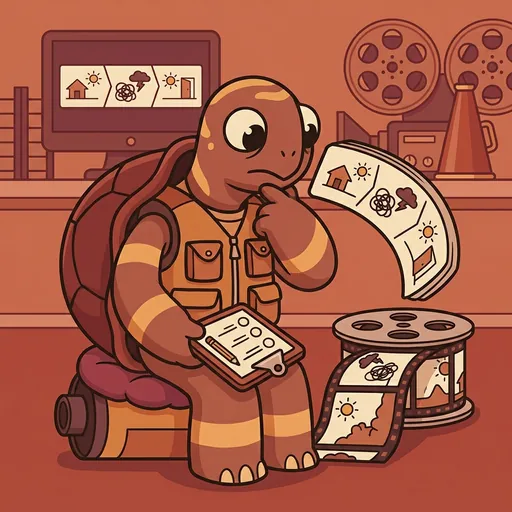
Whole moved slowly, like a careful tortoise crossing a wide road. He wore a warm brown director’s vest with soft yellow stripes, and he carried a single index card with three boxes drawn on it. Beginning. Middle. End.
On the floor of the edit room lay forty little cards, one for every scene the team had shot. Whole crouched down and started sliding them into a line. He put the card marked “the world, before anything goes wrong” on the far left. He put “everything falls apart” in the middle. He put “the fix, or the new thing” on the right.
Then he stood back and looked at the whole line at once, squinting, the way you look at a bridge to see if it will hold.
“There,” he said softly. “Now it’s one thing, not forty things.”
Snip peered over his shoulder. “It was already one thing. It’s our movie.”
“It was forty good pieces,” Whole said. He tapped the left card, then the middle, then the right. “Pieces only become a story when they lean on each other in order. Watch.” He pulled one card out of the middle. The line sagged in his imagination like a rope with a knot cut. He slid it back. It held again.
Whole had learned this the slow way, years before, with a shoebox of photos.
His grandmother had died, and the family gave him a box — hundreds of loose pictures, no order, spilling everywhere. Everyone said, “Make us an album.” So little Whole spread every photo across the kitchen floor and tried to pick the best ones. He picked the prettiest. He glued them in.
When his aunt opened the album, she frowned. “Why does the wedding come after the funeral? Why is the baby picture last?”
Whole looked at his beautiful, jumbled pages and felt his stomach drop. Every single photo was good. And together they meant nothing. They were just a pile that happened to be stuck to paper.
So he peeled them all off. It took a whole afternoon. Then he laid them out again — but this time in the order things had happened. Born. Grew up. Married. Grew old. Gone, but remembered. When his aunt opened the second album, she went quiet, and then she cried the good kind of tears.
That was the day Whole understood: the order of the parts is what carries the feeling.
Whole arrived at the reelforge academy the way he did everything — last, and calm about it. The other five were already there. Slate, their teacher, asked each newcomer to show what they could do.
Whole didn’t pull out a camera or a light. He walked to the wall where the team had pinned up thirty scene cards in the order they’d filmed them — which was no order at all, just whatever day they’d shot each one.
He took them all down. The room went nervous. Then, without hurrying, he pinned them back up in a new line, left to right, and read them aloud like a single sentence.
“A kid finds a stray dog,” he read from the left. He moved to the center. “The dog gets lost.” He reached the right end. “The kid finds it again — but now they’re not the same kid.”
Slate raised an eyebrow. “You didn’t shoot a thing.”
“I don’t shoot,” Whole said. “I put the shot things in the order that makes them mean something.” He gestured at the wall. “Same thirty cards you already had. Now they’re a story with a shape.”
Slate nodded slowly. “That’s the last chair we needed filled.”
Their first finished film sat on the screen, glowing. The team crowded into the edit room to watch it back, proud and tired.
Whole paused it on shot twelve.
“This one,” he said. On screen, the main character walked down a long hallway. The light was gorgeous. The camera glided. “Snip, this is the most beautiful thing we shot.”
Snip beamed. “It took us an hour to get.”
“I know.” Whole slid three scene cards out of his line and laid them on the desk. “Watch what it’s between.” He tapped the first card. “Before this, they’re in the kitchen.” He tapped the third. “After this, they’re back in the kitchen.” He tapped the beautiful middle card. “So this walk starts nowhere and ends nowhere. The story doesn’t move an inch while it plays.”
“But it’s beautiful,” Snip said, quieter now.
“It is.” Whole didn’t argue. He picked up the middle card, held it a moment, then set it aside off the line. The remaining two cards slid together. The kitchen led straight into the kitchen — the story tightened like a belt. “A shot that only looks good is a photo,” he said gently. “A shot that carries the story into the next one is film.”
Snip stared at the two cards touching. Then she reached over and, with her own hand, moved the beautiful hallway card into the “cut” pile.
They watched the film again with the hallway gone. It was ninety seconds shorter and it felt twice as fast — and somehow the ending landed harder than before, like a door clicking shut instead of drifting.
Nobody spoke for a second. Then the room let out a breath all at once, the kind you don’t notice you were holding.
Slate broke the quiet from the back. “That’s the hardest part of the whole craft,” he said. “Loving something and letting it go so the bigger thing can breathe.”
Snip wiped one eye and pretended it was dust. “I hated that,” she admitted. “And I’m — I don’t know. Proud? It’s weird. I feel lighter.”
Whole gathered his scene cards into one neat stack, beginning on top, end on the bottom, and squared the edges against his palm.
“That lighter feeling,” he said, looking around at the six of them — Draft, Aim, Bright, Buzz, Snip, and himself, one line of friends who each held a different piece — “that’s the feeling of it finally being one thing. Not six skills. Not forty pieces. One.”
He held the stack up so they could all see it: a single small block, everything in order, nothing loose.
“Any of you could make this,” he said. “A phone camera. An editing app. A pad to plan on. That’s all it ever took.” He tucked the stack into his brown vest, over his heart, where it fit exactly. “The parts were always yours. Today you felt them become whole.”
And for a long, warm moment, none of them wanted to leave the little glowing room.
The ReelForge ensemble
Whole is part of ReelForge's distributed-narrative cast. Each character embodies a different curricular primitive; together they teach the full subject.
-
Draft
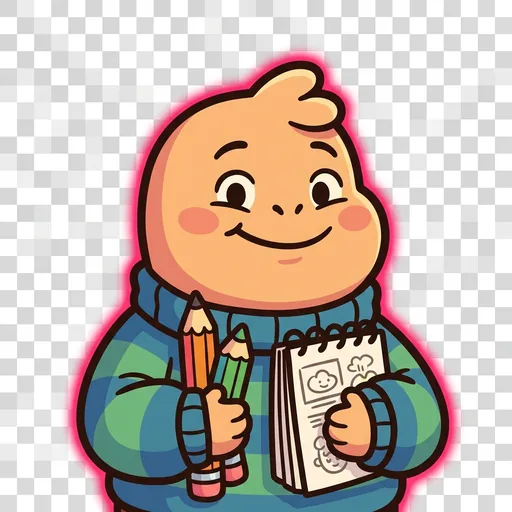
Storyboarding — pre-visualization; 'Draw it first. Then film it.'
-

Aim
Camera angles + framing — 'Where the camera stands changes the story.'
-

Bright
Lighting design — 'Three lights. Different feelings.'
-

Buzz
Sound design — foley + ambient + dialogue — 'Sound is the other half.'
-

Snip
Editing — timeline + transitions + pacing — 'Cut here. Not there.'