Synth
SYNTHESIS — *combining evidence across multiple sources; finding agreement, disagreement, gaps.* The research-method primitive of *building understanding from multiple sources, not summarizing one source at a time.*
Listen along — Synth
Loading audio…
Press play to listen along. The line being read lights up as you go.
Show full transcript
Loading transcript…
Chapter 4 — Synth and the Multi-Thread Weaving-Frame
The threads were fighting again.
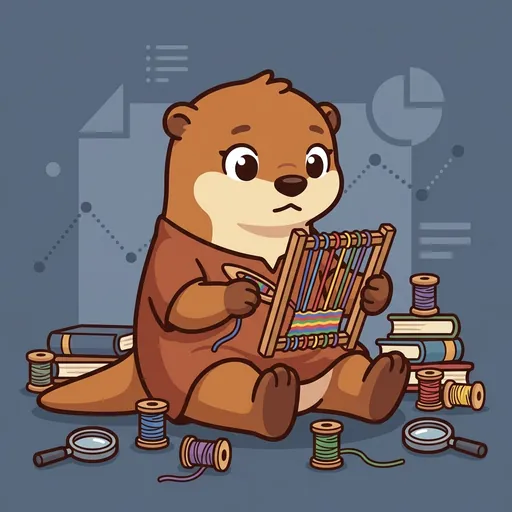
Synth sat cross-legged on the reading-room floor, her little hand-loom balanced on her knees, and three colored threads dangled from it, refusing to line up. The blue thread said otters ate fish. The green thread said otters were mostly playing, not eating. The amber thread said nobody had watched otters in winter at all. A sleek brown otter-tween with cream fur and quick eyes, Synth chewed her lip, then began to weave — over the blue, under the green, catching the amber at the edge.
“See,” she murmured to the empty room, “you don’t pick one. You cross them.” Over, under, catch. Where blue and green touched, the cloth glowed a little — agreement. Where they pulled apart, she left a deliberate gap and marked it with the amber. By the time the light shifted, she had a small square of fabric that no single thread could have made. She held it up. It was warm. It was hers.
She had learned the crossing before she learned to read.
Synth grew up by the Whispering River, in a family of weavers so old the village couldn’t remember a time without them. Her mother would sit her down with a tangle of mismatched fibers — river-reed, sheep-wool, a scrap of someone’s old net — and say nothing, just weave, letting Synth watch her paws.
“That one’s ugly,” six-year-old Synth complained once, pointing at a lump of gray fiber. “It doesn’t match anything.”
“On its own, no,” her mother said. She kept weaving. She pulled the gray up against a warm red, then a river-blue, crossing them so the gray sat between. When she finished the row, the gray had disappeared into something that looked, impossibly, like firelight. “A thread on its own is just a thread. Cross it with the others and it stops being itself. It becomes the cloth.”
Synth stared at the row for a long time. Something clicked shut in her, gently, like a latch. A single thread was weak. Many threads, crossed right, made a blanket you could sleep under. She never forgot the feeling of watching the gray fiber turn to firelight.
Years later she walked into the great ResearchQuest hall carrying that same loom, and the Scholar behind the enormous desk looked at it, then at her.
“Combine these for me,” he said, and slid three books across the desk. “Tell me what they say — together.”
Most visitors, Synth knew, would have picked up the books one at a time and reported each in turn. She didn’t. She opened all three at once, spread them across the desk like threads on a frame, and ran a paw between them.
“This one and this one agree,” she said, laying two fingers side by side. “Otters are clever with their paws — both saw it. So I trust that; two eyes, same picture.” She moved to the third. “But this one says otters are shy, and the others call them bold. They watched at different times of year, look — so they’re not really fighting, they’re seeing different seasons.” Then she paused, and tapped the empty desk between the books. “And none of them watched winter. That hole — that’s mine to fill.”
The Scholar was quiet a moment. “You organized it by the idea,” he said. “Not by the book.”
“The book’s just where a thread comes from,” Synth said. “The cloth is the idea.”
He smiled and welcomed her in.
Her workshop at the academy smelled of river-reed and ink. A student named Wren came in one afternoon looking wrung-out, dragging four books and a page of notes.
“I read all of them,” Wren said miserably. “I wrote what each one says. Book A says the volcano was loud. Book B says it was fast. Book C says the town got warning. Book D says nobody warned them. It’s just — a list. It’s boring and it doesn’t say anything.”
Synth set her loom on the table and handed Wren a fistful of colored threads. “Give the loud-and-fast ones a thread each,” she said. Wren tied on a red and an orange. “Now — do they fight, or do they fit?”
Wren frowned. “They fit. Loud and fast. Same picture.”
“Cross them, then.” Synth guided Wren’s paws — over the red, under the orange. Where they met, the weave tightened. “That’s agreement. You don’t report them one at a time. You say the eruption was sudden and violent, and you point at both threads at once.”
“But C and D fight,” Wren said. “Warning, no warning.”
“Do they, though? Or did they ask different people?” Synth left a small gap in the weave and knotted the two disagreeing threads on either side of it, facing each other. “Show the clash. Don’t pretend it away, and don’t just count — three books beat one book is a lazy trick. Ask why each one saw what it saw. The clash is interesting. Weave it in on purpose.”
Wren worked in silence, crossing threads, leaving the gap. Slowly a small rough cloth took shape — loud-and-fast twisted tight, warning-and-no-warning held apart with a clean space between them.
“There’s a hole here,” Wren said, touching the gap. “Nobody said what the townspeople actually did.”
“Then that hole is yours.” Synth’s eyes went bright. “That’s the part you add. That’s not a mistake in your cloth. That’s the reason you’re weaving.”
Wren left with the little rough square clutched to her chest, and Synth sat alone in the reed-smelling quiet, listening to her go.
She picked up her own loom, felt the first threads of a new cloth waiting, and didn’t start weaving yet. She was thinking about the moment Wren’s shoulders had come down — how the girl had walked in knotted and tangled and walked out holding something whole, something warm, something that had been four separate books an hour ago and was now, unmistakably, hers.
A soft glow spread through Synth’s chest, slow and steady, better than any finished blanket. That loosening in someone else — the tangle coming untangled, the scatter pulling together — that was the thing she loved most. She smiled at nobody, and the threads on her frame caught the last of the light.
The ResearchQuest ensemble
Synth is part of ResearchQuest's distributed-narrative cast. Each character embodies a different curricular primitive; together they teach the full subject.
-
Wonder
Question-formulation — narrowing vague interest into focused, answerable research questions
-

Vet
Source-evaluation — CRAAP test (Currency, Relevance, Authority, Accuracy, Purpose)
-

Quote
Note-taking — quoting + paraphrasing + summarizing; keeping voices separate
-

Tether
Citation — attribution + bibliography; gratitude + map back to sources
-

Survey
Background reading — read around a topic to learn the lay of the land before narrowing (W.7)
-
Trawl
Search strategy — cast a wide net of keywords, then pull it tight; refine when it comes back wrong (W.8)
-

Crosscut
Lateral reading / corroboration — don't trust one page; cross-check a claim across independent sources
-
Verdict
Forming a thesis — gather the evidence, then take a stand; 'here's what I think, and here's why' (W.1)
-
Wellspring
Primary vs secondary sources — trace a claim upstream to its original, firsthand source