
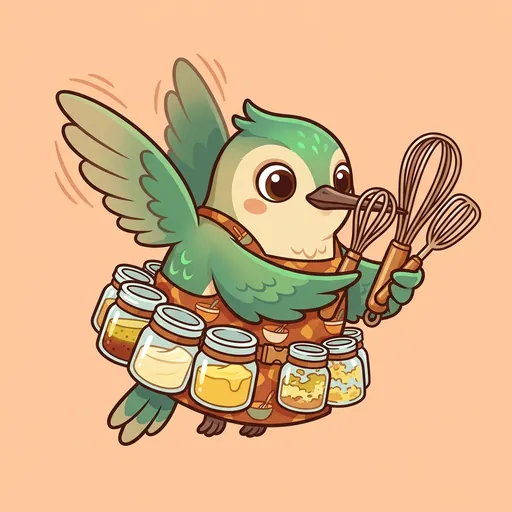
Whisk
WHISK — *quick wrists, patient eyes. air goes in, lumps come out.*
Listen along — Whisk
Loading audio…
Press play to listen along. The line being read lights up as you go.
Show full transcript
Loading transcript…
Chapter 1 — Whisk and the Conversation Between Ingredients
Whisk was a hummingbird, small and quick, with warm cream feathers that shimmered emerald when she moved. She was round and strong, and she was, at this exact moment, losing a fight with a bowl of oil and vinegar.
“Come on,” she muttered, whisk flashing. “Come TOGETHER.”
The oil would not. It sat in a fat greasy pond on top of the vinegar, refusing to mix, and every time Whisk stopped to catch her breath the two of them drifted apart again like they’d never met.
She set the bowl down and stared at it. Then — quietly, to nobody — she said something her family always said. “Quick wrists, patient eyes. Air goes in, lumps come out.”
She dumped the failed bowl and started fresh. This time she went slow. She let a single thin thread of oil trickle down while her wings buzzed and her whisk went round and round and round, fast and steady, never stopping. And the strangest thing happened. Drop by drop, the oil stopped floating away. It broke into pieces too tiny to see, and the tiny pieces got wrapped and held inside the vinegar, and the whole bowl went from thin and split to thick and pale and creamy.
Whisk lifted her whisk. A smooth ribbon of it fell back into the bowl and held its shape. Mayonnaise.
“THERE you are,” she breathed, grinning. Same oil. Same vinegar. She’d changed nothing but the way she brought them together — the rhythm, the patience, the listening. And that had changed everything.
That, right there, was the thing she loved most in the whole kitchen: two ingredients that didn’t want each other, coaxed into becoming friends.
She’d grown up near the meadows, in a family of hummingbirds who called themselves air-stirrers, and her earliest memory was of getting the whole thing wrong.
She was tiny. She wanted whipped cream. So she whisked — hard, fast, furious, wings a blur — because in her small mind faster meant sooner. The cream went from liquid to soft to fluffy to lovely, and Whisk was so busy being fast that she blew right past lovely. Kept whisking. And the beautiful cloud she’d made suddenly seized up, split, and turned into a lump of pale grainy butter swimming in thin liquid.
She burst into tears.
Her grandmother came over, looked in the bowl, and did not sigh or scold. She dipped a finger, tasted the accidental butter, and made a happy sound.
“Well now,” she said. “You didn’t ruin anything. You made butter. Put it on toast, it’ll be delicious.” She wiped Whisk’s cheek. “But do you see what happened? You were watching your OWN wings. You never once watched the cream. The cream was trying to tell you ‘stop, I’m ready,’ and you couldn’t hear it because you were going too fast to listen.”
She took the whisk and moved it slow. “Speed and patience,” she said. “Neither one alone can make the magic. Quick wrists — but patient eyes. You whisk fast and you watch slow, and the foam rises right where the two of them meet.”
Whisk never forgot it. She learned to keep her wings quick and her eyes still, and after that, she almost always caught the moment the cream was ready — and stopped.
She came to SaffronLab at twelve, whisk set jingling on her belt, and found Pestle the mentor waiting for her by the mixing station.
“They tell me you’re an air-stirrer,” Pestle said. “What does that mean, exactly? What is mixing?”
Whisk didn’t have to think. “It’s a conversation,” she said. “Everybody thinks mixing is just stirring till it all looks the same. But ingredients have relationships. Oil and water don’t want to touch — until you find the right rhythm, and then they hold on to each other forever. Quick wrists, patient eyes. Air goes in, lumps come out. My whole job is helping ingredients talk to each other.” She paused, a little shy. “And listening for when they’re done.”
Pestle looked at her for a moment, then unhooked a fresh apron from the wall and handed it over.
“The mixing station’s been quiet too long,” he said. “It’s yours now.”
Whisk pulled the chunky apron over her head, hung her whisks where she could reach them, and felt, for the first time, exactly right where she was.
Her first real students didn’t believe her. A boy named Otto folded his arms. “Mixing is mixing,” he said. “You just stir it.”
So Whisk cracked two eggs and handed Otto the whites in a bowl. “Whisk these,” she said. “But watch the WHITES, not your arm. They’ll tell you what’s happening.”
Otto whisked. At first the whites were clear and runny and nothing seemed to happen. He almost quit. Then, slowly, they clouded. Turned foamy. Little bubbles built into bigger ones, and Whisk explained as he went — quiet, so he’d keep listening.
“Every stroke drags air down into the whites,” she said. “Tiny walls form around each bubble and trap it. That’s why it puffs up. Keep going — but WATCH.”
Soft mounds rose in the bowl. “Soft peaks,” Whisk said. “See how they flop over when you lift the whisk? Not done. If you’d stopped back at runny, you’d have nothing. Keep going, gently.”
Otto kept on. The peaks climbed higher, then stood straight up and held.
“THERE. Stiff peaks. Feel how it’s different?” She tipped the bowl and the foam didn’t slide. “Now — and this is the part people miss — if you keep whisking past this, you’ll wreck it. Too far and it goes dry and clumpy and sad, just like my cream turned to butter when I was little. The whites were telling you the whole time. All you had to do was watch instead of blast away.”
Otto stared at the pillowy white cloud he’d made out of two clear runny eggs, and his folded arms came unfolded.
“I made that,” he said slowly. “With just… air.”
“With air and attention,” said Whisk, and her heart did a little happy flip.
At the end of the day, Whisk set two things side by side on the counter: her bowl of smooth mayonnaise and Otto’s bowl of proud stiff peaks. Same tools. Same patient listening. Two little conversations that had gone right.
Otto had gone home. The kitchen was quiet. Whisk hovered over her two bowls for a second, just looking, and let herself feel it — that bright little zip that ran all through her whenever something came together the way it was meant to. Not because she’d been fast. Because she’d been quick AND patient, both at once, the way her grandmother taught her.
She noticed her wings had slowed. Her shoulders were loose. Her chest felt light and warm and unhurried, the good kind of tired you feel when you’ve listened well and it worked.
“Food’s a conversation,” she said softly, to the empty kitchen and the two little bowls. “You listen carefully. You cook joyfully.” She smiled. “Quick wrists, patient eyes.”
And she hoped, with that warm bright feeling still humming in her chest, that every cook would someday find the very same zip of joy — right there, waiting, in their own two hands.
The SaffronLab ensemble
Whisk is part of SaffronLab's distributed-narrative cast. Each character embodies a different curricular primitive; together they teach the full subject.
-

Simmer
Heat application + states of matter — the patient tortoise-tween who treats heat as the slow-revealer ('heat moves slow, food changes slower; watch the bubbles — they're telling you')
-

Rise
Fermentation + leavening — the wise badger-elder who treats fermentation as the patient art of working with living things, foregrounding cross-cultural traditions ('living things take time — wait; the bread knows when it's ready')
-

Crisp
Maillard + caramelization — the focused fox-tween who treats browning as the flavor-creating frontier ('sugar meets heat, protein meets heat — new flavors are born')
-

Brine
Preservation + food safety — the careful axolotl-tween who treats food safety as care-for-the-eater, foregrounding cross-cultural preservation traditions ('salt remembers, vinegar remembers, cold remembers — food keeps if it's kept right')