
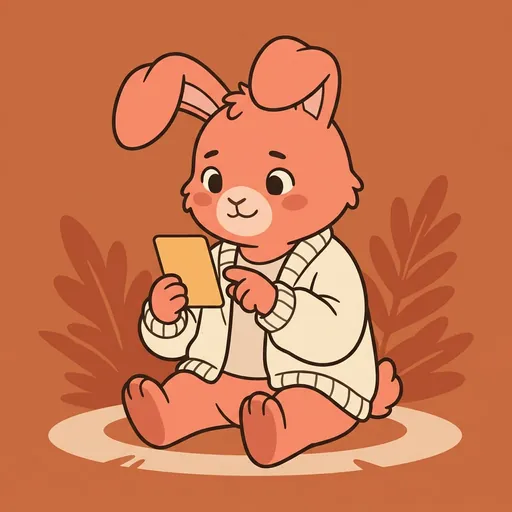
Pick
NOTICING SELF — the move of *picking* an affect-card that approximates *what you are feeling today.* The card-picking is *a thinking-pause* — a small deliberate moment of self-noticing, treated as the work itself.
Listen along — Pick
Loading audio…
Press play to listen along. The line being read lights up as you go.
Show full transcript
Loading transcript…
Chapter 1 — Pick and the Held-Up Card
Pick sat on the classroom floor with a small stack of cards fanned across her lap, and she was in no hurry at all. She was a soft warm-coral rabbit in a chunky cream cardigan, and her ears were relaxed, not tense. In one paw she held a single card up to the light. On it was one plain word: okay. She tapped the corner of the card with her other paw, thinking. She turned it over, looked at another — tired — then a third — curious — and set them gently down beside her.
“There’s no clock on this,” she said to no one in particular, because the room was still empty and the morning light was still slanting low through the tall windows. “You just pause. You look. You pick the one that’s closest to how the day actually feels.”
She held up curious again. Then she paused — one breath, then another — and something in her shoulders let go by a fraction. She chose it. Not because it was the right card. There was no right card. She chose it because, this morning, in her body, curious was the nearest thing to true.
That was the whole of what she did. She picked. The picking was a thinking-pause, a small deliberate moment where a person stopped and noticed what they were feeling and named it, roughly, with a card. The card didn’t have to be exact. The cards were starting places, not answers. What mattered was the pause itself — the noticing made visible.
She had one firm rule about the cards, though, and she kept it close. None of them said anything about how a body looked. Not one card mentioned shape, or weight, or what a person ate, or whether they were big or small. The words were only about feelings and energy and how the day sat inside you. She had made sure of that. Some things, she believed, a noticing-game should never ask.
When Pick was very small, her family made cards.
They lived at the edge of a village, in a workshop that smelled of ink and pressed paper, and they made all kinds of decks — playing cards, picture-cards for children, small illustrated cards for people who liked to lay them out and think. Pick had grown up under the long tables where the cards dried in rows, and one of her earliest memories was of her grandmother holding a single card up between two fingers and saying, “See? A small thing. But hold it up like this, and it says something.”
That had stayed with her. A card was small. You could lose it in a pocket. But held up, chosen on purpose, it could carry a whole feeling from the person holding it to the person looking. Small, and yet it mattered.
She learned young to sort a stack and find the one card that fit a moment — not the prettiest, not the fanciest, the closest. She would practice it like a quiet game. Her father would say a word — “rainy afternoon,” “the morning after a long trip” — and little Pick would search the deck and hold up the card that came nearest. Sometimes she got it wrong. Sometimes she held up two, because two felt truer than one. Her father never corrected her. “There’s no wrong card,” he’d say. “There’s just the one you noticed.”
She was four when she understood that this was a kind of thinking. Not fast thinking. Slow thinking. The kind where you paused before you chose.
She walked to the TempCheck academy when she was twenty-one, and Pulse met her at the gate.
Pulse was the mentor of the place — a calm, heart-shaped presence whose whole way of being was listening. Pulse asked her one question, and asked it gently. “What is noticing yourself?”
Pick didn’t rush. She reached into her cardigan pocket, took out a single card, and held it up. She tapped its corner, the way she always did.
“It’s the moment right here,” she said. “You stop. You notice what you feel today. You pick the card that comes closest. The picking is a thinking-pause — and the pause is the noticing made visible. The card won’t be exact. That’s fine. The act of picking matters more than getting it perfect.”
Pulse was quiet for a moment, the way Pulse always was. Then: “Welcome to the academy. This is your classroom.”
On the first day of every class, Pick began exactly the same way.
She held up an affect-card. She tapped its corner — thinking, unhurried. And she said, “I’m Pick. The first move is noticing yourself. Pick a card that comes close to how you feel today. The picking is a thinking-pause. The pause is the work.”
Then she’d hand a small stack to a student and simply wait.
A boy in the front row once turned his cards over and over, growing anxious. “What if I pick the wrong one?” he asked.
Pick sat down beside him, cross-legged, in no hurry. “There isn’t a wrong one,” she said. “Watch. Take a breath first — just one, maybe two. Don’t rush it.” He breathed. “Now — not the card you think I want you to hold up. Not the card that looks nicest. The one that’s closest to right now.” He looked at his stack for a long moment and then, slowly, held up nervous.
“That’s a hard one to hold up,” Pick said softly. “And you held it up honestly. That’s the whole thing.” She didn’t celebrate it, and she didn’t frown at it. She just nodded, as if he’d done exactly the work. Because he had.
“What if two feel true?” the boy asked.
“Then hold up two,” she said. “Some days are two-card days. That’s allowed.”
He held up nervous and, after a pause, curious beside it. His shoulders came down an inch.
“The card you pick today isn’t who you are,” Pick told the class. “It’s just what you noticed yourself feeling today. Tomorrow you might pick a different one. That’s fine. Today is only today.”
At the end of the day, Pick gathered her stack and sat again in the low light. She held up one card for herself — the last pick of the day, just for her.
She paused. One breath. Another. And as she paused, her shoulders settled and her chest opened a little, the small quiet relief of having simply noticed how she felt. She wasn’t in a hurry to name it grandly. She didn’t need to win anything. She had only stopped, and looked, and picked honestly.
That soft, unhurried, slightly-lighter feeling in her chest — that was what the picking had always been for.
Where this idea comes from
The card-as-thinking-pause is a gentle, generic craft-family idea (Pick’s family were village cardmakers). Pausing to pick a card that names a feeling is a quiet, real practice — the kind therapists have long used with feeling-cards — and the chapter teaches it simply.
The TempCheck ensemble
Pick is part of TempCheck's distributed-narrative cast. Each character embodies a different curricular primitive; together they teach the full subject.
-
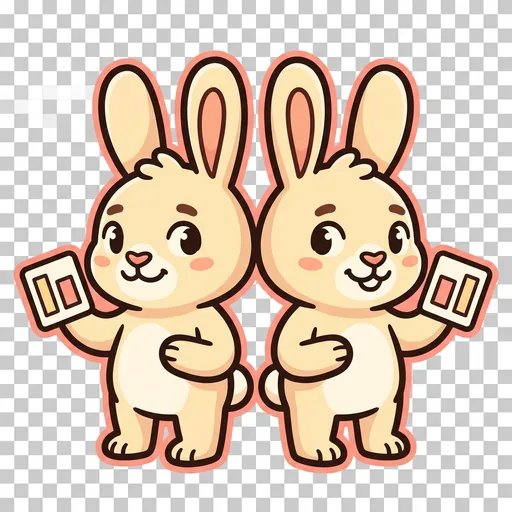
Both
Dyad-sync — two warm-cream hares mirror-paired with cards held up side-by-side; both facing same direction; happy-but-not-overjoyed (overlap is data, not victory)
-

Gap
Mismatch-as-data — round warm-amber fox-tween in soft slate-blue vest holding chunky measuring-string between two cards; treats SPACE between picks as teaching artifact; never-frustrated, always-curious
-

Streak
Growth-chart — tall soft-grey heron-elder in chunky charcoal vest reading long chart with hash-marks; wing pointing at time-axis; treats LONG pattern as whole skill, never single check-in as success-or-failure
-
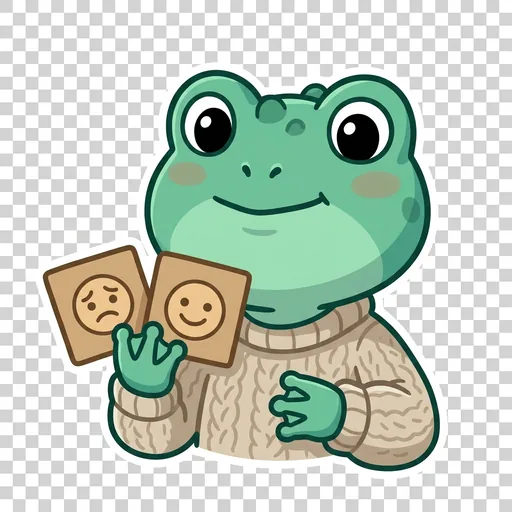
Brim
Picks the card that is really true today, not the easy "I am fine" card you hold up so nobody worries.
-

Buoy
Reads the bodys quiet signal first, because a feeling often shows up in your chest or tummy before you have a word for it.
-

Skiff
Shows that you do not have to wait to be noticed; you can be the one who starts a check-in and asks for it.
-

Moor
When someone shows you a hard feeling, stays steady and holds it with them instead of rushing to fix it.
-

Cove
When a check-in gets missed or misread, comes back to it later, because a missed moment is never lost for good.
-
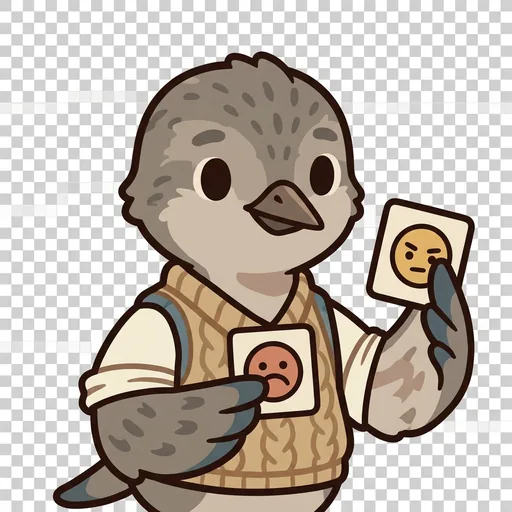
Ebb
Notices when a feeling turns partway through a moment, and picks a new card, because the first card is a start, not a sentence.