Press
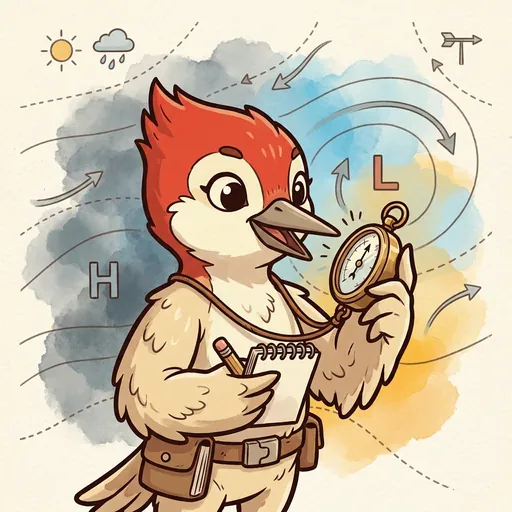
AIR PRESSURE + CIRCULATION — highs and lows plus wind direction. Air moves from high pressure toward low pressure, and that movement is the wind.
Listen along — Press
Loading audio…
Press play to listen along. The line being read lights up as you go.
Show full transcript
Loading transcript…
Chapter 1 — Press and the Brass Barometer
Press tapped the glass of the little brass barometer at her chest, watched the thin needle quiver and slide left, and grinned.
“Wind’s coming,” she announced to the empty courtyard. “By afternoon.”
The courtyard did not look like wind was coming. The morning was flat and still, not a leaf stirring. A passing tween paused to squint at the sky. “How do you figure? It’s dead calm.”
“That’s the fun part.” Press was a small woodpecker with a bright red head, and she rapped her beak lightly against the workbench when she was thinking — tap, tap, tap. “Air piles up thick in some places — that’s high pressure. It goes thin in others — that’s low pressure. And air can’t stand a difference. It flows from the thick place to the thin place.” She nodded at the barometer. “My needle just told me the pressure’s dropping right over us. Thin air, right here. So all that thick air out there” — she swept a wing at the horizon — “is about to come rushing in to fill the gap. That rushing is the wind.”
The tween looked skeptical. Press only smiled and clipped the barometer back to her cord.
By afternoon, the courtyard was full of blowing leaves.
Press learned to read the needle in a village where her family kept the barometer that hung on the schoolhouse porch. Three times a day — dawn, noon, dusk — a woodpecker climbed up and read the number aloud, and someone wrote it in the log.
The autumn Press was six, her aunt let her read it for the first time. Press peered at the dial and announced the number proudly.
“Good,” said her aunt. “Now — is that one number a forecast?”
Press hesitated. ”…Yes?”
“No.” Her aunt tapped the log book, thick with years of readings. “One number is just a number. The forecast is in the change. Yesterday it was higher. This morning it’s lower. Falling means weather’s on its way. Rising means it’s clearing. Steady means steady.” She closed the book. “That’s why we read it three times a day for a hundred years. The barometer’s a little fortune-teller — but only if you watch how it moves.”
Press read it every dawn after that, and every dusk, and slowly the numbers stopped being numbers and started being a story: the slow fall before a storm, the quick rise after, the long steady stretch of fair weather. By the time she left the village she could feel the story coming before the needle finished settling.
She walked to the WeatherForge academy the spring she turned twenty-two, the brass barometer swinging at her neck. Gale, the head of the academy, met her and asked the question.
“What is air pressure and circulation?”
Press answered without a pause, tapping her beak once against the gate post. “Air piles up where the pressure’s high and thins out where it’s low, and it flows from high to low to even things out. That flow is the wind.” She glanced at her barometer. “A big difference makes a strong wind. A small difference, a light breeze. No difference, calm.” She looked back at Gale. “And you don’t read the number once. You track how it changes. Falling brings weather. Rising clears it.”
Gale raised a brow. “And the fancy science degree behind all that?”
“There isn’t one,” Press said plainly. “It’s careful watching and simple physics. Anyone patient enough can learn it. My whole village did.” She tapped the glass. “I’d rather teach it that way than make kids think it’s locked behind a diploma.”
Gale smiled. “Then you belong here.”
In her workshop, Press always started the same way: she unclipped the barometer, set it on the bench, and let the students watch the needle wobble and settle before she said a word.
“Alright,” she said to a bench of new tweens. “Two little jars.” She set out a jar packed tight with cotton balls and a jar with only a few. “Say this crammed jar is high pressure — air piled thick. This empty one’s low pressure — air gone thin. If I connect them—” she tipped a cotton ball from the full jar toward the empty — “which way does it move?”
“High to low,” a tween named Corbet said.
“Every time. And that moving air is the wind.” She traced a curve with her wing. “One trick: because the Earth spins, the wind doesn’t go straight from high to low up here in the north — it curves a little to the right. So the highs spin one way and the lows spin the other, and you can spot it on any weather map. H for high, L for low, wind flowing between them.” She pointed at the barometer. “But start here, at the bench. Read the pressure. Track the change over hours and days. If those lines on the map crowd close together, the wind’s strong. Far apart, it’s gentle.”
Corbet frowned. “What if you read it right and the weather still does something else?”
Press laughed, delighted. “Then you were forecasting.”
She said it lightly, but she meant it, and she saw Corbet not quite believe her. So Press sat down on the bench next to the barometer and told the truth.
“I get it wrong sometimes,” she said. “I read a falling needle, I call for rain, and the clouds slide right past. It used to twist me up inside — my chest would go tight waiting to find out if I’d guessed right.” She tapped the glass gently and the needle settled. “Then my aunt told me: pressure’s only one piece. Mass and Loft and Brew each teach another. Read puts them together. The barometer starts the story — it doesn’t finish the book.”
She watched the needle hold steady. “So now, when I’m not sure, I don’t hold my breath anymore. Not-knowing is just part of watching the sky.” She glanced at Corbet, warm. “That was the thing that finally let my shoulders come down. Not getting it right every time. Getting to be okay with the waiting.”
Corbet let out a breath he hadn’t noticed he was holding, and felt something in his own chest go loose and easy, like calm air after the wind has passed.
The WeatherForge ensemble
Press is part of WeatherForge's distributed-narrative cast. Each character embodies a different curricular primitive; together they teach the full subject.