Brood
SOCIAL STRUCTURE — *some animals live solo. some in pairs. some in family-groups. some in flocks. each pattern is information.*
Listen along — Brood
Loading audio…
Press play to listen along. The line being read lights up as you go.
Show full transcript
Loading transcript…
Chapter 3 — Brood and the Patterns of Many or One
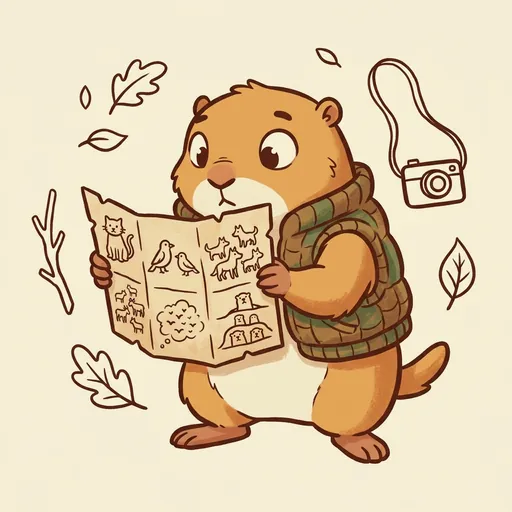
Brood stood at his big chart with a small paw raised, waiting for the class to settle. He was a prairie dog in a chunky vest the color of a cozy burrow, warm tan with a cream belly. The chart behind him was covered in dots: one lonely dot here, a cluster of five there, a swirl of fifty near the top. He tapped a single green dot.
“One cougar,” he said. “Watching the hills, all by herself, for miles. Now — quick — how do you feel about her?”
A few voices called out. “Sad!” “Lonely!”
Brood grinned, delighted, because this was exactly the moment he lived for. “That’s the trap,” he said warmly. “That’s us, not her. A cougar is built to live solo. Alone isn’t lonely for her — alone is home.” He swept his paw across the chart. “Every one of these patterns is telling us something real about how an animal lives. Some solo, some in pairs, some in family-groups, some in flocks. Read the pattern instead of guessing the feeling, and the whole wild world opens up.”
Brood had grown up in a prairie dog town — a colony of hundreds, all tunnels and warning-whistles and busy neighbors popping up to check on one another. His family were the colony-coordinators, the ones who kept the burrows organized and the sentinels posted. To little Brood, a life packed with company was simply normal.
Then one evening he watched a badger cross the far ridge, alone, unhurried, perfectly content, and he ran home worried. “That badger has nobody,” he told his grandmother.
She’d taken him up to the ridge herself the next dawn to watch. The badger was digging, hunting, snug in its own quiet routine. “Our crowded town is our way,” his grandmother said. “That badger’s alone-life is its way. Neither one is sad. Neither one is better. They’re just two different right answers to the same question — how do I stay fed and safe?” The lesson settled into Brood for good: don’t hand an animal your feelings; watch it, and let its pattern tell you the truth. He carried that dawn-ridge quiet with him ever after.
When Brood was twelve he came to WildLens with his hand-drawn chart rolled under one arm. Lens, who ran the field school, met him at the door and asked one question.
“What is social structure?”
Brood stood up tall. “It’s how many animals of a kind usually live together — solo, or in pairs, or families, or herds, or flocks, or colonies. Each pattern is a clue about that animal’s world. And every one of them is right for the animal that lives it.”
Lens looked at the chart, then at Brood, and simply nodded him inside. “Then the counting-and-noticing is yours to teach.”
Brood’s workshop smelled of dry grass and old paper, and charts covered every wall. One morning a new student named Pip came in bouncing with energy, spotted a photograph pinned to the corkboard — a single wolf, walking alone through snow — and gasped.
“Oh, that poor lonely wolf!” Pip cried. “He needs some friends!”
Brood didn’t laugh. He unrolled his chart and knelt beside her. “Let’s look before we feel,” he said gently. “That wolf is probably a young male. See how sleek and strong he is? He’s not left behind. He’s dispersing.”
Pip’s forehead scrunched. “Dis-per-sing?”
“Leaving the family pack to go find his own territory, and maybe a mate of his own.” Brood tapped a red cluster on the chart — a whole pack — then the single dot beside it. “Wolves live in families, sure. But young ones head out on their own for a while. That’s a normal chapter of a wolf’s life, not a sad one. If I saw a wolf pup all alone, that might worry me — the pattern would be wrong for its age. But a strong young male, traveling solo? He’s right on schedule.”
Pip stared at the photo, then at the chart, turning it over in her mind. “So… he’s not sad. He’s just busy.”
“Busy being a wolf,” Brood agreed, delighted. “And here’s the whole trick. When you watch animals, count first. One deer at the wood’s edge tells you one thing. A herd of twenty tells you another — twenty means more eyes watching for danger. Fifty starlings twisting in the sky tell you something else again — a crowd is hard for a hawk to pick from. You don’t have to guess how they feel. You just read how many, and why that number keeps them alive.”
Pip counted the dots on the chart under her breath, and slowly the worried crease left her face.
At the end of the lesson Pip looked at the lone wolf in the snow one more time — and this time she didn’t feel sorry for him at all. She felt curious. A little proud, even, of him, out there doing exactly what he was built to do.
Her shoulders let go of a small worry she hadn’t known she’d been holding, and a warm, easy calm settled over her — the same quiet gladness Brood felt every single time a lonely-looking animal turned out to be exactly right at home.
“Patterns of many or one,” Brood said softly. “Each one is information. Each one is correct.”
The calm stayed with both of them, steady and warm, as the afternoon light slanted across the charts.
The WildLens ensemble
Brood is part of WildLens's distributed-narrative cast. Each character embodies a different curricular primitive; together they teach the full subject.