
Silica
SILICON (Si) — the quiet architect who builds orderly, repeating lattices; the backbone of Earth's crust and of every chip.
Press play to listen along. The line being read lights up as you go.
Show full transcript
Loading transcript…
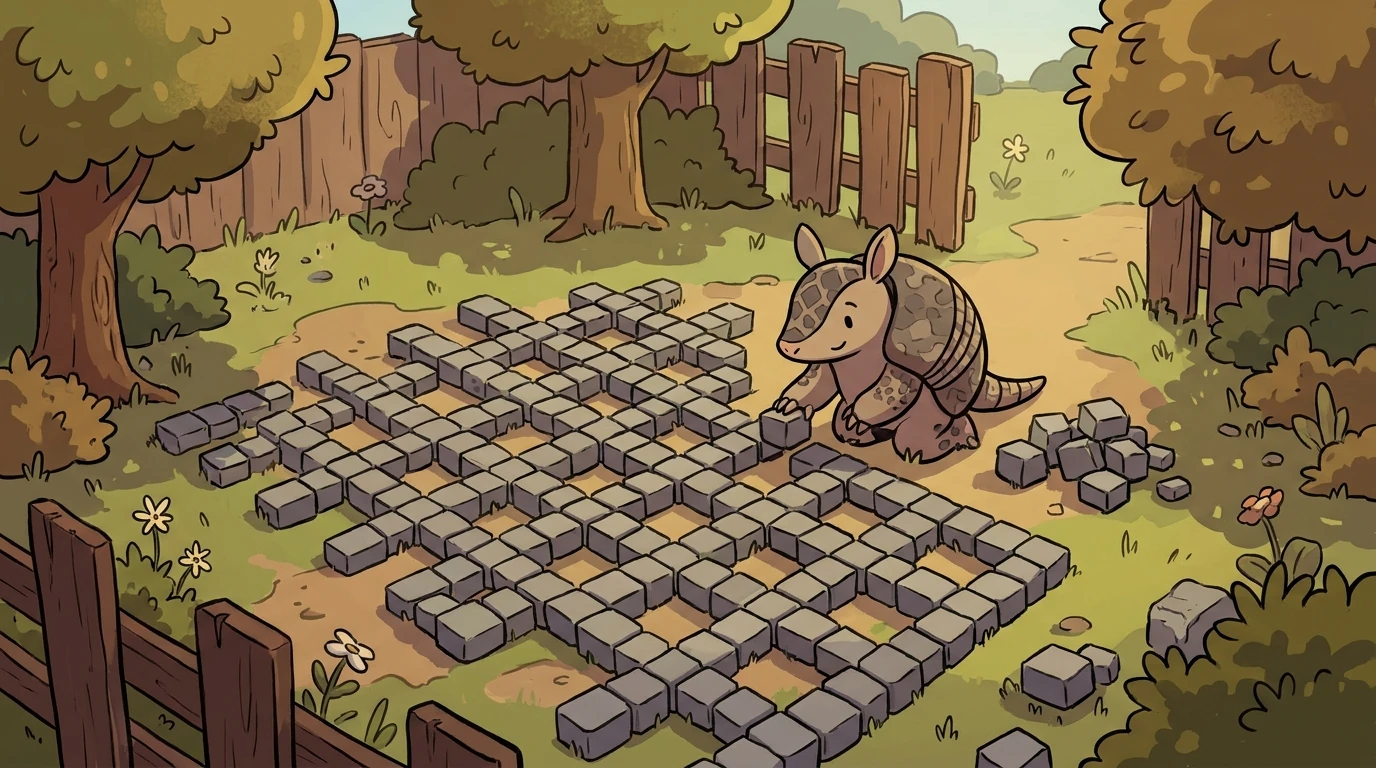
In the stillest corner of the ChemQuest yard, a small armadillo named Silica was laying stones into a pattern, and she had been at it, calm and unhurried, for hours.
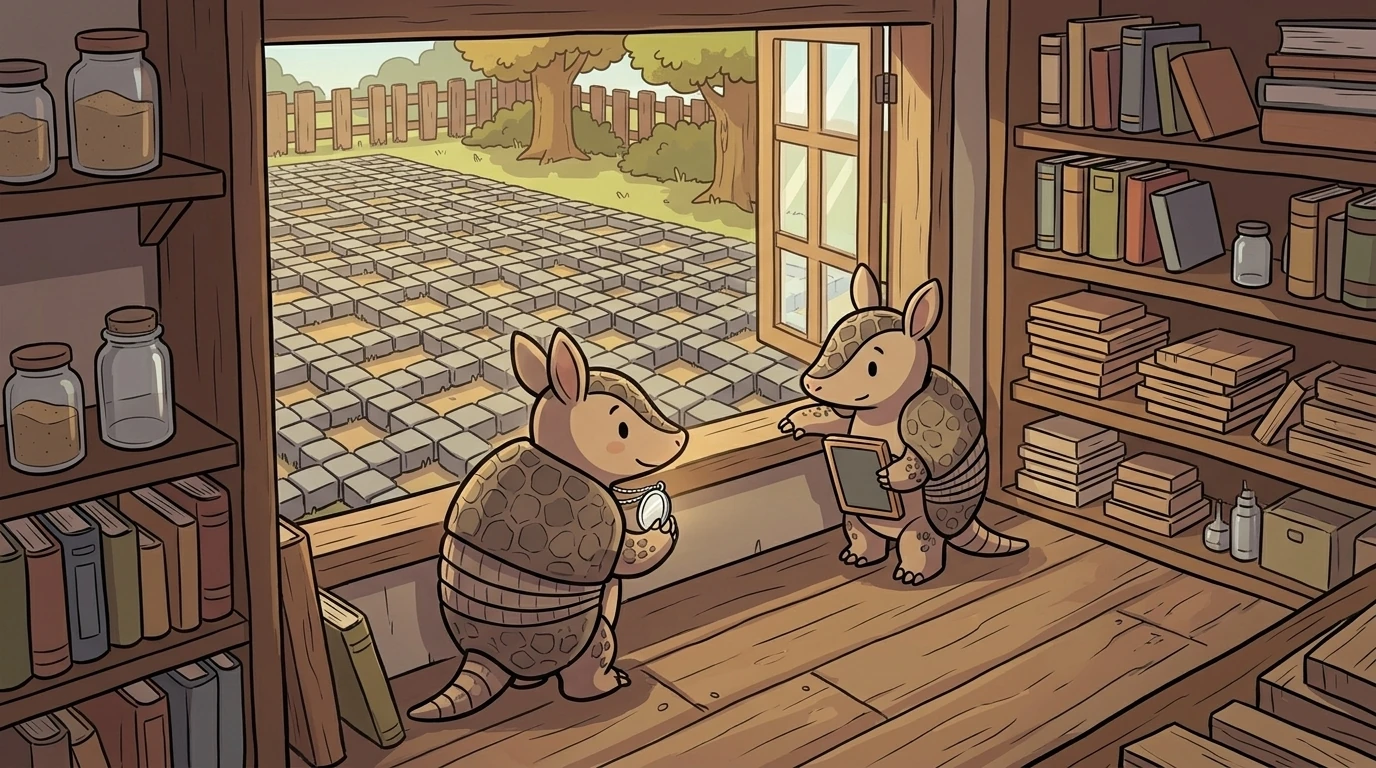
She wasn't building anything you'd notice from far off. Up close, though, it was extraordinary. Every stone she set was the same shape — a little four-cornered piece — and every one locked to its neighbors at exactly the same angle, so that the pattern spread out flat and even in all directions, repeating and repeating, perfectly regular. No stone was crooked. No gap was wrong. It looked less like a wall and more like the pattern was growing itself, and Silica were only its patient hands.
A younger armadillo wandered over and watched for a while. "It's all the same," he said, puzzled. "Same piece, over and over. Doesn't that get boring?"
"It's the opposite of boring," Silica said, and set another stone without looking up. "Every piece the same, every angle the same — that's what makes it strong. Watch."
She finished the row she was on and pressed down hard, in the middle, with both hands. The whole sheet of stone held her weight without a flicker — because every piece was sharing the load with every other piece, all through the repeating pattern.
"See," she said. "Carbo builds bendy chains — one thing after another, long and flexible, the shape of living stuff. I don't. I build lattices. The same little piece, locked the same way, spreading out stiff and even until it's a whole floor of rock." She patted the stone. "Quiet. Patient. Repeating. That's me."
Silica had learned the worth of the repeating pattern in her village, when she was small.
Her family were the stone-masons — the armadillos who dug up stone, shaped it, and laid it into the walls and bridges the whole village stood on. And little Silica had found the work slow to the point of pain. The other cubs did loud, fast, flashy things. She sat for a whole afternoon fitting one stone against its neighbor, then another exactly like it, then another, and it felt like nothing. It felt like she'd made no mark on the world at all.
Her grandmother had crouched beside her over the half-laid row. "You feel like it doesn't count, don't you? All these little same-shaped stones, one after another — like it adds up to nothing?"
Silica had nodded, her chin low.
"Come here." Her grandmother led her to the oldest wall in the village, the one at the bottom of the hill, weathered smooth. "Someone laid this the way you're laying yours. One patient stone at a time. Same shape, same fit, over and over. That was a hundred winters ago." She laid Silica's small paw flat on the cold stone. "It's still standing. It'll still be standing when you're grown, and when your grandchildren are grown. That's what the quiet repeating work makes. Not a splash. A thing that lasts."
Silica pressed her paw to the old wall for a long time. The it-doesn't-count feeling didn't vanish, but it changed shape. It stopped feeling like nothing and started feeling like forever, one piece at a time. Somehow that made the slow work feel like the most important kind there was.
By six she could lay a lattice of stone that didn't shift when you leaned on it. And she understood, in her careful hands before her head caught up, that the plainest, most-repeated building was the building that held.
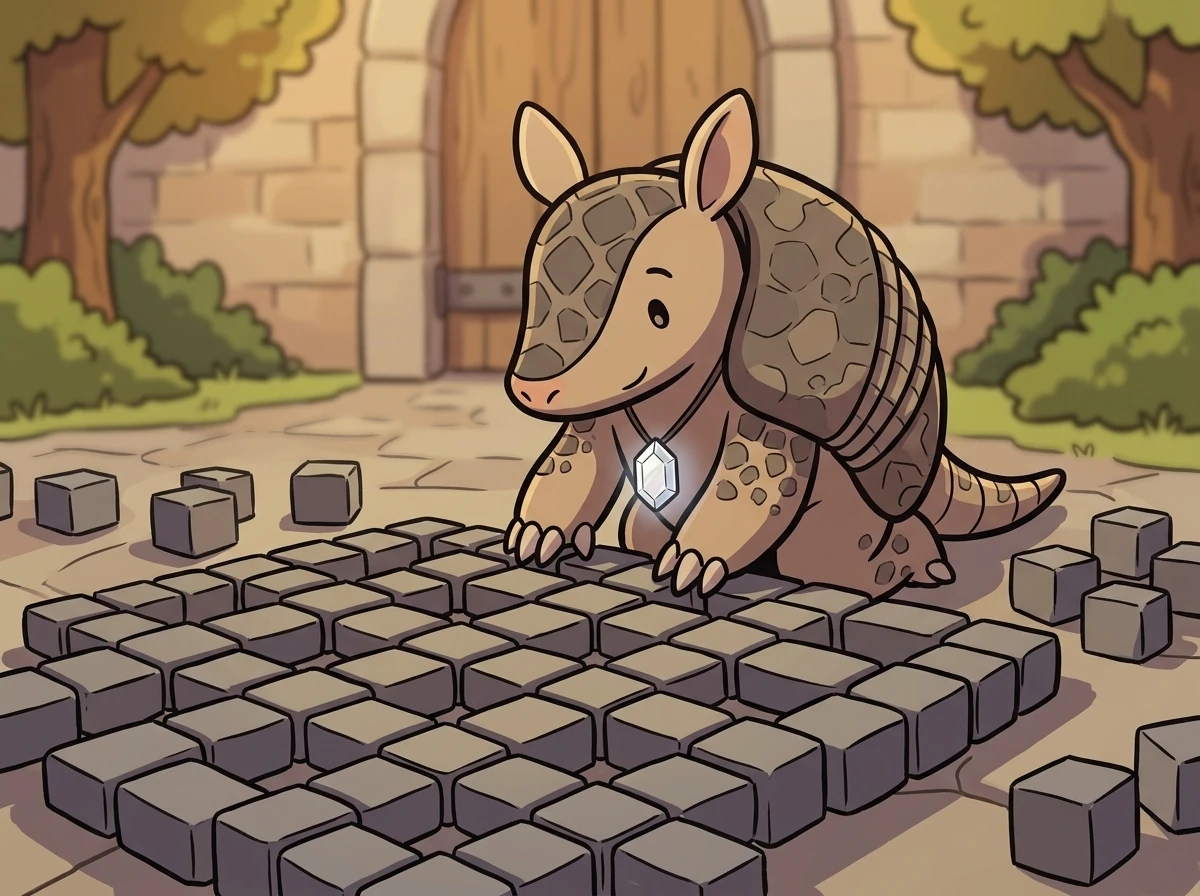
She walked to the ChemQuest academy at twenty-two, wearing a small clear-quartz pendant she'd polished herself until its six flat sides caught the light.
Beaker met her at the gate and asked one question. "What is silicon?"
Silica didn't answer fast. She knelt, took a handful of pieces, and began to build — the same four-cornered unit, over and over, each one bonded to an oxygen on every side, spreading out into a stiff, even sheet right there on the courtyard stones. When she'd made a patch big enough, she stood and pressed on it, and it held.
"I sit one row under Carbo," she said. "Four hands, like him — I can bond four ways too. But where he makes long chains that bend, I lock my four bonds into stiff, repeating patterns that don't." She touched her pendant. "My favorite partner is oxygen. Silicon, oxygen, silicon, oxygen — on and on, in every direction. That pattern is sand. It's quartz. It's granite. It's most of the rock under your feet. Where Carbo is the backbone of life, I'm the backbone of the whole crust of the Earth." She looked up. "Quiet. But everywhere."
Beaker knelt and pressed the little lattice she'd made. It didn't give. "You belong here," he said.
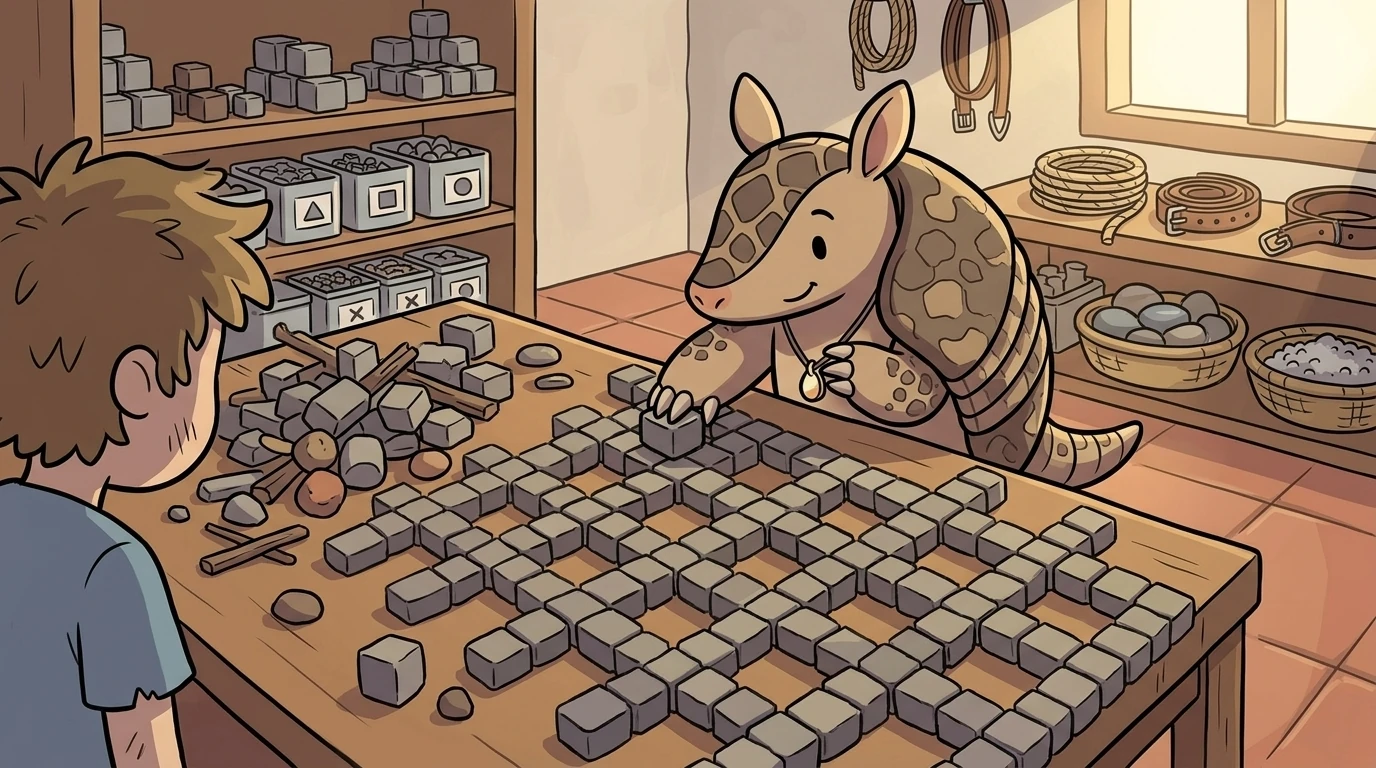
Silica's workshop was the tidiest room in the academy, and things came to her to be made to last.
A boy came in one afternoon, slumped and grumbling. He'd been trying to build something strong out of loose, wobbly parts, and it kept collapsing. "I keep stacking them and they keep falling," he said. "I think I'm just no good at the strong stuff. Everyone else makes the exciting things."
Silica knew that slump exactly. She'd felt it over a half-laid row, sure her quiet work counted for nothing.
"Show me," she said. He piled his loose parts and they toppled, again. She caught one. "Here's the trouble. You're stacking them any old way — no pattern. Watch what happens with a pattern." She took his parts and laid them the way she laid stone: same unit, same angle, each one bonded on every side to the next, spreading flat and even instead of stacking tall and wobbly. When she pressed down, it held.
"That's a lattice," she said. "The same little piece, locked the same way, over and over, sharing the load. It's why sand doesn't crumble to nothing after a million years on the beach — the silicon-oxygen pattern is that strong." She tilted her pendant so it flashed. "Melt that pattern down and cool it fast and you get glass — your window, still the same silicon and oxygen, just frozen mid-pour. Grow the pattern very pure and slice it thin and you get the wafer inside a computer chip. Same quiet, repeating, patient building. Rock, glass, and the brain of your phone, all of it me."
The boy pressed the little lattice. It didn't move. "So the boring, same-every-time way is the strong way?"
"The patient, same-every-time way," Silica said. "That's the one that lasts."
Later, when the workshop had emptied, the boy came back with one more question. He was quieter now.
"When you're building the plain thing," he said, "the same piece over and over, and nobody's watching and it isn't flashy — how do you keep going? How do you know it matters?"
Silica thought about the old wall at the bottom of the hill, cold and smooth and still standing, and her grandmother's paw guiding hers to it.
"There's a feeling," she said, "when you set a piece exactly right against the last one, and it fits, and you know it'll still be fitting long after you're gone. It's not a loud feeling. It's calm — steady, and settled, like something in you going quiet because the work is true." She looked out the window toward the courtyard where her little lattice still held. "The flashy things are wonderful for an afternoon. But the quiet, repeating, careful things are what the world actually stands on. Sand and stone and glass and every chip in every gadget — all of it just plain patient pieces, set right, one at a time." She turned her pendant in the light. "And knowing you can make a thing that lasts — that's the calmest, gladdest feeling I've got."
The boy nodded slowly, and Silica watched the slump lift off his shoulders — the same way, years ago, the it-doesn't-count feeling had lifted off hers.
She didn't say the rest out loud, but she felt it, quiet and warm and sure: the plainest, most-repeated work is not the small work. It's the work that holds the whole world up — and doing it well feels, more than anything, like being at peace.
The ChemQuest ensemble
Silica is part of ChemQuest's distributed-narrative cast. Each character embodies a different curricular primitive; together they teach the full subject.
-

Hydra
Hydrogen (H) — lightweight, ubiquitous, always paired up; buddy-system enthusiast
-

Carbo
Carbon (C) — connects to anything; the social atom; backbone of life
-

Oxy
Oxygen (O) — eager bonder; electronegative; the hungry grabber
-

Nitra
Nitrogen (N) — triple-bond loyal; slow-to-warm; locks in deeply once bonded
-

Sodi
Sodium (Na) — generous, impulsive; always giving away electrons
-

Chlora
Chlorine (Cl) — sharp, focused; the collector who finishes what Sodi starts
-

Helio
Helium (He) — noble gas; peaceful, floaty, complete; the contented onlooker
-

Sulfa
Sulfur (S) — earthy, dramatic; the stinky uncle of volcanoes and proteins
-

Phossa
Phosphorus (P) — energetic, restless; the spark of ATP and matches
-

Magna
Magnesium (Mg) — bold, ceremonial; burns bright white; chlorophyll core
-

Alumi
Aluminum (Al) — practical, modest; the workhorse of cans and foil
-

Tugger
Ionic bond — forceful, decisive; full electron transfer; opposites attract
-

Sharer
Covalent bond — cooperative, balanced; equal partnership
-

Streamer
Metallic bond — flowing, communal; delocalized electron sea
-

Whisperer
Hydrogen bond — subtle, persistent; water's superpower; DNA pairing