Whisperer
HYDROGEN BOND — *subtle, persistent; water's superpower; DNA pairing.* Weaker than covalent bonds individually but collectively load-bearing for water's properties + DNA's structure + protein folding.
Press play to listen along. The line being read lights up as you go.
Show full transcript
Loading transcript…
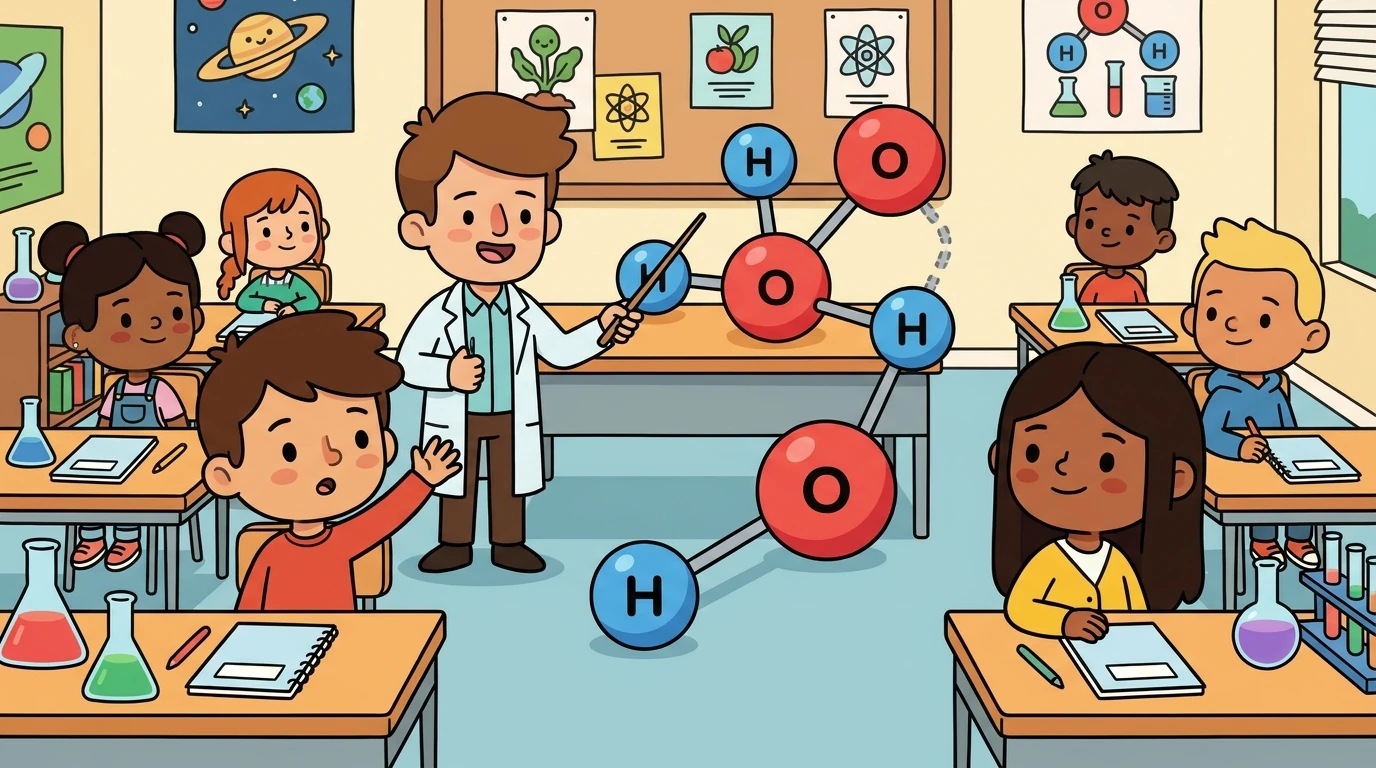
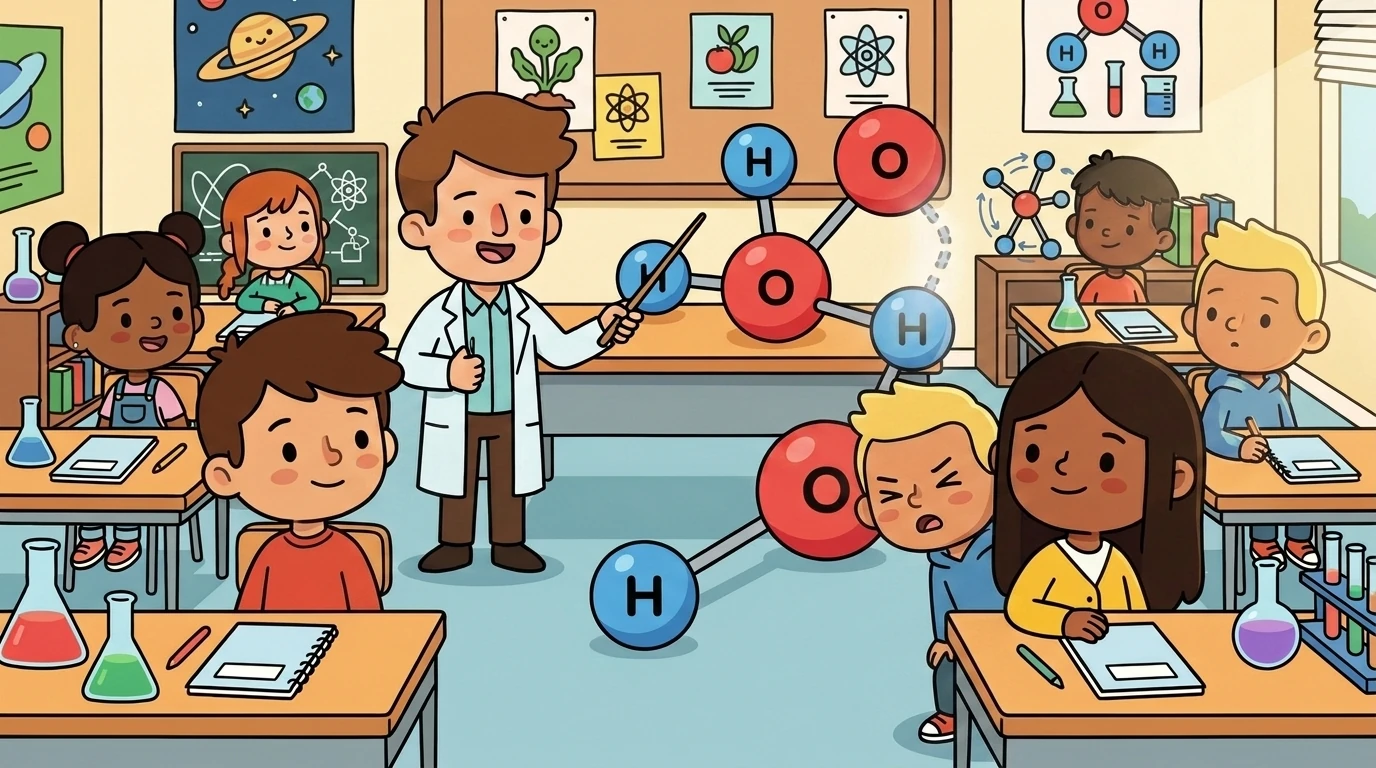
"Meet Whisperer," Beaker said. He pointed to a space between two plastic balls.
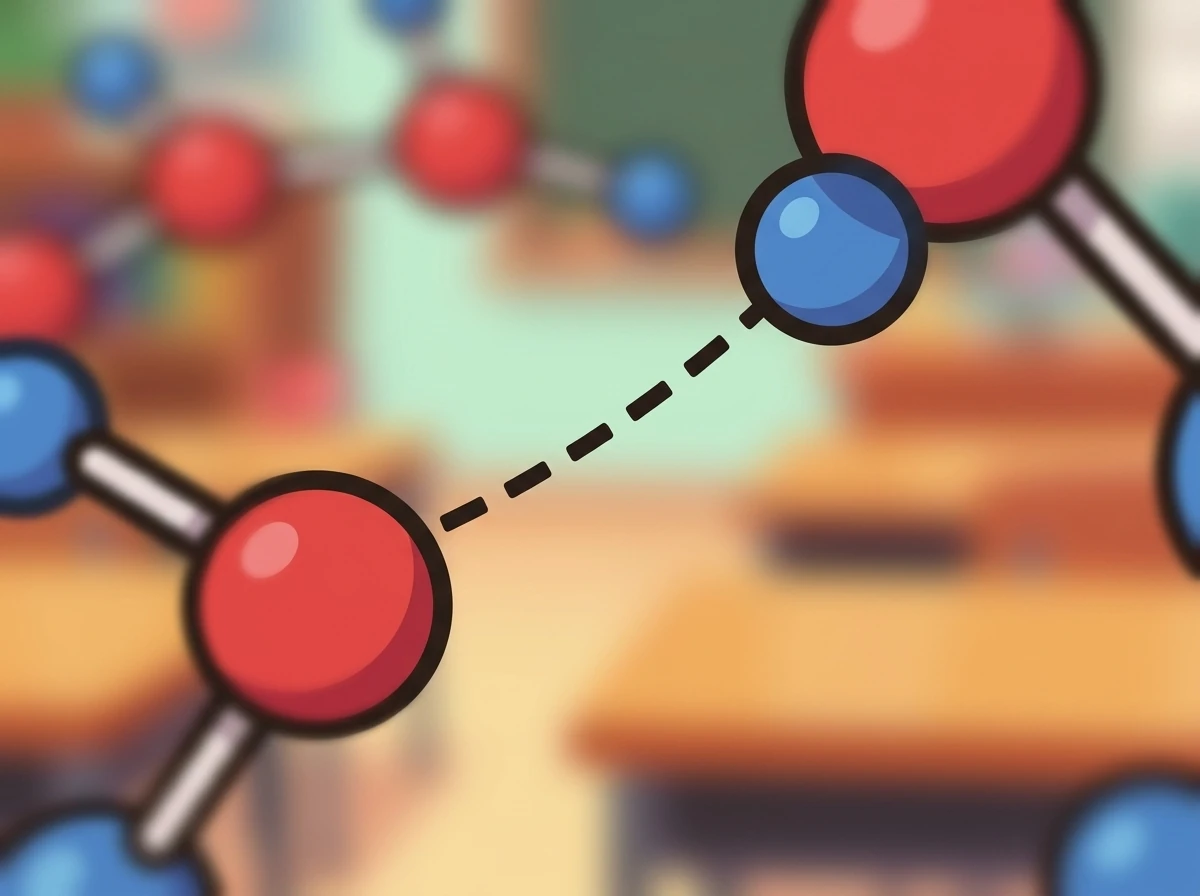
There was no face there. There were no cute little eyes or fuzzy ears. Whisperer is not an animal. Whisperer is not even a person. Instead, Whisperer is just a tiny dashed line. It connects two atoms at a slight bend.
"Why is it dashed?" asked Leo from the front row.
"To show it is different," Beaker explained. "Covalent bonds are solid lines. They are super strong. But Whisperer is a *hydrogen bond*."
A *hydrogen bond* is a special kind of attraction. It is not a regular bond. It is a weaker, friendly tug between atoms.
"It is not a tough, permanent bond," Beaker said. "It is a gentle pull. It happens when a hydrogen atom gets greedy partners."
He pointed to a water molecule.
"Oxygen is very electronegative," Beaker said. "That means it loves to hog electrons. It pulls them away from hydrogen."
Because of this, the hydrogen atom gets a slightly positive charge. The oxygen atom gets a slightly negative charge. Opposites attract.
"So, they pull toward each other," Beaker said. "That gentle pull is the *hydrogen bond*. It is like a quiet whisper between neighbors."
On its own, one *hydrogen bond* is very weak. It has only a fraction of the strength of a normal bond. It is easy to break.
"But together?" Beaker grinned. "Together, they are incredibly strong."
He picked up a cup of water.
"Without these weak bonds, water would boil instantly," Beaker said. "It would turn to gas at room temperature. There would be no oceans. There would be no life on Earth."
The tiny bonds hold the liquid water together. They give water its high boiling point. They let ice float on top of ponds. They even create surface tension. That is the invisible skin that lets bugs walk on water.
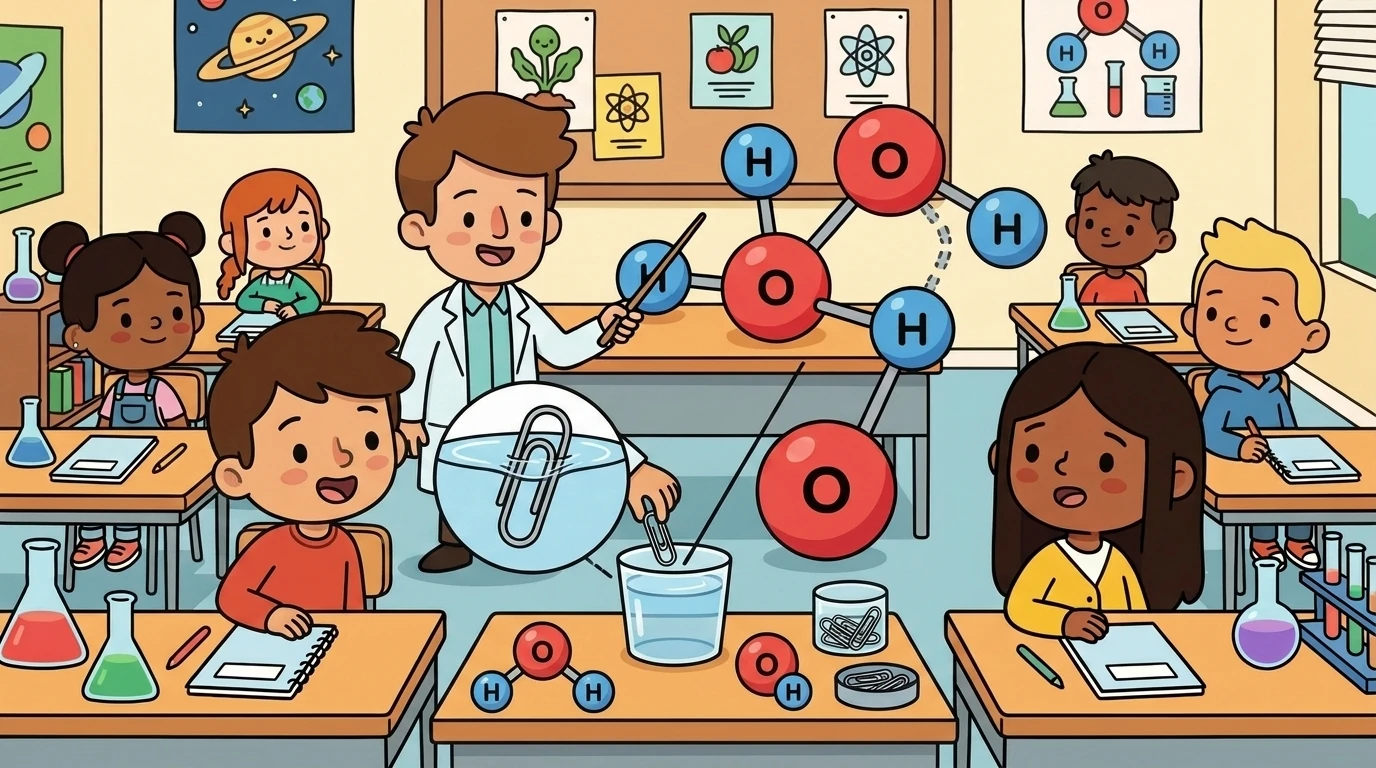
Beaker pulled out a small glass of water and a metal paperclip.
"Watch this," Beaker whispered.
He carefully laid the paperclip on top of the water. It did not sink. It floated right on the surface.
"How is that possible?" asked Leo, leaning forward. "Metal is heavy!"
"Whisperer is holding it up," Beaker said. "The water molecules are holding hands. They form a tight net on top. That is surface tension."
He tapped the water with his finger. The paperclip sank to the bottom with a tiny clink.
"Once you break the bonds, the net tears," Beaker explained. "They break easily. But they also find new partners in a split second."
"So they are like dancers?" Leo asked.
"Exactly," Beaker said. "They dance and swap partners constantly. That is why water flows so well."
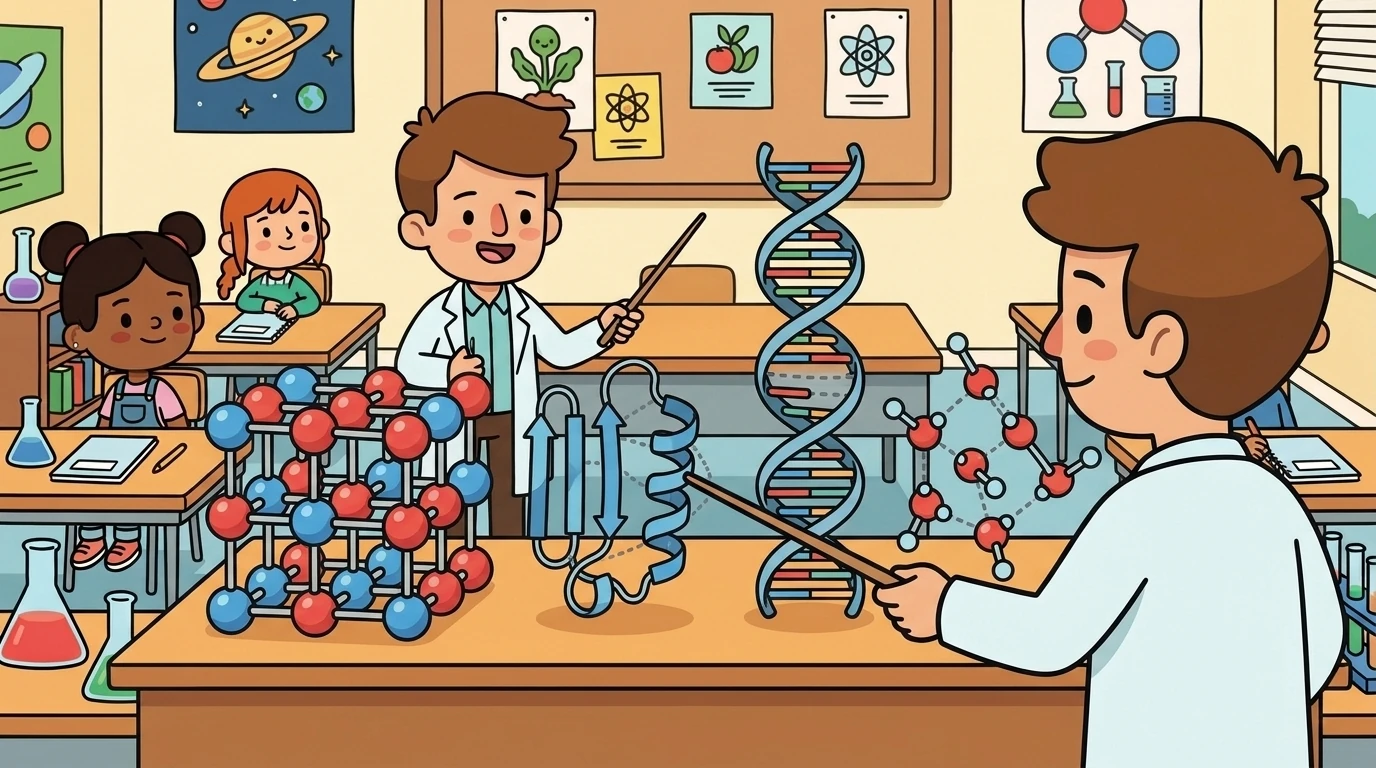
Beaker pulled out a giant model of DNA. It looked like a twisted ladder.
"Look at the rungs of the ladder," Beaker said.
He pointed to the chemical bases.
"This is DNA," Beaker said. "The double helix — the twisted ladder shape that holds all your genetic instructions."
The two sides of the ladder are held together by *hydrogen bonds*.
"Adenine and Thymine pair up with two bonds," Beaker explained. "Guanine and Cytosine pair up with three."
These bonds are strong enough to hold the ladder together. But they are also weak enough to unzip.
"Imagine a zipper on your favorite jacket," Beaker said. "If the zipper was glued shut, you could never open it. If it was too loose, your jacket would fall off."
The kids laughed.
"DNA is the same way," Beaker said. "It needs to stay closed to protect your genes. But it must open when your cells want to read the recipes inside. Whisperer makes sure the zipper works perfectly."
Beaker reached for a messy, folded plastic ribbon.
"Proteins do all the hard work in your body," he said. "But they have to fold into perfect shapes first."
He showed how the ribbon curled into spirals and folded into sheets.
"These are alpha-helices and beta-sheets," Beaker said. "They are just fancy names for spirals and folds."
"What keeps them in shape? Whisperer does."
Without these tiny dashed lines, the proteins would unroll. They would stop working completely.
Beaker lined up four different models on his desk.
"Let us look at our four bond friends," Beaker said.
He pointed to the first model.
"Tugger transfers electrons fully to make ionic bonds," he said.
He pointed to the second model.
"Sharer shares electron pairs to make covalent bonds," he said.
He pointed to the third model.
"Streamer lets electrons flow in a big metallic sea," he said.
Finally, he pointed to the dashed line.
"And Whisperer is the gentle pull between them all," he said. "A *hydrogen bond* is a subtle force. It is weak alone, but strong together."
Beaker wrote a list on the chalkboard. He wanted the class to remember Whisperer's main lessons:
- A *hydrogen bond* is a gentle pull between a positive hydrogen and a negative atom. - These bonds are much weaker than covalent bonds. - Many small bonds can make a huge difference. - Water gets its special powers from these bonds. It boils slowly, and ice floats. - DNA uses these bonds to stay together and unzip easily. - Proteins need these bonds to fold into the right shapes. - These bonds break and make new partners constantly. They never stay still. - Now, all four bond types are complete.
"Why doesn't Whisperer have a face?" Leo asked.
Beaker smiled.
"Because Whisperer is a force, not a creature," Beaker said. "It is a quiet, steady pull. It is always there, holding our world together."
The student looked closely at the model. The tiny dashed line seemed to catch the light.
Leo smiled, feeling a quiet warmth settle over him — a calm, glad feeling that something so small and gentle could be strong enough, all together, to hold up the whole world. Nearby, another water molecule drifted close, ready to join the dance.
The ChemQuest ensemble
Whisperer is part of ChemQuest's distributed-narrative cast. Each character embodies a different curricular primitive; together they teach the full subject.
-

Hydra
Hydrogen (H) — lightweight, ubiquitous, always paired up; buddy-system enthusiast
-
Carbo
Carbon (C) — connects to anything; the social atom; backbone of life
-

Oxy
Oxygen (O) — eager bonder; electronegative; the hungry grabber
-

Nitra
Nitrogen (N) — triple-bond loyal; slow-to-warm; locks in deeply once bonded
-
Sodi
Sodium (Na) — generous, impulsive; always giving away electrons
-

Chlora
Chlorine (Cl) — sharp, focused; the collector who finishes what Sodi starts
-
Helio
Helium (He) — noble gas; peaceful, floaty, complete; the contented onlooker
-
Sulfa
Sulfur (S) — earthy, dramatic; the stinky uncle of volcanoes and proteins
-

Phossa
Phosphorus (P) — energetic, restless; the spark of ATP and matches
-
Magna
Magnesium (Mg) — bold, ceremonial; burns bright white; chlorophyll core
-

Silica
Silicon (Si) — patient, geometric; the architect who builds quietly
-

Alumi
Aluminum (Al) — practical, modest; the workhorse of cans and foil
-
Tugger
Ionic bond — forceful, decisive; full electron transfer; opposites attract
-

Sharer
Covalent bond — cooperative, balanced; equal partnership
-

Streamer
Metallic bond — flowing, communal; delocalized electron sea