
Sulfa
SULFUR (S) — *earthy, dramatic; the stinky uncle of volcanoes and proteins.* Six outer-shell electrons (like oxygen but with more shells); two-bond capacity; flexible chemistry; the smelly element; structural anchor in proteins.
Press play to listen along. The line being read lights up as you go.
Show full transcript
Loading transcript…

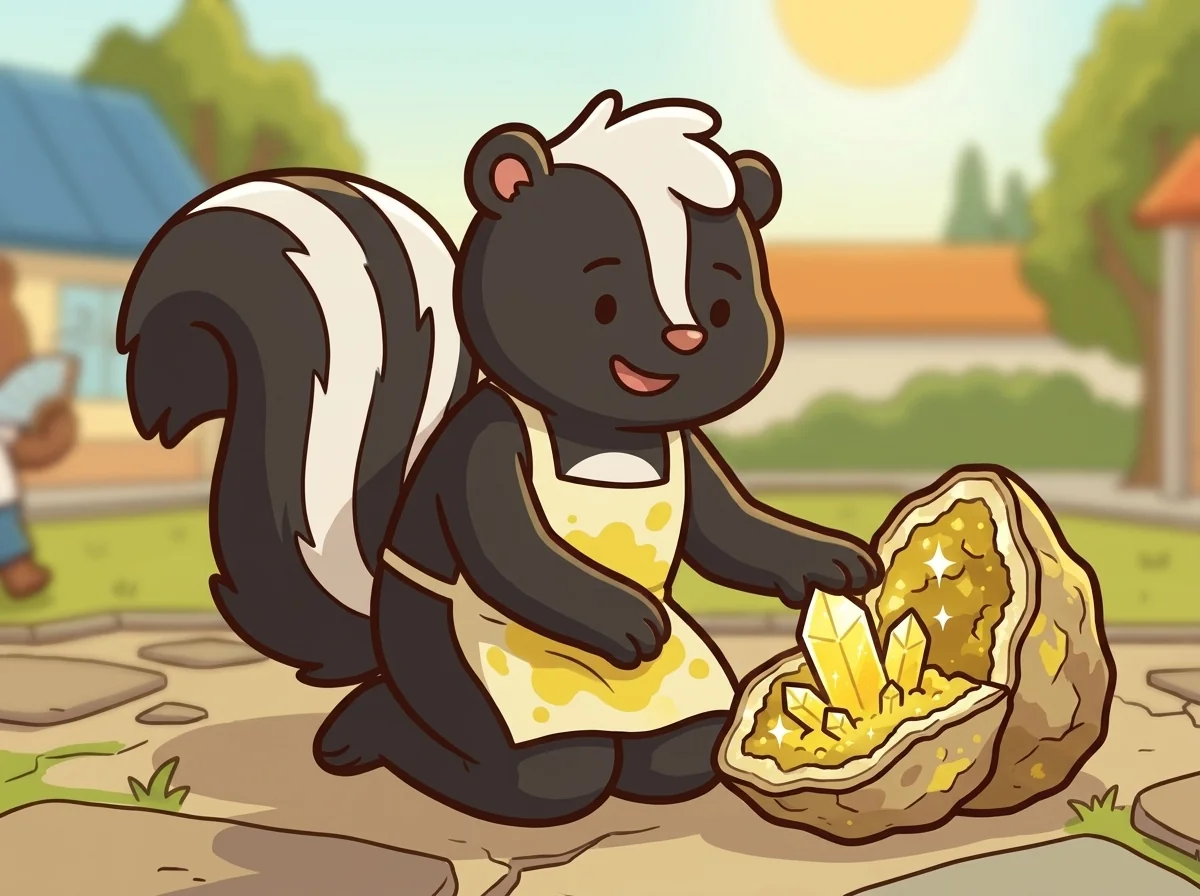
Sulfa was a small skunk-tween, round and warm-coded like a friendly cartoon. She wore a workshop apron, canvas that had started cream-colored but was now permanently stained with yellow sulfur-marks. These weren't dirt; they were part of her uniform. The stains didn't wash out, no matter how many times she tried.
She was short, with black and white stripes streaked with that same warm yellow. Her eyes were steady, always looking closely at details. She loved a good story, especially one that unfolded slowly, with all the necessary facts. Sometimes, when the moment called for it, she could be quite dramatic.
Sulfa embodied *sulfur (S)*. Sulfur sits right below oxygen on the periodic table. It's in the same column, but its outer electron shell is one layer deeper. This means sulfur, like oxygen, has six electrons in its outermost shell. It wants two more to be complete. But because sulfur’s outer shell is farther from the atom’s center, its bonding is more flexible than oxygen’s. Sulfur can make two single bonds, just like oxygen does in water. Or, it can form more complex multi-bond shapes, like in sulfuric acid.

Sulfur is famous for its strong smells. Hydrogen sulfide, or H₂S, gives off that rotten-egg smell. Sulfur dioxide, SO₂, smells like a match strike. Volcanic sulfur compounds fill the air with that distinct, sulfurous scent. This intense smell isn't just a random fact. It's real chemistry. Sulfur-containing molecules trigger strong responses in human nose receptors. Evolutionarily, smelling rotten eggs signals food gone bad, a helpful warning.
But sulfur also plays a huge role in biology. Two amino acids, cysteine and methionine, contain sulfur. Amino acids are the tiny building blocks that make up proteins. Disulfide bridges, which are two cysteine molecules linking up with S-S bonds, hold many proteins in their three-dimensional shapes. Your hair, your skin, your fingernail keratin—all of these are rich in sulfur disulfide bridges. Sulfur is both the stinky uncle and the structural anchor of the chemical world.
Sulfa was always very clear about this. "I'm earthy," she'd say, holding up her hands. "I smell. But that's part of the chemistry. Sulfur compounds bind strongly to nose receptors. And I'm also in your hair, your skin, your enzymes. Disulfide bridges hold proteins together. Without me, your hair wouldn't be hair. Don't mistake my smell for badness. The smell is information, and the structural work I do is essential."
Sulfa grew up in a small village nestled among sleeping volcanoes. Her family had been the village's volcanic-spring guardians for generations. They were the skunks who maintained the village's sulfurous hot-spring bath-house. Villagers used these springs for medicinal soaks, believing they helped with aches and pains. The work required a tolerance for strong smells. It also demanded an appreciation for the hidden chemistry bubbling up from underground. And, of course, careful attention to keeping the springs clean and accessible for everyone. By age six, Sulfa understood that sulfur was a generous worker. It just hid behind a strong smell.
When she was twenty-two, Sulfa walked all the way to the ChemQuest academy. Beaker, the academy's founder, had a single question for her. "What is sulfur?"
Sulfa stood tall, her yellow apron catching the light. "I sit below oxygen on the periodic table," she began. "Same column, deeper shell. I make two bonds, more flexibly than Oxy. I'm the smelly element—H₂S, that's rotten-egg. SO₂, that's match-strike. Volcanic atmosphere, too. But I'm also in your hair, in the disulfide bridges in keratin. I'm in your enzymes, in cysteine and methionine amino acids. Smelly and structural."
Beaker nodded slowly. "You are appointed," he said.
Now, Sulfa taught the young students about the *sulfur scaffolds*. She’d draw a periodic table on the board. "Sulfur makes two bonds, just like oxygen," she'd explain. "Look, same column. So sulfide compounds are like oxide compounds."

She'd hold up a model of H₂S. "This is hydrogen sulfide. It smells like rotten eggs. You know that smell, right?" A few students would wrinkle their noses. "It's toxic in high concentrations, so we're always careful in the lab. But that smell is a signal. It tells you something isn't right."
Next, she'd show SO₂. "Sulfur dioxide. That's the match-strike smell. You find it in volcanic atmospheres, too. It's also a common pollutant from burning coal."
Then came the big one: H₂SO₄, sulfuric acid. "This is a strong industrial acid," Sulfa would say, her voice serious. "Used in fertilizers, battery acid. Highly corrosive. Not kitchen-chemistry, kids. We treat it with extreme respect." She'd point to the warning labels on a bottle. "Corrosive means it eats away at things. It can burn skin."
She'd move on to biology. "Two of the twenty amino acids in proteins contain sulfur: cysteine and methionine. These are building blocks for everything in your body." She'd draw a long, wiggly line. "And cysteine's side chain, that little -SH part, can form S-S bonds. We call those disulfide bridges."

She'd then point to her own hair, then to a student's. "Disulfide bridges hold proteins' 3D shapes. Your hair, your nails, the keratin that makes them up—sulfur is the cross-linking anchor. It gives your hair its curl or its straightness. It makes your nails strong."
Sulfa always made sure to resist any personality-only framing of sulfur. "My dramatic smell is the chemistry," she'd insist. "And my structural role is the biology. It all comes from the atomic structure. The smell isn't badness; it's signal."
When students asked Sulfa if sulfur chemistry was hard, she always gave the same answer.
"It is not hard," she'd say, tapping her pen on the periodic table. "It is like oxygen but flexible, with strong smells and structural work. Two bonds. Below oxygen. Stinky uncle and structural anchor."
Her yellow apron would catch the light, and Sulfa would smile down at those stubborn stains with a warm, quiet pride. They were hers, and she was glad of them — happy, all the way through, to be exactly the loud, earthy, one-of-a-kind self she was.
The ChemQuest ensemble
Sulfa is part of ChemQuest's distributed-narrative cast. Each character embodies a different curricular primitive; together they teach the full subject.
-

Hydra
Hydrogen (H) — lightweight, ubiquitous, always paired up; buddy-system enthusiast
-

Carbo
Carbon (C) — connects to anything; the social atom; backbone of life
-

Oxy
Oxygen (O) — eager bonder; electronegative; the hungry grabber
-

Nitra
Nitrogen (N) — triple-bond loyal; slow-to-warm; locks in deeply once bonded
-
Sodi
Sodium (Na) — generous, impulsive; always giving away electrons
-

Chlora
Chlorine (Cl) — sharp, focused; the collector who finishes what Sodi starts
-

Helio
Helium (He) — noble gas; peaceful, floaty, complete; the contented onlooker
-

Phossa
Phosphorus (P) — energetic, restless; the spark of ATP and matches
-

Magna
Magnesium (Mg) — bold, ceremonial; burns bright white; chlorophyll core
-

Silica
Silicon (Si) — patient, geometric; the architect who builds quietly
-

Alumi
Aluminum (Al) — practical, modest; the workhorse of cans and foil
-

Tugger
Ionic bond — forceful, decisive; full electron transfer; opposites attract
-

Sharer
Covalent bond — cooperative, balanced; equal partnership
-

Streamer
Metallic bond — flowing, communal; delocalized electron sea
-

Whisperer
Hydrogen bond — subtle, persistent; water's superpower; DNA pairing