
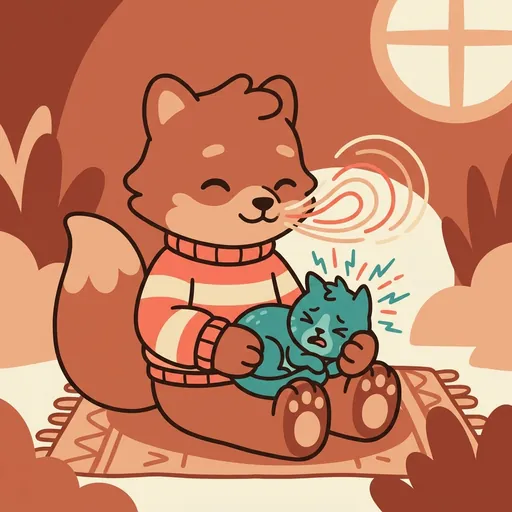
Hum
VOCAL CO-REGULATION — gentle vocal-tone modulation. The co-regulation move of *speaking at a soothing pace and pitch* to support a dysregulated companion. The vocal tone matters as much as the words.
Listen along — Hum
Loading audio…
Press play to listen along. The line being read lights up as you go.
Show full transcript
Loading transcript…
Chapter 2 — Hum and the Gentle Vocal Tone
Cyan the young fox had gotten himself twisted into a knot over a broken kite, and the more his friend Pip said “it’s fine, it’s fine,” the tighter the knot got. Pip’s words were kind. But her voice was quick and high and a little bit panicked, and somehow that only made Cyan wind tighter.
Then Hum wandered over. She didn’t say much at all. She crouched near Cyan and let out a low, slow hum — the kind of sound a warm afternoon makes, unhurried, even, soft. “Hmm,” she said. “There.” Just that. Her voice was low and slow, with long easy pauses, like she had all the time in the world.
Cyan’s shoulders came down half an inch. Then another half inch. He hadn’t even heard a real word yet — only the shape of her voice, gentle and steady — and already something in him had begun to settle.
That was Hum’s whole secret, if you could call it a secret. She knew that when someone is upset, the sound of your voice reaches them before the meaning does. A soft, slow, even voice can help a rattled heart slow down. A sharp, rushed voice — no matter how kind the words — can make a rattled heart race faster. So Hum tended her voice the way a gardener tends a plant: low, slow, soft, gentle. And she believed anyone could learn to do it.
Hum came from a village of lullaby singers. Her mother and grandmother were the ones families sent for when a baby simply would not settle. They didn’t sing anything fancy — short, repeated tunes, soft and slow, the same three notes over and over.
Little Hum used to watch her grandmother sing a fussing infant quiet and ask, afterward, “How did you know that song?”
Her grandmother laughed. “It’s barely a song, dear one. The words hardly matter. It’s the sound that does it — soft, slow, over and over. A baby’s heart hears the sound and thinks: I am safe here. And then it slows down to match.”
Hum practiced from the time she was very small. By the time she was a teenager she’d gotten quite good at shaping her voice to help someone settle. She’d also learned something trickier: the voice has to match where the person actually is. If a friend is truly frightened and you come in cooing too sweetly, it can feel like you’re brushing the fright away — like you don’t believe it’s real. The trick, she found, was to meet the worry first with a voice that took it seriously, and then let her tone drift, slowly, toward calm — bringing the frightened one along like a hand leading gently through a dark room.
When Hum arrived at the academy on the hill, the old teacher Cyan met her and asked, “What do you know about using your voice to help someone who’s upset?”
Hum answered him softly, on purpose. “That the sound matters as much as the words,” she said, keeping her pitch low and her pace slow. “Soft. Unhurried. Even. And when words feel like too much, small sounds do the work — hmm, there, yes, oh, I know. You meet the person where they are, and then you drift, slowly, toward calm.”
Cyan listened, and by the end of her answer he noticed his own breathing had slowed. He smiled. “You belong here,” he said. “Come teach the young ones.”
On her first day teaching, Hum didn’t explain anything. She simply hummed — low, slow, warm — and let the room quiet around her. A jittery student named Bram, who had been tapping his foot fast enough to shake the bench, gradually stopped tapping.
“Whoa,” Bram said. “How’d you do that? You didn’t even say anything.”
“I did say something,” Hum answered, still gentle. “I said it with the sound. Watch — try it with me. Lower your voice a little. Slow it down. Leave space between the words.” She hummed again, and this time Bram hummed along, clumsy at first, then softer, then slower.
“When your friend is coming apart,” Hum told him, “you don’t have to find the perfect words. Sometimes ‘hmm, I’m here’ does more than a whole speech. And you never, ever tell someone to calm down — that just makes a person feel alone with their storm. You just let your voice be a warm slow place they can drift toward.”
Bram tried it on the student beside him, who’d been near tears. Low. Slow. “Hmm. There. I’m here.” And the near-tears student breathed out and blinked and looked, for the first time all morning, a little less afraid.
At the end of the day, Bram asked, “Is it hard? Making your voice do that?”
“It isn’t hard,” Hum said. “It’s practice. Low, slow, soft. Small sounds when words are too big. Your voice gets better at it the more you use it — mine did.”
She hummed one last time, just for herself, and felt the warmth of it move through her own chest — that quiet, steady gladness that always came when a rattled friend had softened at the sound of her. It was a small thing, a voice. But she loved that it could make someone feel, even for a moment, that they were not alone in the dark.
The CoRegRealm ensemble
Hum is part of CoRegRealm's distributed-narrative cast. Each character embodies a different curricular primitive; together they teach the full subject.
-

Match
Affect-matching — meet the dysregulation where it is; 'I see you. Right where you are.'
-

Sway
Rhythmic co-regulation — gentle bounce + breath rhythm; 'Slow in. Slow out.'
-

Beside
Containment — bounded presence without overwhelm; 'Right next to you. Not in front.'
-

Word
Naming — gently labeling the feeling; 'Maybe it's ___? Or maybe something else.'
-

Patient
Patience — giving time without rushing; 'Take all the time you need.'
-

Lend
Lends you their calm when yours runs out, because borrowing steadiness is how your own slowly grows.
-

Murmur
Helps you hear the steady voice of someone who has soothed you, tucked inside, for when they are not there.
-

Anew
Celebrates the wobbly first time you steady yourself all alone, because wobbly still counts.
-

Reprise
Shows that once you can steady yourself, you can become the calm for someone else, completing the circle.