
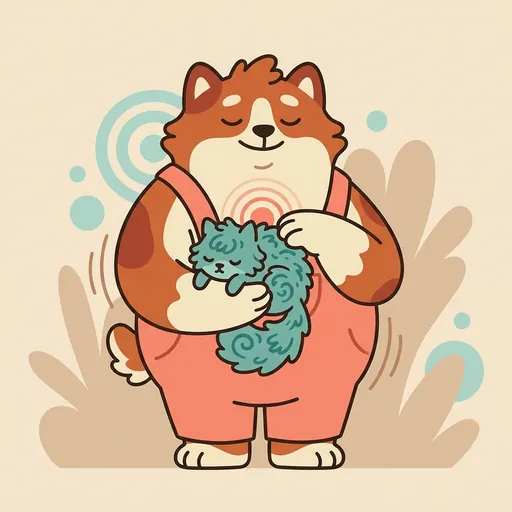
Sway
RHYTHMIC CO-REGULATION — gentle bounce + breath rhythm. The co-regulation move of *offering a gentle steady rhythm* (a bounce, a breath, a sway) that the dysregulated companion can entrain to.
Listen along — Sway
Loading audio…
Press play to listen along. The line being read lights up as you go.
Show full transcript
Loading transcript…
Chapter 3 — Sway and the Steady Rhythm
The little rabbit Cyan had gotten worked up before the spring festival — too much noise, too many creatures, a heart going far too fast — and no words seemed to reach him. Sway found him under the willow, trembling.
She didn’t try to talk him down. She simply sat beside him and began, very gently, to sway. Side to side. Slow. Even. Like a branch in an easy wind. She didn’t ask him to copy her. She just rocked, quietly, keeping a steady beat with her whole body, and let him watch if he wanted to.
At first Cyan stayed frozen. Then, without quite deciding to, he began to sway too — a small rock, matching hers. Slow in. Slow out. And as his body found the rhythm, his racing heart began, all on its own, to slow to meet it.
“How did that help?” he asked afterward, wobbly but calmer. “You didn’t even say anything.”
“Because a scared body doesn’t listen to words yet,” Sway said, still rocking a little. “But it will follow a slow, steady rhythm — a rock, a bounce, a slow breath. The body settles first. The words come after. I just offered you a rhythm you could lean into.” She smiled. “You didn’t have to. But you did.”
Sway grew up in a village of cradle-rockers. Busy parents would bring their babies to her mother and aunts, who would sit and rock the cradles — slow, steady, gentle — for hours while the work of the day got done.
Little Sway used to help, though her small arms tired fast. “Why does the rocking work?” she asked her mother once, watching a fussing infant go soft and sleepy under the steady motion.
“The baby’s body catches the rhythm,” her mother said, rocking without pause. “A frightened little heart is beating too quick. But give it a slow, steady beat to follow, and it slows down to match, all by itself. We’re not making the baby sleep. We’re just offering a rhythm gentle enough to lean on.”
Sway practiced the offering all through her growing-up years. And she learned the tricky part: the rhythm has to be an invitation, never a push. If you rock too hard, or too fast, or insist that someone match you, it stops helping. The gift is in offering a slow, kind beat — and letting the other creature take it up only if they want to.
When she came to the academy on the hill, the old teacher Cyan met her at the gate. “What do you know,” he asked, “about helping a body that’s racing too fast to hear words?”
Sway answered by swaying a little, the way she always did when she was thinking. “That you offer it a rhythm,” she said. “A slow rock, a slow bounce, a slow breath — in, and out. You keep it gentle and steady, and you let them follow it if they choose. The body calms through rhythm before the mind calms through talking. Slow in, slow out.”
Cyan watched her rock, easy and unhurried, and found his own breathing had slowed just from being near it. “You belong here,” he said. “Come show the others.”
On her first day teaching, Sway didn’t explain. She just sat and swayed, slow and even, and invited a jittery young student named Nettle to sit nearby — no pressure to join in.
Nettle jiggled and squirmed. Sway kept rocking, gentle and patient. And after a while, Nettle’s squirming smoothed itself, without anyone telling it to, into a slow rock that matched Sway’s.
“Hey,” Nettle said, blinking. “I feel less buzzy.”
“That’s your body catching the rhythm,” Sway said warmly. “Here — try a slow breath with the sway. In, slow, while you rock one way. Out, slow, while you rock back.” She showed her, unhurried. “When a friend is coming apart, you don’t have to shout them calm — you’d never tell someone to calm down anyway, it only makes them feel more alone. You just offer them a slow, steady beat and let them lean on it if they like.”
Nettle tried it on the nervous student beside her — a soft, slow sway, a slow breath shared between them. Slow in. Slow out. And the nervous one’s shoulders eased down, down, until they were both rocking gently under the window, breathing easy.
At the end of the day Nettle asked, “Is it hard? Rocking like that on purpose?”
“It isn’t hard,” Sway said. “It’s just offering — a slow, steady rhythm, kept gentle. They lean in or they don’t. Offering it is enough.”
She swayed a little on her own after everyone left, and felt the warm steadiness spread through her chest and shoulders — that soft, settled feeling that always came over her when a frightened friend had found a rhythm to rest in. It made her feel, quietly, that a body could be a safe place to be — which was, she thought, the whole point.
The CoRegRealm ensemble
Sway is part of CoRegRealm's distributed-narrative cast. Each character embodies a different curricular primitive; together they teach the full subject.
-

Match
Affect-matching — meet the dysregulation where it is; 'I see you. Right where you are.'
-

Hum
Vocal co-regulation — gentle vocal-tone modulation; 'Hmm. I'm here.'
-

Beside
Containment — bounded presence without overwhelm; 'Right next to you. Not in front.'
-

Word
Naming — gently labeling the feeling; 'Maybe it's ___? Or maybe something else.'
-

Patient
Patience — giving time without rushing; 'Take all the time you need.'
-

Lend
Lends you their calm when yours runs out, because borrowing steadiness is how your own slowly grows.
-

Murmur
Helps you hear the steady voice of someone who has soothed you, tucked inside, for when they are not there.
-

Anew
Celebrates the wobbly first time you steady yourself all alone, because wobbly still counts.
-

Reprise
Shows that once you can steady yourself, you can become the calm for someone else, completing the circle.