Brace
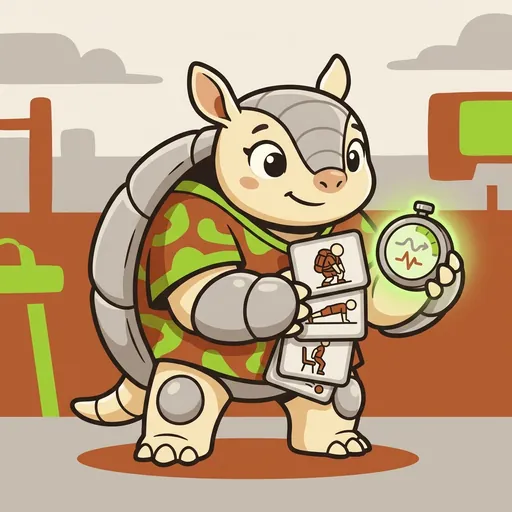
BRACE — internal armor. tight middle, free limbs.
Listen along — Brace
Loading audio…
Press play to listen along. The line being read lights up as you go.
Show full transcript
Loading transcript…
Chapter 3 — Brace and the Internal Armor That Steadies Every Move
The library cart was piled higher than Brace was tall.
Brace is a small armadillo, a tween like you, round and stone-grey with soft plates down her back. She had a loose tunic thrown over her shell and a stack of cue cards tucked in her pocket, and right now she had a very full cart of books to move across a very long room. The other kids at the burrow watched her the way you watch someone about to drop something.
She didn’t drop it.
Brace gripped one handle and squeezed her whole middle at once — front, sides, and the small of her back — like she was getting ready for a friendly poke in the belly. Then she walked. The cart pulled hard to one side, trying to bend her sideways, but she stayed straight as a fence post the whole way. When she set it down, she wasn’t even breathing hard.
“How did you not tip over?” a small mouse asked.
“Internal armor,” Brace said, patting the round front of her tunic. “Tight middle, free limbs. My arms carried the cart. My middle just held me up so the cart couldn’t fold me in half.”
The mouse squinted at her. “You don’t look like you lift heavy stuff.”
Brace grinned. “That’s the best part. You can’t see it. It’s on the inside.”
Brace grew up near the desert burrows, where her whole family were famous long-armored walkers. They hauled water and firewood for the whole village, up slopes and across sand, and never once threw out their backs.
When she was small, she thought it was because they were tough on the outside — because of the plates. Her grandmother set her straight one evening, handing her a heavy clay jug.
“Carry that to the fire and don’t let it bend you,” Grandmother said.
Brace wrapped both arms around the jug and started to lean, and her grandmother pressed one paw gently against Brace’s belly. “No. Don’t lean. Get hard right here. Tighten everything around your middle, all the way around, like a strong can. Then walk.”
Brace tried it. The jug still felt heavy — but she didn’t fold. Her back felt safe, held, like something inside her had turned into a brace between her top half and her bottom half.
“There,” Grandmother said. “The armor everyone can see is nothing. It’s the armor inside that keeps you from breaking. That’s the one that matters. Big kids, small kids, round kids, thin kids — they can all build it. It’s not how you look. It’s what you can hold.”
Brace never forgot the feeling of her middle going solid and steady. She practiced it carrying everything she could find.
When Brace was twelve, she walked all the way to FitQuest to learn more.
Her mentor there was named Brio, and Brio met her at the door with a question. “Show me what you do.”
Brace didn’t say a word. She dropped to the floor into a front plank, straight as a board from her head to her heels, and held it. She breathed slow and easy through her nose the whole time. Ten seconds. Twenty. Thirty. Her middle never sagged and her back never dipped.
Then she stood, picked up the heaviest bag in the room, held it in one paw, and walked a straight line while it tried its best to yank her over. It couldn’t.
Brio watched, arms folded, then finally nodded. “You keep your middle steady so the rest of you can move free. Most kids try to move their middle. You hold yours still. Welcome, Brace. This is your workshop now.”
Brace’s workshop filled up fast the next morning. She held up a cue card with a picture of a kid carrying a fat backpack.
“Watch closely,” she said, and dropped into a plank. “Feel all the way around your middle — front, sides, and back — get it tight, and keep breathing. This isn’t about muscles you can see. It stops your body from folding. That’s the real job.”
A tall kid named Ollie tried it and immediately let his hips sag toward the floor.
“Squeeze like you’re about to get a gentle poke in the belly,” Brace called. “There — feel that?”
Ollie’s whole middle went firm. His body straightened into a line. “Oh,” he said. “That’s different than doing sit-ups.”
“Way different,” said Brace. “Sit-ups bend your spine over and over. Bracing keeps it from bending. They’re opposite jobs — and real life needs the holding-still one way more.” She stood and picked up the heavy bag again. “This is a suitcase carry. The bag tries to bend me sideways. My middle says no. It’s one of the best things you can practice, because you already do it every day — groceries, backpacks, pushing a stuck door.”
Ollie carried the bag across the room, wobbled, then locked his middle and steadied. He set it down and looked at his own belly like it had surprised him.
“You have a strong core,” Brace told him. “Right now. Not someday when you look a certain way — right now. Lots of round, soft kids have really strong middles. That’s the whole secret. What your core does and what your body looks like are two different things.”
At the end of the day, when the others had gone, Ollie stayed behind.
“I used to think being strong meant your stomach had to look a certain way,” he said quietly. “My cousin’s always talking about that.”
Brace sat down next to him on the workshop floor. “A lot of people think that. But think about what you did today. You carried a heavy bag all the way across the room and your back felt fine. You held a plank. You stood up strong.” She made a circle with her paws. “Your middle is the link between your top and your bottom. When that link is solid, everything you do is safer and easier. That’s not about a mirror. That’s about being hard to knock down.”
Ollie thought about it. Then he sat up a little taller, pulled his middle tight the way she’d shown him, and just… felt it. Solid. Held. Like nothing could tip him over.
A slow, warm certainty spread through him, the steady kind you feel when your whole body finally holds you up and you know, deep down, you’re not going to fall.
“That feels good,” he said, surprised. “Really good. Like I’m safe inside myself.”
Brace nodded, patting the round front of her own tunic. “Internal armor. Tight middle, free limbs.”
The FitQuest ensemble
Brace is part of FitQuest's distributed-narrative cast. Each character embodies a different curricular primitive; together they teach the full subject.
-
Push
Push-pattern (chest press / push-up / push-door-open) — force-INTO-space; foundational upper-body functional movement
-
Hinge
Hip-hinge pattern (deadlift / picking-up-groceries) — BENDING-AT-THE-HIP-not-the-spine; anti-back-pain primitive
-
Breath
Breath as foundational locomotor + autonomic-regulation — nasal-breathing default + box-breath + breath-as-tempo
-

Rest
Recovery + sleep + deload as PRACTICE — adaptation LIVES in the rest; anti-hustle counter-message