
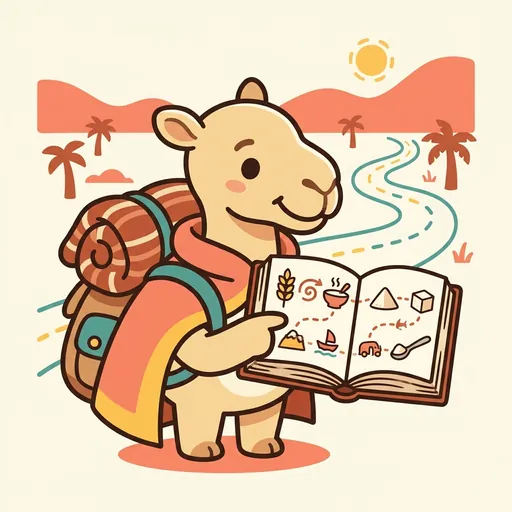
Bridge
COGNATES + LOANWORDS — *shared roots; trade-route borrowings. languages are connected through history.*
Listen along — Bridge
Loading audio…
Press play to listen along. The line being read lights up as you go.
Show full transcript
Loading transcript…
Chapter 4 — Bridge and the Words That Crossed Borders
The market square smelled of cinnamon and dust, and Bridge the camel-tween was on his knees in the middle of it, chasing a word.
A merchant had just haggled over a sack of sugar, and the sound of it — sukkar — snagged on Bridge’s ear like wool on a thorn. He tugged his little atlas out of his pack and flipped it open on the cobblestones, tracing a line with one hoof. “Sanskrit,” he muttered, following the ink. “Śarkarā. Then Persian, shakar. Then the traders carried it into Arabic, sukkar.” His hoof kept sliding. “Italy said zucchero. And here it lands, on this cart, on this Tuesday.” He looked up at the startled merchant, cape slipping off one shoulder. “Do you know how far your sugar walked to sit in that sack?”
The merchant did not know. Bridge, grinning, told him anyway.
Bridge had grown up on the trade road, in a family of caravaneers who crossed continents for a living. His mother could smell a mountain pass a week away. His grandfather had once walked from one sea to another and back.
But it was his aunt who gave Bridge the thing that changed him. She was old, her hump gone soft and lopsided, and one night by the fire she pressed a small thick book into his hooves. “The camel carries what the trader gives,” she said, poking the cover. “Salt, silk, a bolt of cloth. But listen, little one — the trader carries something too. A word. He says it at every stop, and by the time he reaches the far city, that word has stepped off the road and stayed.” She smiled her lopsided smile. “Both arrive somewhere new. Both change a little on the way. Fill this book. Follow the words home.”
Bridge filled the book. He never stopped.
He was twelve when he walked the last stretch of road into LinguaQuest, atlas strapped to his back, hooves aching. Mira was waiting at the gate, and instead of a greeting she gave him a puzzle.
“There’s a word I can’t place,” she said. “Algebra. An old word. A math word. Where does it come from?”
Most travelers would have shrugged. Bridge dropped his pack, knelt, and opened the atlas right there in the dirt. “Al-jabr,” he read, following the line backward. “Arabic. It meant the reunion of broken parts — putting a thing back together.” His hoof traveled on. “A scholar wrote it in Baghdad, more than a thousand years ago. Traders and scholars carried it into Latin, and Latin handed it to us.” He sat back on his heels. “It didn’t fall out of the sky into your math class. Somebody walked it here.”
Mira crouched to look at the traced line, and something in her face went soft. “You didn’t just answer me,” she said. “You showed me the road.” She helped him to his feet. “Stay. There’s a workshop with your name on it.”
Bridge’s workshop was small and lined with maps, and the day a cluster of students crowded in, he had a jar of ketchup on the table for no reason they could see.
“Watch,” he said, and opened the atlas to a page thick with arrows. “Say a word travels. Where does it go?” He traced one route for them — silk and tea and paper strung along the old Silk Road, ginger and cinnamon riding the spice ships, whole crowds of words spilling into English after armies crossed in the year 1066. “Nearly six words in every ten you use came in from French or Latin,” he said. “Borrowed. Every one.”
A girl in the front frowned. “So English is fake? All borrowed?”
“Richer,” Bridge said at once, gently. He picked up the ketchup. “This word started as kê-tsiap in southern China — a fish sauce, not a tomato in sight. Malay traders said kichap. English sailors said ketchup.” He set the jar down with a little thump. “The sauce changed. The recipe changed. The word held on the whole way.” He looked around at them. “A word that travels isn’t broken. It’s a passport with a hundred stamps in it.”
The girl turned the idea over. “So when someone says a word ‘doesn’t belong’—”
“Then they don’t know where it’s been.” Bridge tapped his atlas. “Every language is a quilt. All borrowed pieces, stitched together. Nobody’s word is a stranger here.”
After the students had gone, the girl stayed behind. She was tracing one of the arrows with her finger, following it out past the edge of the map.
“My grandmother has a word,” she said quietly. “For a kind of soup. It’s not an English word. Kids at school laughed at it once.”
Bridge came and sat beside her. He didn’t reach for the atlas. “Say it,” he said. She did, careful and small. He listened the way you listen to something rare. “That word crossed a border to be with you,” he said. “It’s carrying your grandmother’s whole kitchen inside it. Her mother’s kitchen too, probably.” He rested a hoof on the map. “It belongs on the page. Right here, with the sugar and the algebra and the ketchup. All travelers. All home.”
The girl said her grandmother’s word again, and this time it stood up straight. Bridge felt the warmth of it spread all the way through his chest — that quiet, steady gladness of watching someone stop being ashamed of where they came from.
“There,” he said softly. “Feel that? Every time you welcome a word’s whole journey — your heart makes a little more room. And it never runs out.”
The LinguaQuest ensemble
Bridge is part of LinguaQuest's distributed-narrative cast. Each character embodies a different curricular primitive; together they teach the full subject.
-

Bough
Language families (genetic descent — Indo-European / Sino-Tibetan / Afro-Asiatic / Niger-Congo / Austronesian)
-

Drift
Sound change (phonological evolution — Grimm's Law, vowel shifts, palatalization)
-

Glyph
Writing systems (alphabetic / abjad / abugida / syllabic / logographic — and how each captures speech)
-

Cant
Sociolinguistics — dialect, register, code-switching, formal/informal speech
-
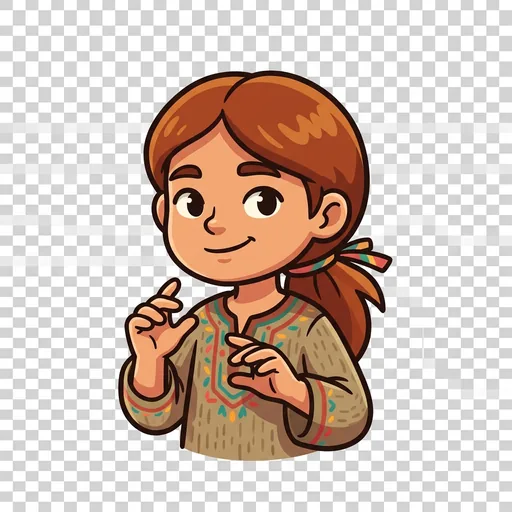
Sign
Signed languages — full natural languages spoken with hands, face, and space; each Deaf community's own, never 'just gestures'
-
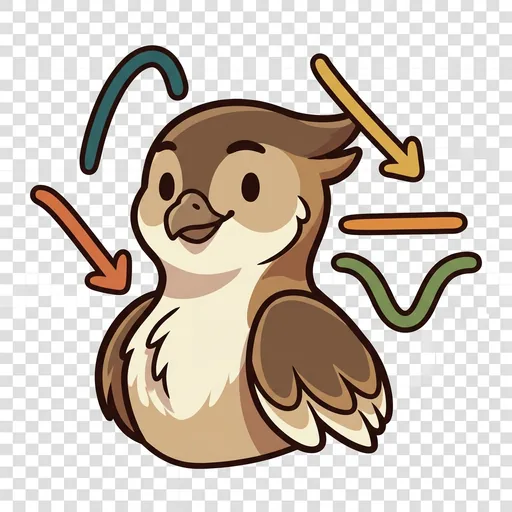
Swoop
Tone — pitch that changes a word's meaning (tonal languages); precise and sophisticated, never 'sing-song' or 'exotic'
-
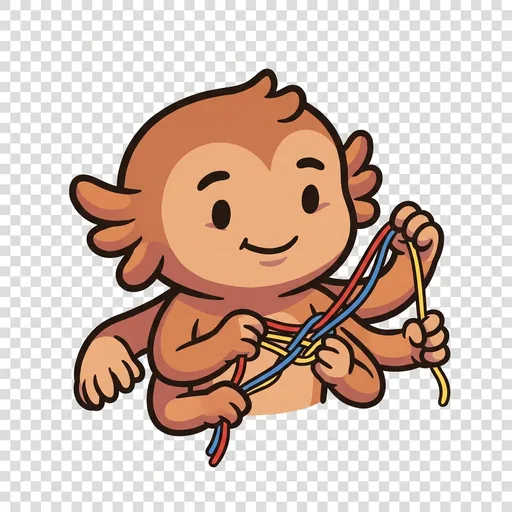
Weft
Word order / syntax — languages arrange words differently (SVO/SOV/verb-first); no order is 'backwards,' each is complete
-

Lex
Untranslatable words — words no other language has in one breath; not a gap in your language but a gift another can offer
-

Nook
Endangered languages + revitalization — keeping fading languages safe; decline is from histories of harm, never the speakers' fault; communities lead the revival