Cant
SOCIOLINGUISTICS — *dialect, register, code-switching, formal/informal. how you speak depends on who you're speaking with.*
Listen along — Cant
Loading audio…
Press play to listen along. The line being read lights up as you go.
Show full transcript
Loading transcript…
Chapter 5 — Cant and the Voice That Shifts Without Shame
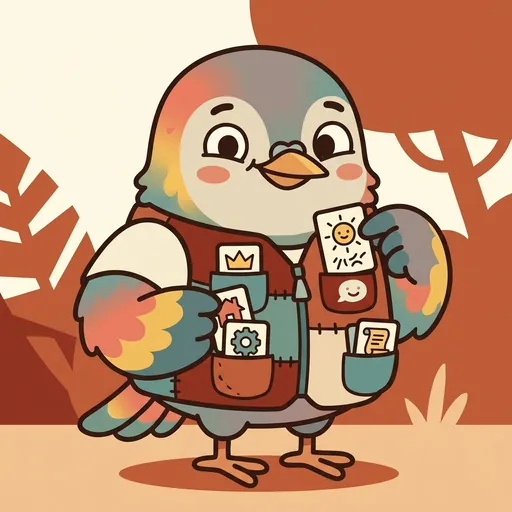
The market square went quiet the moment the storm-cloud rolled in, because Cant the starling changed his whole voice mid-sentence.
He’d been chatting with a bread-seller, warm and loose — “yeah, so, the trick is you let the dough just sit, y’know?” — when the wind picked up and the first fat raindrops hit the awnings. Cant snapped upright on his perch, and his voice came out sharp and carrying, cutting clean across the whole square. “COVER THE STALLS. RAIN’S FAST. MOVE NOW.” Merchants scrambled. Tarps went up. Then the danger passed, and Cant turned right back to the bread-seller, soft again. “So — where were we? The dough.”
The bread-seller blinked. “You’ve got a whole different bird in there when you need it.”
“Same bird,” Cant said, ruffling his shimmery feathers. “Different call. It’s the only way I know how to be understood.”
Cant came from a long line of village announcers — starlings whose whole family trade was knowing which call fit which moment. His grandfather had a warning-call that could clear a square, a song-call for weddings, and a low easy chatter-call for the shop.
When Cant was small, he got them mixed up once. He used the loud warning-call to ask his mother for breakfast, and half the village came running with buckets, thinking there was a fire. He was so mortified he wouldn’t speak at all for two days.
His grandmother found him hiding in the rafters. She didn’t scold him. She sat beside him and said, “Different people need different calls, little one. That’s not confusion — that’s a gift you haven’t finished unwrapping yet. The call that fits the listener is the right call for that moment.” She nudged him gently. “You didn’t do it wrong. You just hadn’t learned which pocket to reach into.” That was the day Cant started sewing his vest — a pocket for every voice, so he’d never freeze up again.
He was thirteen when he arrived at LinguaQuest, vest full of voice-cards, and Mira met him with a challenge instead of a hello.
“There’s a family down the road,” she said. “They speak a way some folks call ‘broken.’ The kids are ashamed of it. What would you tell them?”
Cant didn’t reach for a card. He answered from his chest. “I’d tell them nothing’s broken,” he said. “The way they talk has rules — real ones, as tight as any school-book. It just has different rules.” He fluffed up, indignant on their behalf. “When someone calls a way of talking ‘broken,’ what they usually mean is ‘it’s not how the powerful people talk.’ That’s not the same as wrong.”
Mira watched him a long moment. “You didn’t recite me a lesson,” she said. “You defended somebody.” She stepped aside and opened the gate. “The workshop at the end of the row is yours.”
Cant’s workshop had a mirror on one wall and a rack of his voice-cards on the other, and the day a nervous cluster of students filed in, he decided to show them rather than tell them.
He pulled a card labeled formal and cleared his throat. “Good afternoon,” he said, in a smooth, buttoned-up voice. “It is a pleasure to make your acquaintance.” The students giggled. He tugged a second card — informal — and slouched. “Yeah, hi, what’s up.” More giggles. Then a third card, and his voice went warm and cozy, the tone you use with people who’ve known you forever.
“Three voices,” Cant said. “One bird. Three sets of rules I know by heart. That’s not being confused — that’s being good at more than one.” He tapped the mirror. “People do this all day long. You do it. You talk one way with your friends, another way in a school essay, another way at your grandmother’s table. Switching between them has a name — code-switching — and it’s a skill, not a stumble.”
A boy near the back spoke up, quiet. “My cousin talks two ways. At home and at school. Somebody told him he was ‘faking’ at school.”
“He’s not faking,” Cant said, firm as the warning-call but gentle. “He’s bilingual in tone. He can read a room and reach for the right pocket. That’s harder than what the person mocking him can do, not easier.” He crossed to the rack and touched the family-talk card. “And this one — the way you speak at home, the way your own people speak — that one is never up for grading. You can learn the school-voice too. You can carry both. Nobody makes you throw one away to hold the other.”
After the lesson, the boy lingered by the mirror, not quite looking at himself.
“At home we say things a way my teacher marks wrong,” he said. “In red pen.”
Cant hopped down beside him. He didn’t argue with the teacher; he just spoke to the boy. “The way your family talks isn’t a mistake in your mouth,” he said. “It’s a whole grammar, handed down, working exactly as it’s built to. Learn the essay-voice for the essay — that’s a good pocket to have. But when you go home and slip back into your own words—” he paused, and his own voice dropped into something soft and private — “notice the feeling. That warm, steady one, right here in your chest.” He touched a wing to the boy’s ribs. “That’s home. It travels with you everywhere you go, in every voice you own.”
The boy tried it — said a sentence the home way, out loud, on purpose, not flinching. And there it was: the warmth, steady and sure. He looked up, surprised by it.
“Feel that?” Cant said, feathers shimmering. “Hold onto it. Your voice can shift a hundred ways — but that feeling underneath doesn’t have to shift at all. And it never, ever has to be ashamed.”
The LinguaQuest ensemble
Cant is part of LinguaQuest's distributed-narrative cast. Each character embodies a different curricular primitive; together they teach the full subject.
-

Bough
Language families (genetic descent — Indo-European / Sino-Tibetan / Afro-Asiatic / Niger-Congo / Austronesian)
-

Drift
Sound change (phonological evolution — Grimm's Law, vowel shifts, palatalization)
-

Glyph
Writing systems (alphabetic / abjad / abugida / syllabic / logographic — and how each captures speech)
-
Bridge
Cognates and loanwords (shared roots across languages; trade-route borrowings)
-
Sign
Signed languages — full natural languages spoken with hands, face, and space; each Deaf community's own, never 'just gestures'
-
Swoop
Tone — pitch that changes a word's meaning (tonal languages); precise and sophisticated, never 'sing-song' or 'exotic'
-
Weft
Word order / syntax — languages arrange words differently (SVO/SOV/verb-first); no order is 'backwards,' each is complete
-

Lex
Untranslatable words — words no other language has in one breath; not a gap in your language but a gift another can offer
-

Nook
Endangered languages + revitalization — keeping fading languages safe; decline is from histories of harm, never the speakers' fault; communities lead the revival