
Crumble
CRUMBLE — nothing is wasted; everything is returned. Decomposer microbes break down dead leaves, fallen logs, and food scraps into nutrients the soil can use again. The great recyclers — turning endings back into beginnings.
Press play to listen along. The line being read lights up as you go.
Show full transcript
Loading transcript…
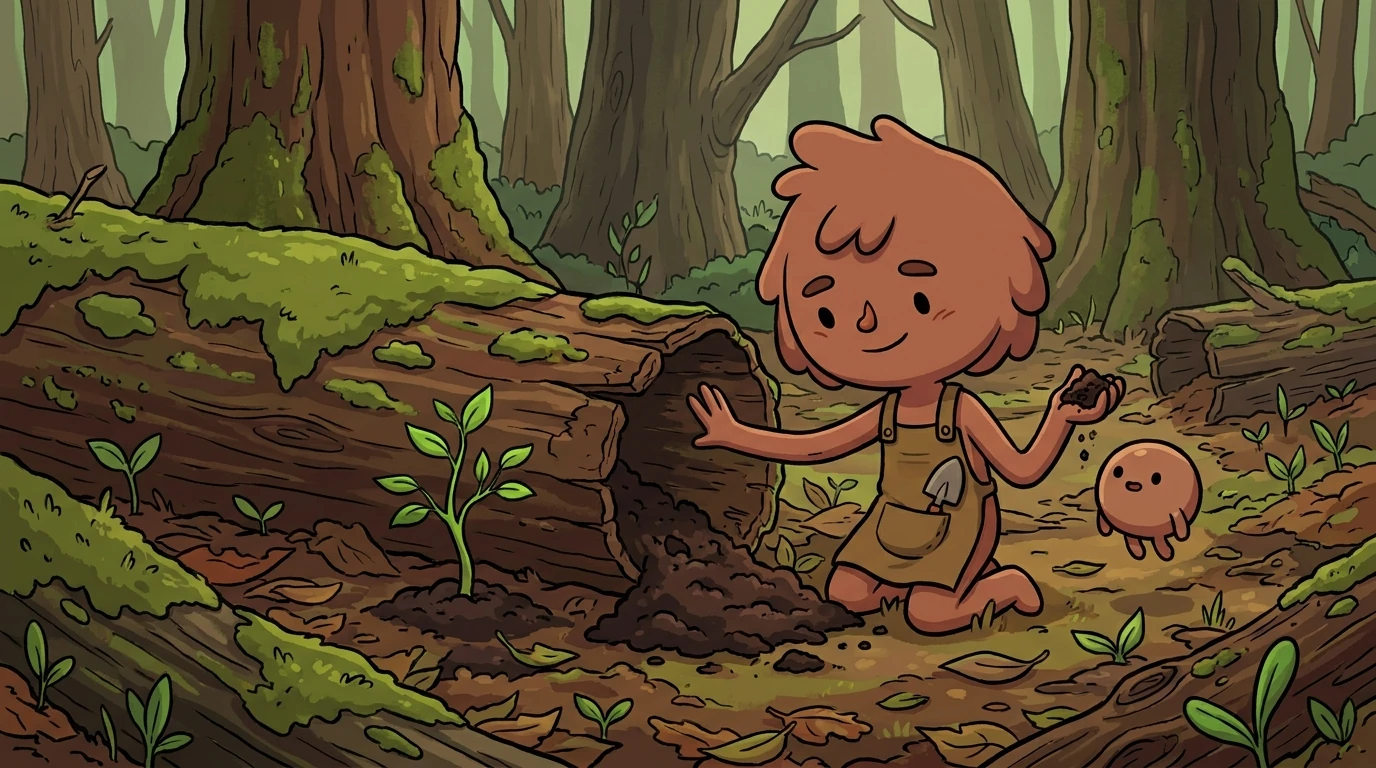
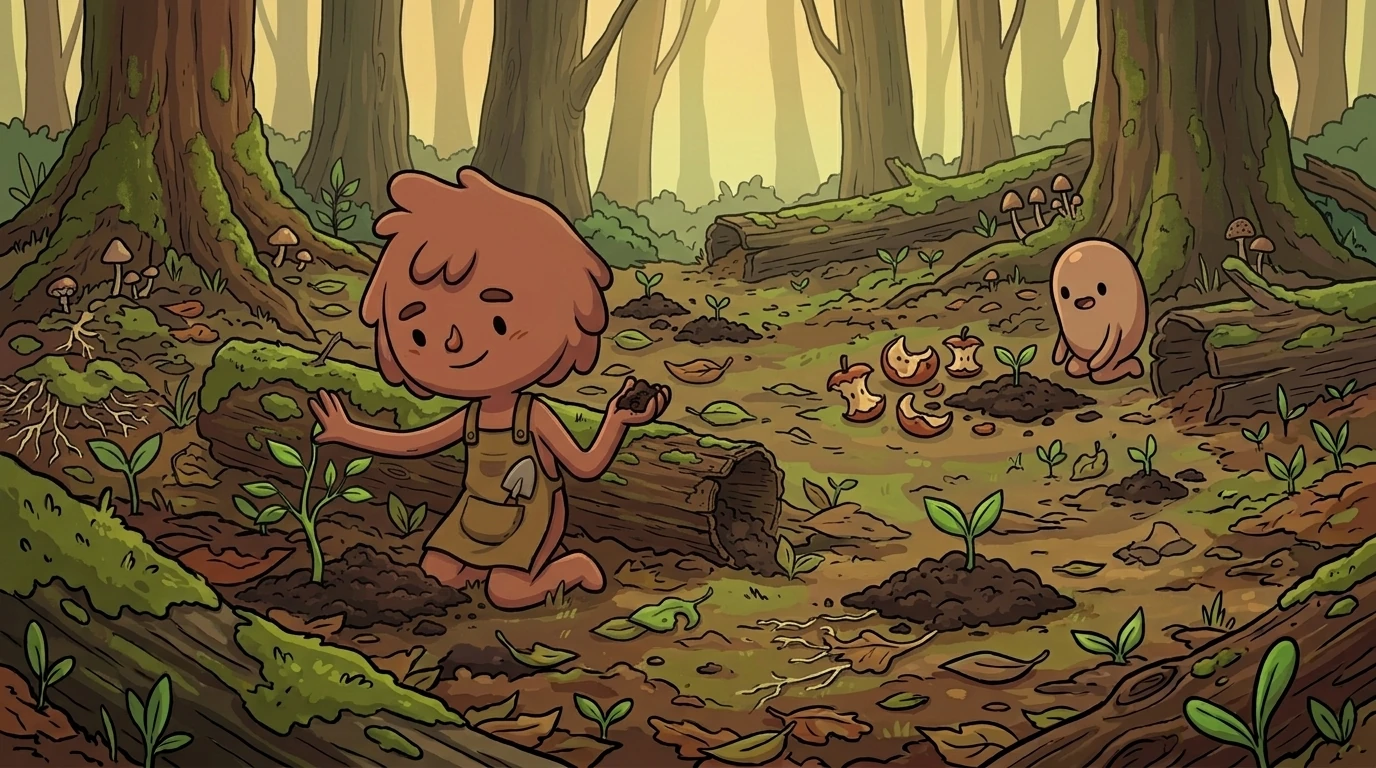
On the floor of the oldest forest in MicrobeLab, a soft russet-brown tween named Crumble knelt over a fallen log and did the slowest, gentlest work in the world.
The log had been a tree once. Now it was going soft. Crumble pressed a thread-thin hand against the bark, and where the fingers touched, the wood darkened and loosened, breaking into crumbs of rich earth. A younger microbe drifted over, watching Crumble turn something dead into something dark and alive.
"Isn't that sad?" the little one asked. "The tree's all finished."
"Finished isn't the same as gone," Crumble said, and lifted a pinch of the new soil so it caught the light. "Watch what it becomes."
Beside the crumbling log, a green seedling had already pushed up through the dark. Crumble tucked the pinch of soil around its roots. The whole forest floor was like this — leaves softening into earth, logs melting into soil, and everywhere, small new green things drinking it up.
"I'm not breaking the tree," Crumble said. "I'm giving it back. The tree drank the soil to grow. Now I return the soil so the next thing can grow too." Crumble smiled, spade tucked in a little earth-toned apron. "Nothing is wasted. Everything is returned."
The younger microbe looked at the fallen log — really looked — and for the first time it didn't look like an ending at all.
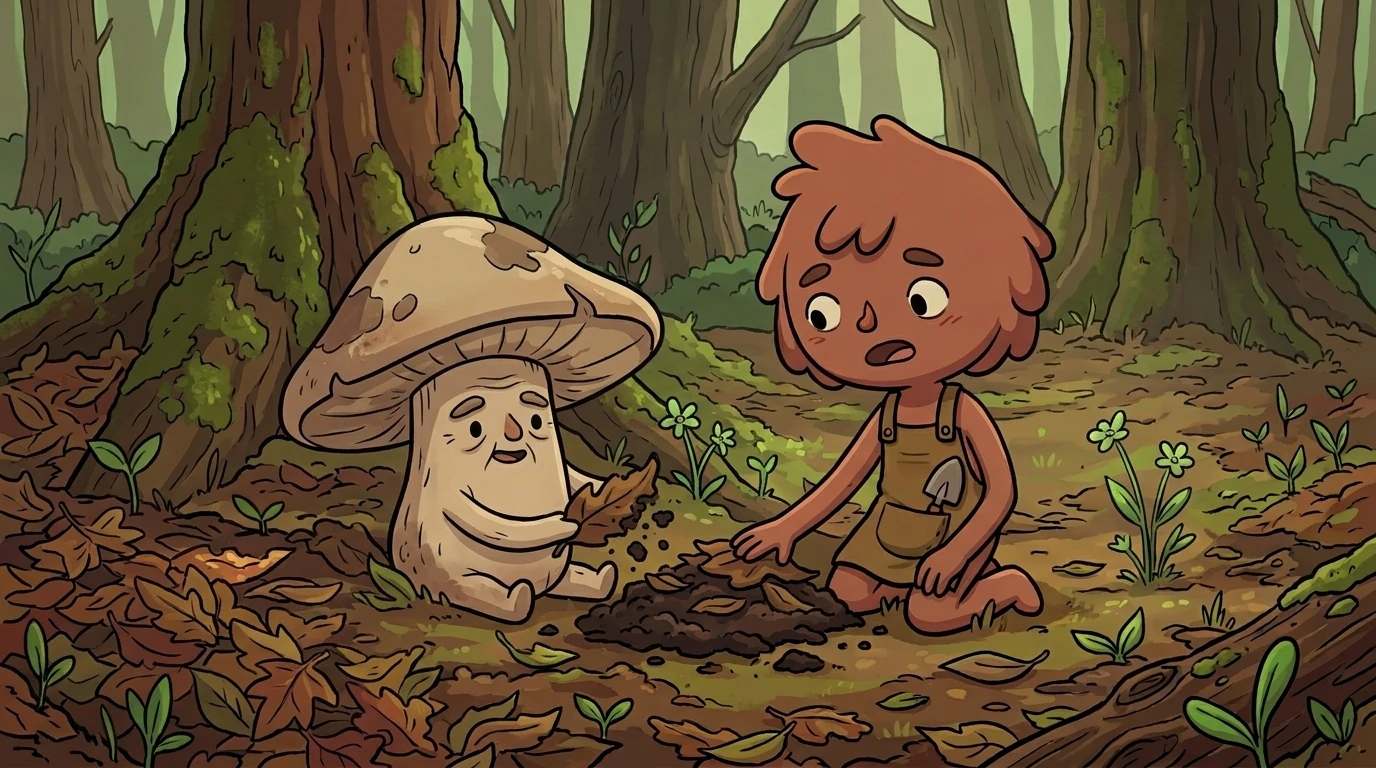
Crumble had grown up on that same forest floor, among the fallen leaves, and had spent a whole autumn convinced something terrible was happening.
The leaves kept dropping. First a few, then hundreds, then a thick brown blanket over everything. To small Crumble it felt like the forest was losing something it couldn't get back — like watching a friend give away everything they owned. It made Crumble's chest go tight and heavy, that piling-up of endings with nowhere for them to go.
An old mushroom found Crumble sitting glumly under the leaf-fall. "You look like the sky's coming down," it said.
"Everything's dying," Crumble whispered. "And it's just — sitting here. Wasted."
"Ah." The mushroom settled beside the little one, in no hurry at all. "It only looks wasted. Wait till spring." It nudged a rotting leaf, already softening into dark crumbs. "This one fell in October. By April it'll be soil, and by May it'll be a wildflower. The forest never throws anything away. It just keeps giving everything a new shape."
Crumble put a hand into the warm dark leaf-mush and felt something loosen in that tight, heavy chest. The endings weren't piling up into nothing. They were piling up into next spring.
"So it's not gone," Crumble said slowly. "It's just — waiting to come back."
"Now you've got it," said the mushroom.
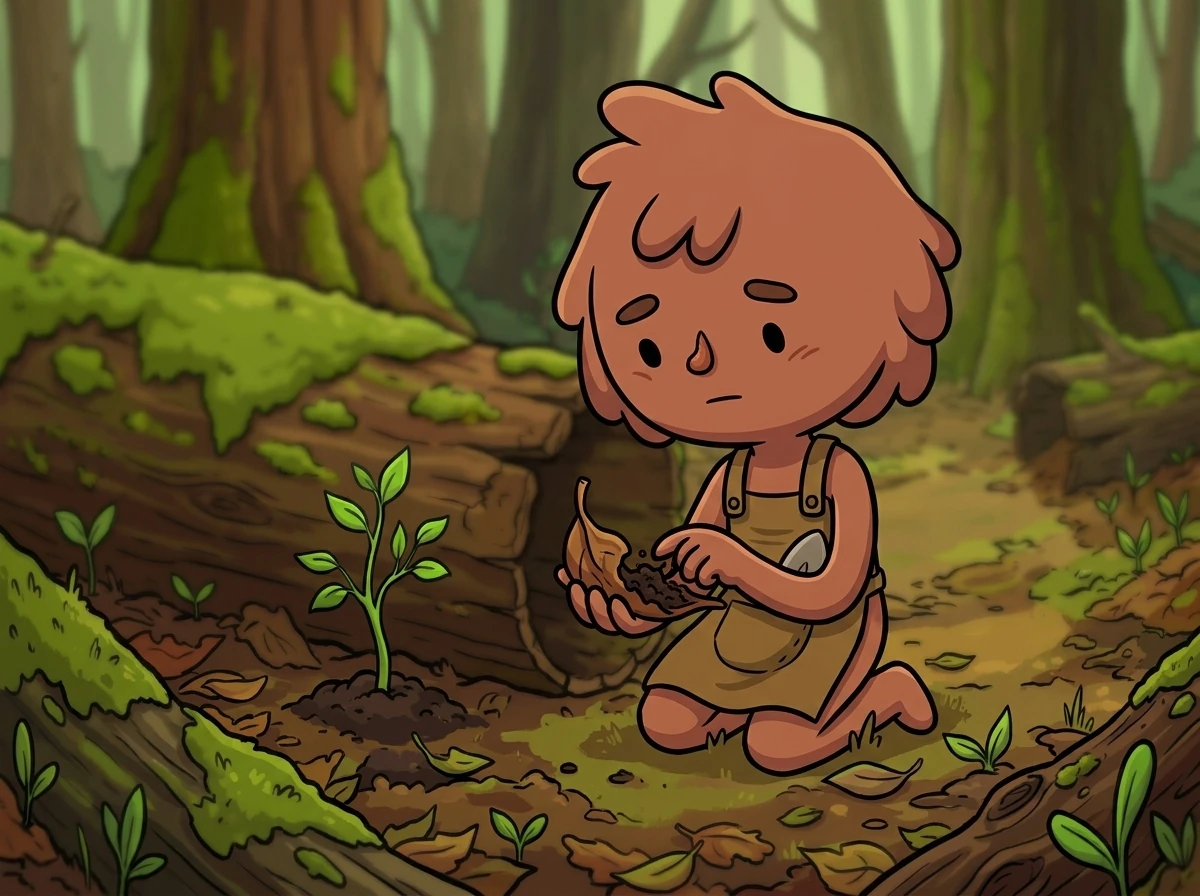
Crumble walked to the heart of MicrobeLab at twelve, because a place that studied tiny living things ought to understand the ones that turned endings back into beginnings.
Spore, the old mentor who kept the lab, met Crumble at the door and asked just one thing. "Show me what a decomposer does."
Crumble didn't answer with words. Crumble picked up a curled brown leaf from the step, cupped it in both hands, and pressed. Threads too small to see reached out from Crumble's fingers into the leaf, and the leaf went soft, then dark, then fell apart into a little heap of rich crumbly earth on the mentor's palm.
"It's ruined," Spore said, testing.
"It's returned," Crumble said. "A plant pulled these nutrients out of the soil to build that leaf. I put them back. Without me and my kind, the nutrients would stay locked in dead things forever, and the soil would run empty, and nothing new could grow." Crumble looked up. "I don't destroy the leaf. I finish the circle."
Spore looked at the dark soil in his palm for a long moment. "You belong here," he said.
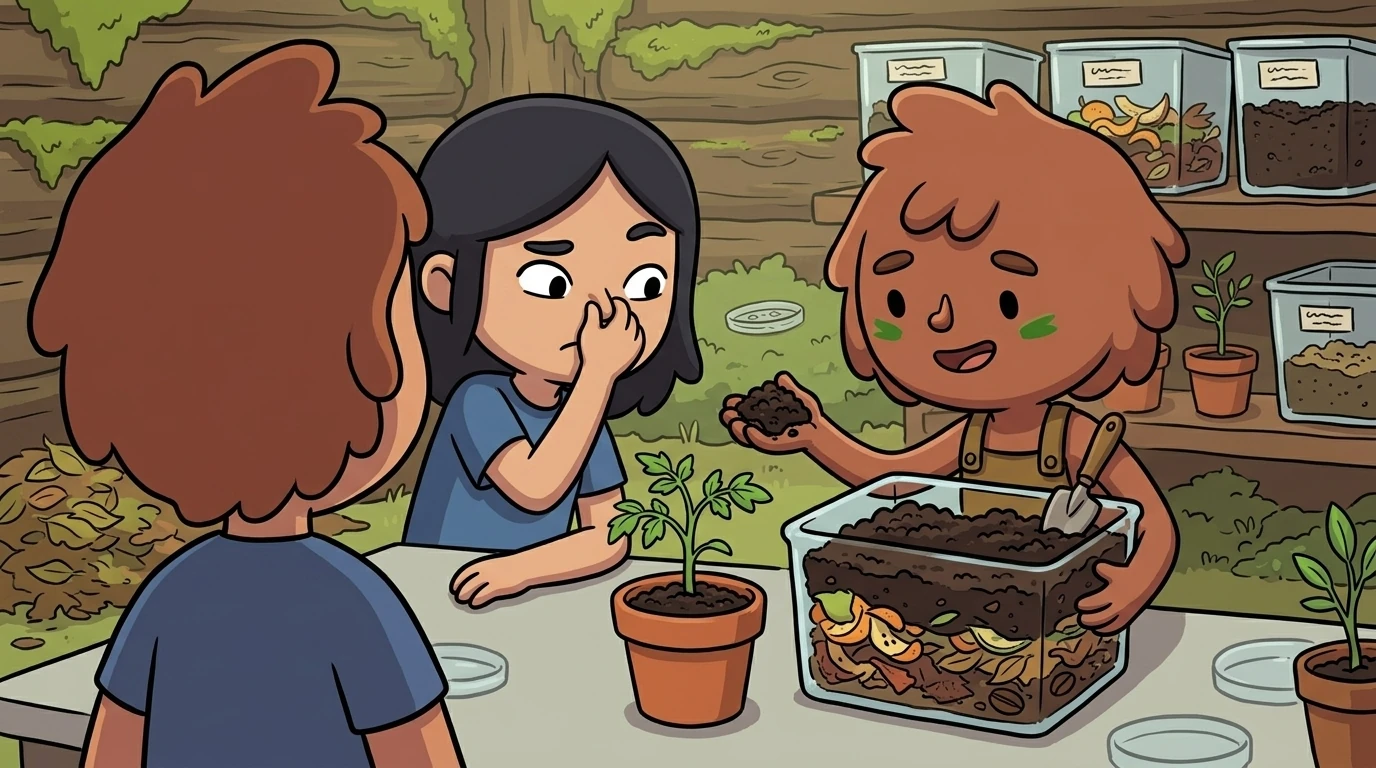
Crumble's workshop smelled like a forest after rain, and it was full of things quietly turning back into soil.
A student came in one afternoon, holding her nose. "It's gross in here," she said. "Rotting stuff everywhere."
Crumble laughed. "Everybody says that. Come look before you decide." Crumble led her to a glass box packed with fruit peels, old leaves, and coffee grounds — and, at the very bottom, dark crumbly soil richer than anything in the garden outside.
"That was kitchen garbage a few weeks ago," Crumble said. "Peels and scraps somebody was going to throw away. My kind — fungi and bacteria, working together — broke it down into that." Crumble scooped a pinch of the dark soil. "The richest soil in the whole lab. Made entirely out of what people called garbage."
The student leaned in, forgetting her nose. "So the peels aren't gone?"
"Watch." Crumble sprinkled the dark soil into a small pot and pressed a seed into it. "This seed's going to grow using nutrients that used to be an apple core. The apple isn't gone. It's becoming a tomato plant." Crumble handed her the pot. "That's the whole trick. We take what's finished, break it down small, and hand it back to the living. We're not destroyers. We're returners."
The student cradled the pot like it was something precious now, watering the seed with careful hands.
Later, when the workshop had gone quiet, the student came back with the pot and one more question.
"When something's just rotting in the box," she said, "and you can't see the good part yet — how do you know it's turning into soil and not just... into nothing?"
Crumble thought about the autumn under the leaf-fall, and the tight heavy chest, and the old mushroom's slow patient voice.
"You wait, and then you feel it," Crumble said gently. "There's a moment — after all the softening and the breaking down — when you dig into the pile and it's warm and dark and full, and you know the whole circle just closed. Every leaf, every peel, every finished thing, packed back into soil that feeds what comes next." Crumble looked out toward the forest floor. "It used to scare me, all that ending. Now it's the calmest feeling I know. Nothing in a forest is ever really lost. It just keeps coming around again, asking nothing in return."
The student held her little pot up to the light, watching the first green thread of a seedling push out of soil that used to be an apple.
And she felt it too — that warm, hopeful calm, the quiet comfort of a circle that never breaks.
The MicrobeLab ensemble
Crumble is part of MicrobeLab's distributed-narrative cast. Each character embodies a different curricular primitive; together they teach the full subject.
-

Lacto
Lactobacillus + helpful-bacteria — 'Friend in your food. Friend in your gut.'
-

Yeast
Saccharomyces + helpful-fungi — 'I make air inside bread.'
-

Photo
Cyanobacteria + photosynthetic-microbes — 'Sunlight. Then air. Then everything else.'
-
Net
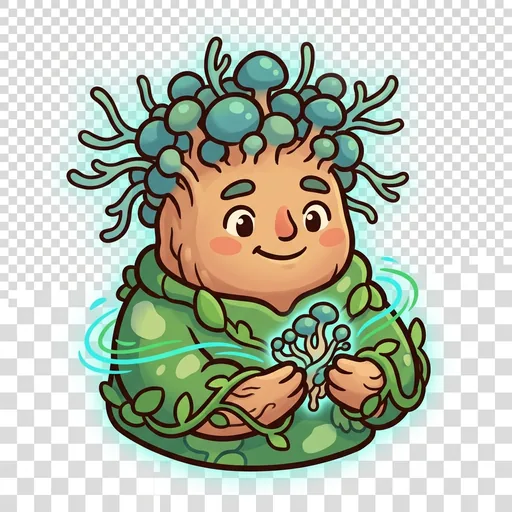
Mycorrhizal-fungi + nitrogen-fixers — 'Forests talk through me.'
-

Spore
Pathogens (opt-in gated) — 'Some friends. Some not. All real.'
-

Guard
Immune cells (T-cell / macrophage / B-cell) — 'I check IDs. Patient + careful.'
-

Thrive
Extremophile microbes that make a home in the hottest, coldest, saltiest places, showing life finds a way almost anywhere.
-

Shimmer
Bioluminescent microbes that turn energy into their own soft glow, lighting ocean waves and partnering with animals like tiny lanterns.
-

Colony
Microbes that build biofilms together, cooperating and protecting each other, because they are far stronger as a community than alone.