
Thrive
THRIVE — *life finds a way, even where nothing should live.* Extremophile microbes survive boiling hot springs, frozen ice, crushing deep sea, and water saltier than the ocean. Wherever the world seems impossible, some microbe has made it home.
Press play to listen along. The line being read lights up as you go.
Show full transcript
Loading transcript…
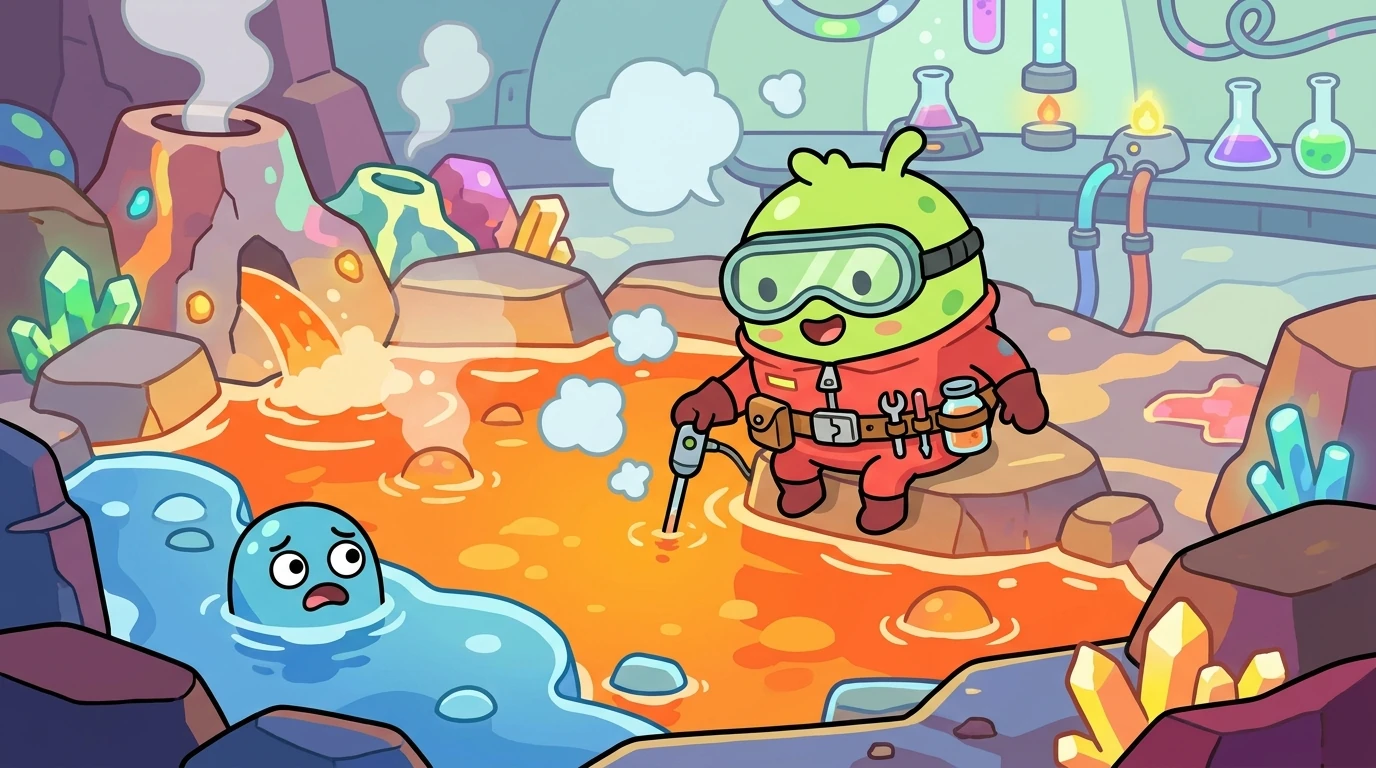
At the lip of a boiling hot spring in MicrobeLab, where the water hissed and steamed and no sensible creature would ever put down roots, a tiny round microbe-tween named Thrive was doing the one thing everyone kept telling her not to do. She was moving in.
She had a weatherproof lab-suit, tiny goggles fogged with mist, and a little kit of thermometers and salt jars slung over one armored side. The spring bubbled at a temperature that would cook an egg in seconds. Thrive dipped one careful sensor into it, read the number, and let out a delighted little whistle.
"Perfect," she said, to no one.
A visiting microbe drifted past on the cooler edge of the pool, took one look at where Thrive was headed, and squeaked. "You can't live there. That water's practically fire!"
"Watch me," said Thrive.
She let the current pull her over the edge and down into the scalding blue. The other microbe braced for the worst — for Thrive to curl up and come apart like a boiled leaf. Instead, Thrive settled onto a warm mineral shelf, stretched, and multiplied. Where there had been one small tough shape, there were suddenly two, then four, then a whole shimmering patch of them, glowing faintly against the steaming stone. The impossible water wasn't killing her. It was feeding her. Given her heat, given her minerals, she was doing what her kind did best — turning a place that should have been empty into a crowd.
"See?" she called up through the bubbles. "The world thinks this corner is empty. It's just waiting for someone built for it."
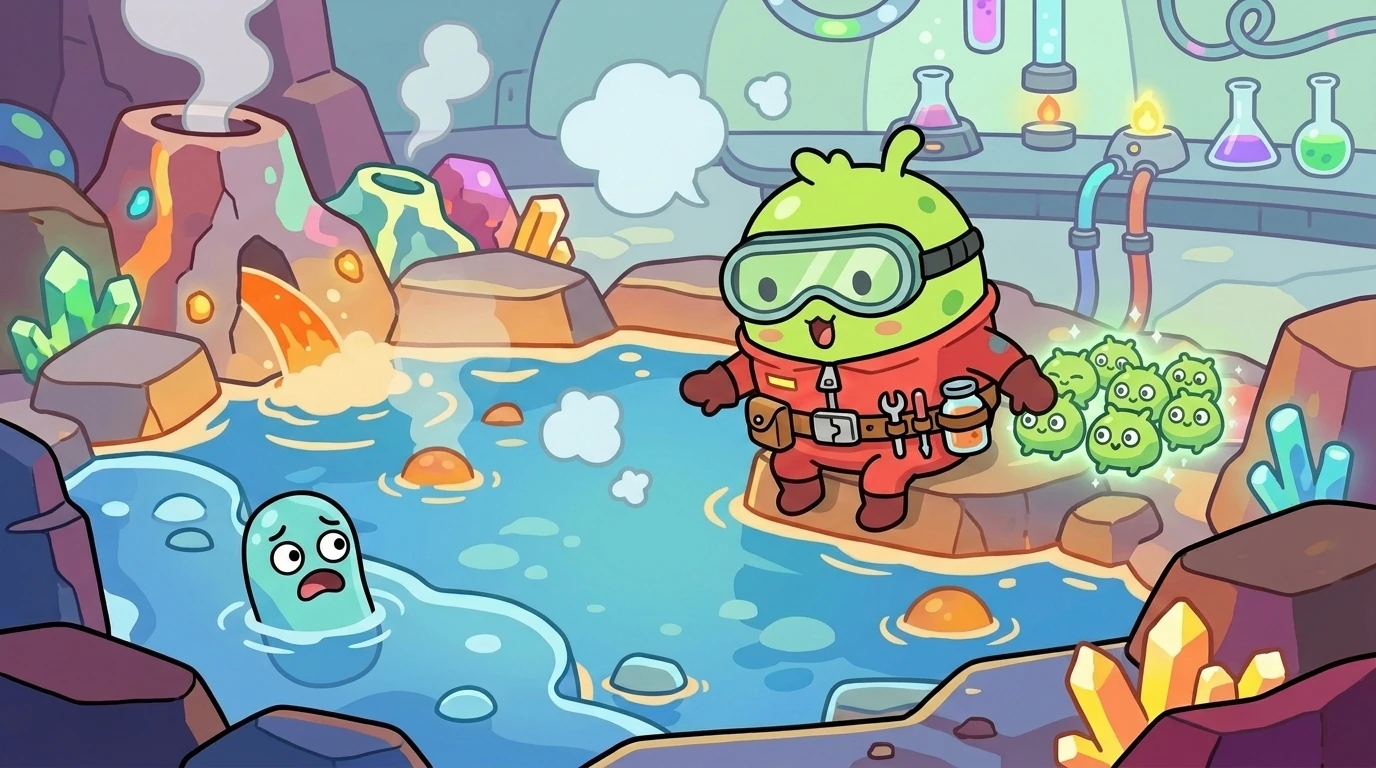
Thrive had learned that near this very spring, when she was small enough to fit on a grain of sand.
Back then she'd been afraid of exactly the thing she now loved. She'd huddle on the cool rim, watching the boiling middle, and think: there's nothing out there. I'm alone. The whole hot heart of this place is dead. It made her feel small in a bad way — like the world was mostly emptiness, with a few frightened specks clinging to the safe edges.
An old heat-loving microbe, one who had lived deep in the scald for longer than anyone could remember, drifted up beside her one day. She didn't tell Thrive to be brave. She just said, "You feel lonely out here, don't you? Like the harsh places are empty?"
Thrive nodded, miserable.
"Look closer, little one." The elder tipped toward the steam. "In the boiling water — life. In the ice up the mountain — life. At the bottom of the darkest sea, by vents that would melt stone — life. There is no corner of this world too harsh for someone to call home."
Thrive stared into the hot blue she'd been so sure was dead. And once she truly looked, she saw them — faint, tough, patient glimmers everywhere, all thriving. The harsh places weren't empty. They were full. The loneliness came apart in her chest and turned into the biggest wonder she had ever felt.
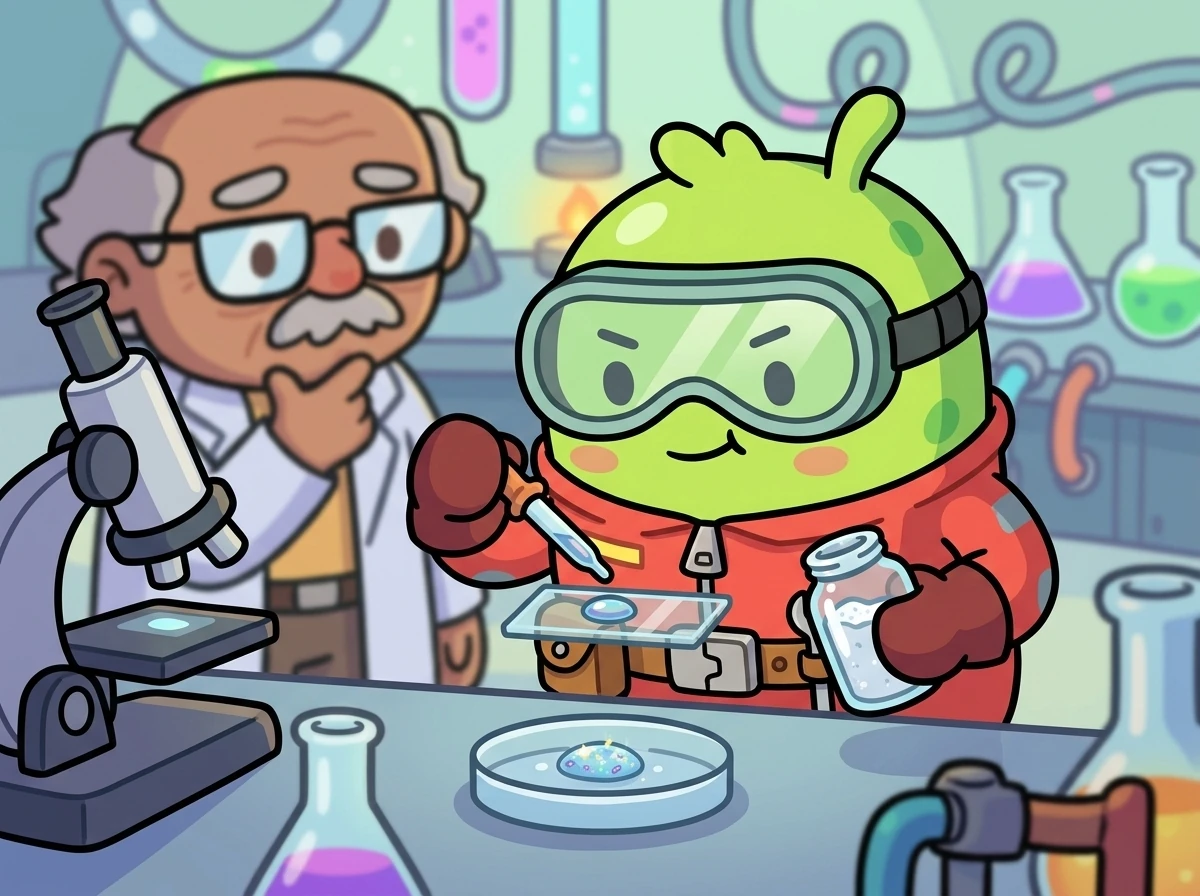
She walked to MicrobeLab at twelve, because a place that studied life ought to understand the kind of life that grows where nothing should.
Photo, one of the older cast who ran the habitat benches, met her at the door. He didn't ask her to prove she was tough. He asked one question. "Where does life live?"
Thrive didn't answer with words. She uncapped her salt jar — brine so heavy it stung the air — and tipped a single drop onto a clean slide. Then she waited. Within a moment the drop began to shimmer, tiny salt-loving specks blooming and dividing in water that should have shriveled anything alive.
"That should be a desert," Photo said, testing her.
"It is a home," Thrive said. "Give something the right conditions — even brutal ones — and it doesn't just hang on. It multiplies. It fills the place up." She watched her specks double again. "Nowhere is as empty as it looks."
Photo looked at the glittering, impossible drop for a long moment. "You belong here," he said.
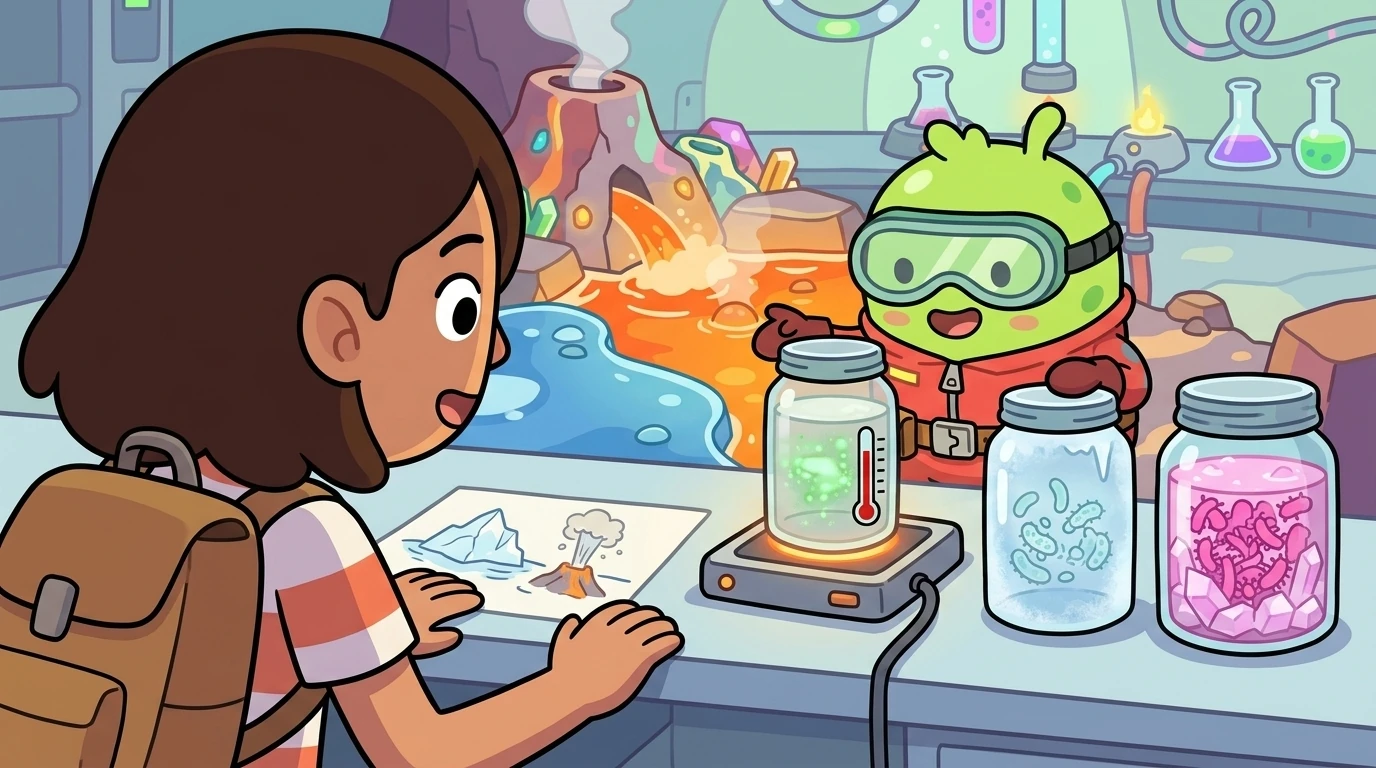
Thrive's bench was crowded with jars that were secretly alive.
A student came in one afternoon, slumped and stuck. She'd been staring at a diagram of a frozen glacier and a boiling geyser, and she pushed it away in frustration. "These places are dead," she said. "Why am I even studying them? Nothing lives there."
Thrive knew that slump. She'd felt it on the cool rim, years ago.
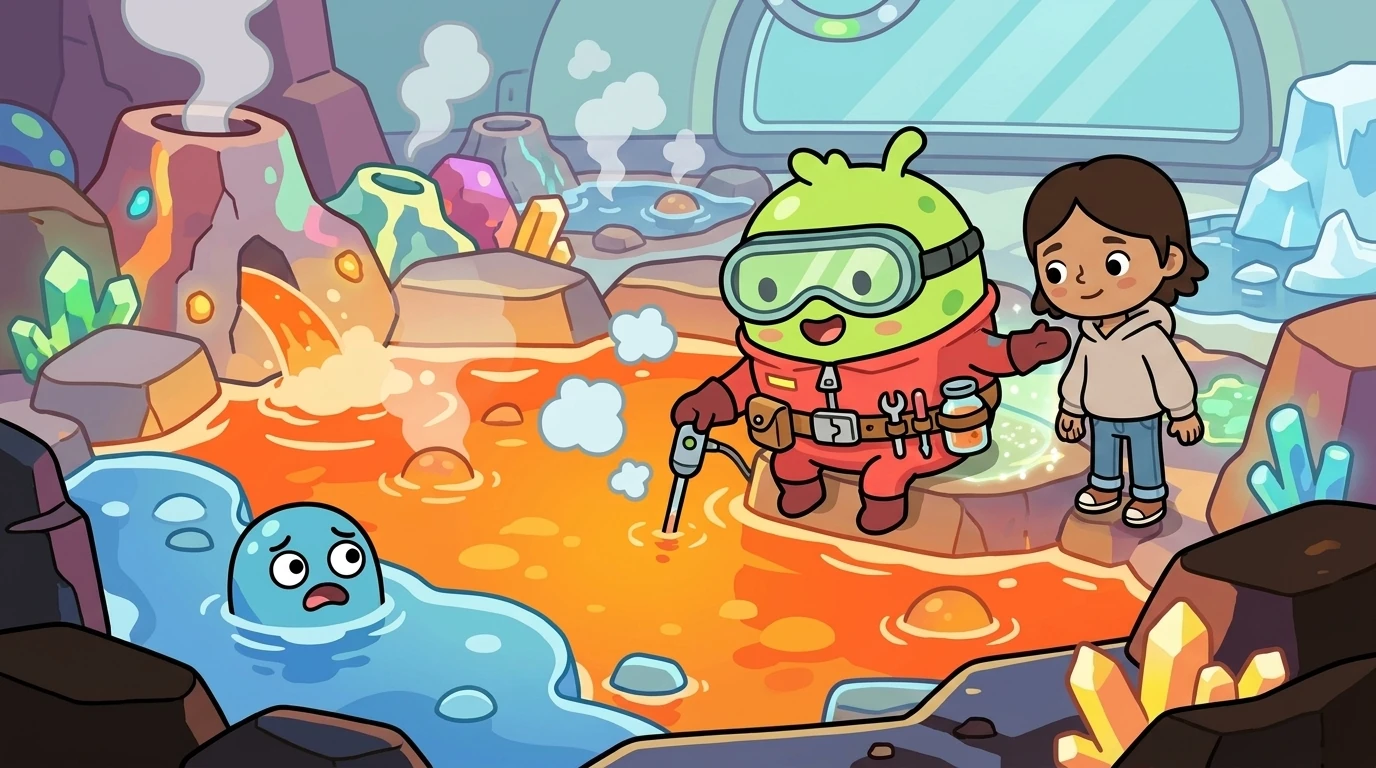
"Warm this jar for me," she said, sliding over a sealed jar of cloudy water and a little heat-pad. The student set it on the warmth. "Now watch the number." A thermometer strip on the side crept up. As it did, faint green glimmers woke inside and began to spread. "Heat-lovers," Thrive said. "They were asleep in the cold. Give them their warmth and they thrive — double, and double again."
She slid over a second jar, this one frosted with ice. "The freezing one isn't dead either. The ice-dwellers just make their own antifreeze and keep going, slow and steady." She tapped the salty brine jar last. "And the salt-lovers fill water that would shrivel you or me. Each one needs its own conditions — heat, or ice, or salt. Give a living thing what it needs, and it doesn't just survive. It grows into a crowd."
The student leaned close as the warmed jar bloomed thick with green. "So they were there the whole time?"
"Waiting for the right conditions," Thrive said. "That's the whole trick. Life doesn't need easy. It just needs its place — and then it fills it right up."
Later, when the benches had gone quiet, the student came back with one more question. She was softer now.
"When a place looks impossible," she said, "and you can't see anything living in it... how do you know something could still make a home there?"
Thrive thought about the cool rim, and the loneliness, and the elder's slow voice turning it into wonder.
"You feel it, once you've seen it enough times," she said. "There's this catch in your chest — a kind of held-breath hope — right before you look closer at somewhere you were sure was empty. And almost always, there they are. Something tough and small, given exactly what it needs, quietly filling the place up." She looked toward her steaming spring through the window. "The hottest, coldest, saltiest, darkest corners of the world aren't the lonely ones. They're crowded. You just have to believe someone might belong there, and then go look."
The student nodded slowly, and Thrive watched the stuck, heavy feeling lift off her shoulders — the same way, years ago, hers had lifted on the rim.
She didn't say the rest out loud, but she felt it, warm and steady and glad all the way through: anywhere can become a home, if you give it what it needs. Even the places that scared you first. Even you.
The MicrobeLab ensemble
Thrive is part of MicrobeLab's distributed-narrative cast. Each character embodies a different curricular primitive; together they teach the full subject.
-

Lacto
Lactobacillus + helpful-bacteria — 'Friend in your food. Friend in your gut.'
-

Yeast
Saccharomyces + helpful-fungi — 'I make air inside bread.'
-

Photo
Cyanobacteria + photosynthetic-microbes — 'Sunlight. Then air. Then everything else.'
-

Net
Mycorrhizal-fungi + nitrogen-fixers — 'Forests talk through me.'
-

Spore
Pathogens (opt-in gated) — 'Some friends. Some not. All real.'
-

Guard
Immune cells (T-cell / macrophage / B-cell) — 'I check IDs. Patient + careful.'
-

Crumble
Decomposer microbes that break down dead leaves and scraps into rich soil, so nothing is wasted and everything begins again.
-

Shimmer
Bioluminescent microbes that turn energy into their own soft glow, lighting ocean waves and partnering with animals like tiny lanterns.
-

Colony
Microbes that build biofilms together, cooperating and protecting each other, because they are far stronger as a community than alone.