
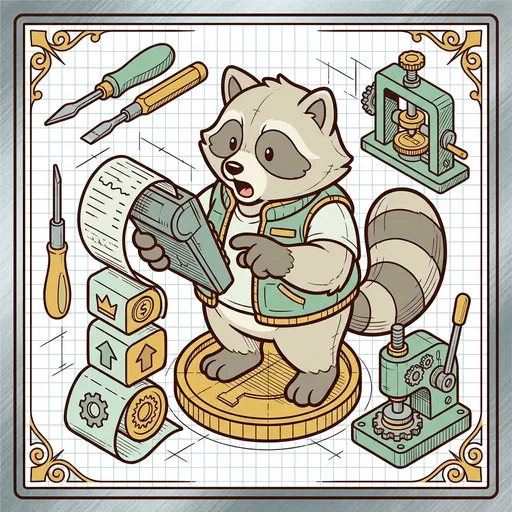
Tag
TAG — the transparent math of how prices are built.
Listen along — Tag
Loading audio…
Press play to listen along. The line being read lights up as you go.
Show full transcript
Loading transcript…
Chapter 2 — Tag and the Math Inside the Price
Tag, a small raccoon in a shopkeeper’s vest, was crouched in front of a fruit stall glaring at a price tag like it owed him money.
“One dollar sixty-two,” he muttered, his ringed tail twitching. “For one apple. Why one dollar sixty-two? Why not one dollar? Why not two?” He pulled a tiny calculator from his vest — it was shaped like a little price tag — and started tapping.
The stall keeper, a large sleepy bear, cracked one eye. “It’s just the price, kid.”
“Nothing,” said Tag, without looking up, “is just the price.” He kept tapping. Somewhere inside that number was a story made of smaller numbers, and Tag could not rest until he’d taken it apart.
He’d been like this since he was a kit. His family lived on Shop Row and watched prices the way other families watched the weather — noticing when things crept up, when a sale was really a sale, when a “bargain” was hiding a bigger number underneath.
His father had a favorite trick. He’d hand young Tag a price tag and say, “Take it to pieces. Where did it start? What got added?” And little Tag would frown and pull apart the number until it made sense — the shop’s own cost buried at the bottom, the extra the shop added on top so it could pay its rent and keep its lights on, then the tax the town tacked on at the very end.
“A price isn’t a mystery,” his father would say, ruffling the fur on his head. “It’s a math problem somebody already solved. You just have to solve it backwards.”
Tag loved solving it backwards more than almost anything.
At twelve he brought his little calculator down to Penny, the old owl who decided who taught at MintForge.
“A shopkeeper sells you an apple for one dollar sixty-two,” Penny said. “Where does that number come from?”
Tag’s paws flew. “The shop bought the apple for a dollar — that’s its cost. Then it added half again on top, fifty cents, so it can cover the stall and still eat — that’s the part they add to make a living. That’s one-fifty. Then the town adds its tax at the register, twelve cents. One dollar sixty-two.” He looked up, bright-eyed. “Every price is built the same way. Cost, then the shop’s add-on, then tax. You can always take it apart.”
Penny clicked her beak, pleased. “Then Shop Row’s math is yours to teach.”
In his workshop, Tag lined up a small carved wooden bird on the counter and beckoned two kids closer.
“Right. This bird.” He tapped it. “The shop paid four dollars for it. That’s where the price starts — the shop’s own cost.” He wrote a big 4 on his roll of receipt paper. “Now, the shop can’t sell it for four, or it makes nothing and closes by winter. So it adds a bit on top. Say it adds forty percent.”
A kid squinted. “What’s forty percent?”
“Best question of the day,” said Tag. “Percent just means out of a hundred. Forty percent is forty out of every hundred — a little under half. So forty percent of four dollars is one dollar sixty.” He wrote it. “Add that to the four, and the bird’s now five dollars sixty. Still no tax yet.”
“Then the tax,” the second kid guessed.
“Then the tax,” Tag agreed, tail swishing happily. “The town adds eight percent at the register — eight out of a hundred, a small slice. Eight percent of five-sixty is about forty-five cents.” He scribbled the last number and tore off the receipt with a flourish. “Six dollars and five cents. And look —” he held the paper up ”— every single number is right there. Nothing hidden. The tag was never magic. It was always this.”
The first kid took the receipt and stared at it, and Tag watched something loosen in her face.
“So a sale,” she said slowly, working it out herself, “is just going the other way. If this bird was ten percent off, that’s one out of ten, so… about sixty cents off?”
“Yes,” Tag beamed. “You’re already doing it in your head. That’s the whole trick — ten percent is easy, just slide the decimal one spot. Twenty percent is double that. Five percent is half of ten. Once your head can do those, no price can sneak past you again.”
He set the wooden bird gently back on the shelf and turned to the kids, quieter now.
“I know prices can feel scary,” he said. “Like they’re daring you to just hand over your money and not ask questions. But you get to ask. Every dollar on that tag was built out of smaller pieces, and pieces can always be taken apart.”
The first kid let out a long breath she’d been holding. The tight, worried knot she always felt at the register — the one that whispered you don’t understand this, just pay — had come undone. Prices didn’t feel like a trap anymore. They felt like a puzzle, and she was suddenly, surprisingly good at it. A light, proud warmth spread through her chest, the kind you get when something once-tangled finally comes clear in your hands.
Tag saw the grin spread across her face, and it made him happy right down to his soft paws. “There it is,” he said. “That’s the feeling. Hold onto that one.”
The MintForge ensemble
Tag is part of MintForge's distributed-narrative cast. Each character embodies a different curricular primitive; together they teach the full subject.
-

Coin
Currency + exchange — what money is, what it does, what it can't measure
-

Grow
Compound interest — patient math of money over time
-

Plan
Budget allocation + opportunity cost — the math of choosing with limited resources
-

Tilt
Risk + variability — the math of uncertain outcomes, distributions over destinies