Tilt
TILT — the math of uncertain outcomes; the many shapes the future can take.
Listen along — Tilt
Loading audio…
Press play to listen along. The line being read lights up as you go.
Show full transcript
Loading transcript…
Chapter 5 — Tilt and the Many Possible Outcomes
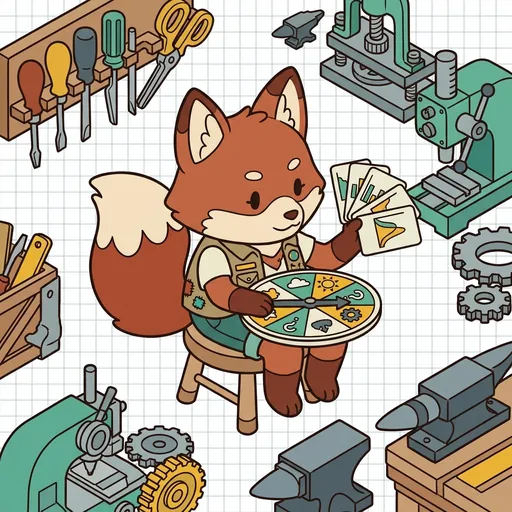
Tilt spun her spinner and let it whirr down. She was a small fox with a scout vest full of pockets, and she was showing a nervous badger cub how the thing worked.
“You keep spinning it,” the cub said. “Why? It never lands the same twice.”
“That,” said Tilt, catching the arrow with one paw, “is exactly the point.” She grinned. “One spin tells you almost nothing. But a hundred spins? A hundred spins draws you a picture of what’s likely — and once you can see the picture, you’re not guessing in the dark anymore.”
The cub looked doubtful. Most folks, Tilt knew, thought every money choice had just one ending — you put money in, you got a set amount back, straight line, done. But the world didn’t work in straight lines. It worked in shapes. And she was about to draw some.
Tilt’s family had been weather-watchers for as long as anyone could remember, out at the edge of the meadow where the farmers lived.
The thing was, her great-great-grandparents never said “it will rain tomorrow.” They said something stranger and more useful: “It might rain a little, it might rain a lot, and here’s how often each has happened before.” They knew farmers couldn’t plan on an average — a field doesn’t care that the average year is fine if this year floods.
When Tilt was small, her grandmother had drawn her a picture in the dirt: a tall skinny hill for “steady, predictable weather,” and a wide flat spread for “wild, all-over-the-place weather.” Same average, totally different lives.
“The average is only half the story, love,” her grandmother had said. “The spread is the other half. Learn to see the spread and you’ll never be surprised the same way twice.”
Tilt carried that picture with her everywhere after that.
At twelve she brought her spinner and her cards to Penny, the old owl who chose MintForge’s teachers.
Penny fixed her with a round stare. “Money is uncertain. How do you make a good choice when you can’t see the future?”
Tilt laid three cards on the table without hesitating. A tall narrow peak. A wide gentle hill. A flat line with one lonely spike way off to the side. “You can’t see the future,” she said. “But you can see its shape. Some choices land close to the same result every time — that’s the narrow one. Some bounce around but mostly turn out okay over time — that’s the wide hill. And some almost always land on nothing, with one tiny chance of a huge number — that’s this last one, and that shape is a trap.” She tapped the spike. “Know the shape first. Then choose.”
Penny’s eyes softened. “Then the uncertain things are yours to teach.”
In her workshop she stood the nervous cub in front of the spinner and a fresh sheet of paper.
“Three games,” she said. “We’ll spin each one twenty times and watch the shape appear. First game: saving money. Spin.”
Whirr. Four percent. Whirr. Five. Whirr. Four and a half. Twenty spins, and the numbers all huddled close together, none of them far from five. Tilt slid the tall narrow-peak card next to the list. “See how they cluster? Boring. Predictable. You basically know what you’ll get.” The cub nodded — this one felt safe.
“Second game: owning a slice of a business, for years. Spin.” Whirr. Ten percent. Whirr. Down two. Whirr. Up fifteen. The numbers jumped all over — some years up a lot, one year down. But when Tilt added them at the end, most were positive, and the pile leaned upward. She set the wide-hill card down. “Messier. More ups and downs. You have to be patient and you can’t panic on the down years. But over a long time, the shape leans your way.”
The cub was leaning in now, less nervous. “And the third?”
“The third,” said Tilt, “is the lottery.” She spun. Whirr — zero. Whirr — zero. Whirr — zero. Again and again the arrow landed on nothing. Nineteen times: nothing. Then, on the twentieth spin, WHIRR — it slammed onto one million.
The cub gasped. “You won!”
“Once,” Tilt said gently. “After losing every other time. Look at the whole sheet, not the one lucky spin.” She laid down the flat card with its lonely faraway spike. “This shape almost always gives you zero. That one giant number can’t make up for all the empty spins — add it all up and you come out behind. That’s not bad luck. That’s just what this shape is. It was built to keep you.” She didn’t frown or scold. She just tapped the flat card. “So when someone offers you this shape, you don’t need to feel tempted or tricked. You just recognize it. Oh — that one. No thanks.”
She gathered the three cards into a little fan. “Don’t gamble away money you actually need — not because it’s naughty, but because the math is simply against you, every time.” Then she softened. “But hear the other half too: don’t be so scared of uncertainty that you freeze. A risk you understand — one whose shape you can see — isn’t a monster. It’s just a trade-off you get to weigh.”
The badger cub let out a slow breath. The knot of dread he always felt when things were uncertain — that jittery, stomach-tight feeling of not knowing — had eased into something quieter and steadier. He couldn’t see the future any better than before. But now he could see its shapes, and shapes were something he could actually hold. A calm settled over him, the good kind, the kind that lets your shoulders drop.
Tilt watched him breathe easier and felt her own chest warm. “There,” she said. “That steadier feeling? That’s what understanding a risk gives you. Not certainty — just steadiness. And steadiness is enough.”
The MintForge ensemble
Tilt is part of MintForge's distributed-narrative cast. Each character embodies a different curricular primitive; together they teach the full subject.