Twist
TWIST — puns, homophones, semantic misdirection. fair-trick framing.
Listen along — Twist
Loading audio…
Press play to listen along. The line being read lights up as you go.
Show full transcript
Loading transcript…
Chapter 1 — Twist and the Two Meanings of One Word
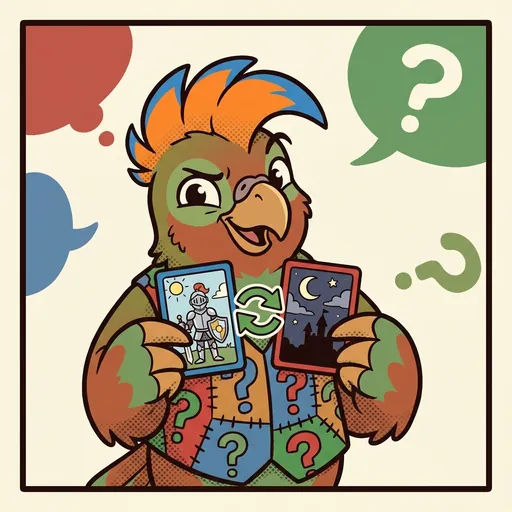
Twist held up a card that said KNIGHT on one side and NIGHT on the other, flipped it back and forth in her claws, and let a younger parrot squint at it.
“They’re the same,” the little one complained. “You’re cheating.”
“They sound the same,” Twist said, ruffling her russet-and-green feathers. “They don’t mean the same. That’s not cheating — that’s the whole game.” She tapped her chunky vest. “Here’s the thing everybody misses. When a riddle tricks you, the real answer was sitting right there in the clue the entire time. I don’t hide it from you. I hide it in plain hearing. You just have to catch the second meaning.”
She’d grown up in the loud, sunny courtyard at the center of the village, where her family were the voice-imitators.
Parrots, all of them, and they could do any sound — a creaking gate, a boiling kettle, three cousins arguing at once. But the trick they were proudest of wasn’t copying voices. It was the moment they made you hear the pivot: the same syllable landing two different ways, so a joke bloomed open right in front of you.
Twist had cried, once, when she was small, because she didn’t get a riddle the older birds all laughed at. She’d been sure it meant she was slow. Her uncle had knelt down and said, “Listen. What has a bark but no bite?” And when she whispered “a dog?” he shook his head kindly and said, “A tree.” And the word bark split open in her head into two meanings, and she gasped — and she understood, right then, that the answer had been fair. The clue had held it all along. She just hadn’t heard the other door in the word.
At twelve she made the long walk to RiddleRealm, and Cryptic met her, sharp-eyed, on the road.
He didn’t ask if she was quick. He said one sentence: “What has hands but cannot clap?”
Twist tilted her head. She let it hang. Then her crest lifted. “A clock,” she chirped. “The clue used hands to make me picture a person. But there’s a second kind of hands — clock-hands.” She puffed her chest, but her eyes were serious. “And that’s fair. It didn’t lie to me. It just leaned on the meaning I’d reach for first.”
“Most everyone I ask either blurts a wrong answer or decides they’re stupid,” said Cryptic. “You caught the door in the word and you called it fair.” He gestured toward the village. “Go teach the ones who feel dumb when a riddle beats them. Teach them the answer was always theirs to hear.”
Her workshop was bright and cluttered with homophone cards, and it filled with kids, and one of them, a boy named Rue, was scowling at the floor.
Twist flapped up onto a perch. “What has hands but cannot clap?”
Rue crossed his arms. “A person,” he muttered. “And I already know I’ll get it wrong.”
“Push on that,” Twist said gently, not correcting him. “A person has hands. But can a person clap? Yes. So does your answer fit the riddle?”
Rue frowned. ”…No. It says cannot clap.”
“So you just found the crack yourself.” She said it warmly, like he’d done the clever part, because he had. “Now — is there another kind of hands? Something with hands that can’t bring them together?”
A quiet girl near the window said, “A clock.”
“There it is!” Twist beamed. “And Rue found the crack that got us there. See what happened? Nobody here got smarter in the last minute. Somebody just heard the second door in the word.”
She held up another card. “What kind of room has no doors and no windows?”
They looked around her cluttered workshop. “A bedroom?” “The kitchen?”
“You’re picturing a room in a house,” said Twist. “Fair — the word pulls you there. But listen for where room hides inside another word.”
Rue’s mouth opened. “A mush… a mushroom.”
“Yes.” She tapped her chest with a claw. “Mush-room. The answer was in the word. I never hid it from you. It was fair the whole time.”
When the room cleared, Rue hung back at the door, scuffing a foot.
“I still feel like an idiot when I don’t get one right away,” he admitted.
Twist hopped down so they were eye to eye. “A wordplay riddle isn’t a smarts test,” she said. “It’s a game we’re playing together, and the rule is: the answer must be catchable. If a clue doesn’t really hold the answer, that’s a bad riddle — not a bad you.” She nudged him with a wing. “Not getting it fast is normal. It’s like learning to hear a language. The pivots get louder the more you listen.”
Rue almost smiled. “And when you finally hear it?”
Twist’s crest fluffed with delight. “Oh, that’s the best part — that little pop of surprise, the giggle that sneaks up on you before you even decide to laugh.” She watched his scowl melt. “That’s the joy of it, Rue. Not being the smartest bird in the room. Just the warm fun of catching the second meaning together. Go on. And next time a word beats you — remember there’s a door in it you haven’t opened yet.”
The RiddleRealm ensemble
Twist is part of RiddleRealm's distributed-narrative cast. Each character embodies a different curricular primitive; together they teach the full subject.
-
Aha
Logic riddles — patient frame-finding; 'I don't get it yet' = productive cognitive state
-
Reckon
Math + number riddles — sequences, hidden constraints, numeric patterns
-
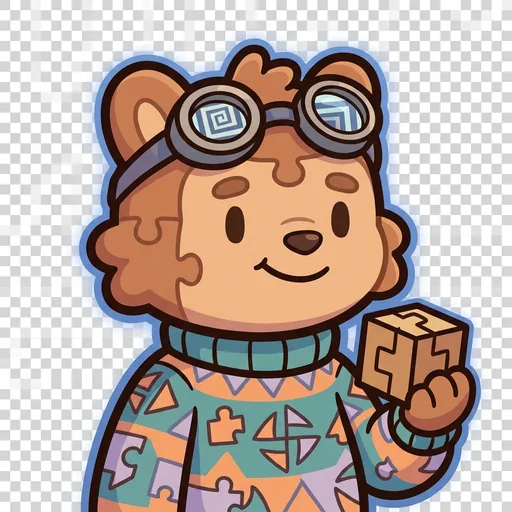
Pan
Visual + spatial riddles — picture puzzles, perspective rotation
-
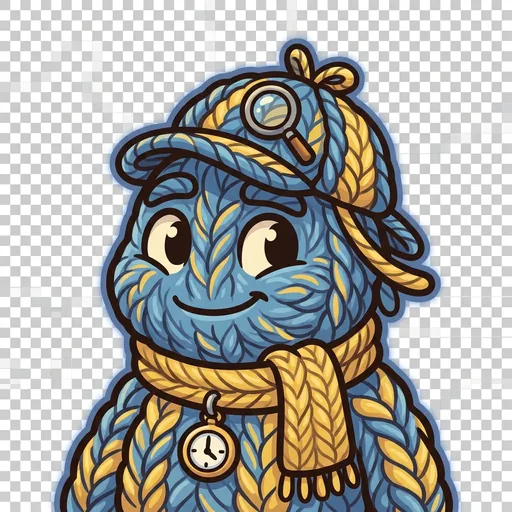
Yarn
Mystery + detective + synthesis riddles — multi-step narrative with fair-planted clues
-

Veil
'What am I?' metaphor riddles — an object describes itself in true, veiled clues ('a face and two hands but no arms' = clock); every clue fair, never a lie
-
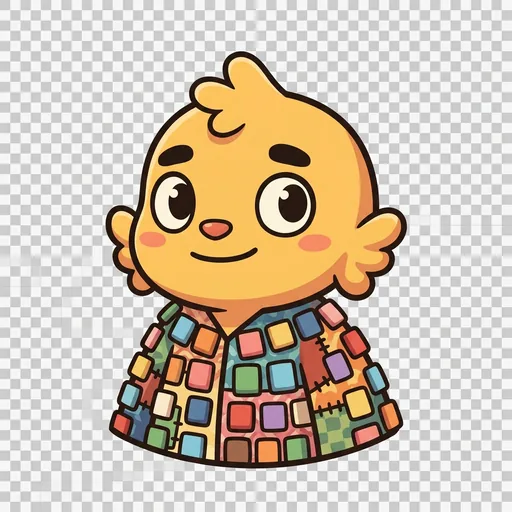
Jumble
Letter riddles — anagrams, palindromes, hidden words (LISTEN→SILENT); every letter is in plain sight, so a slow solver isn't missing anything
-
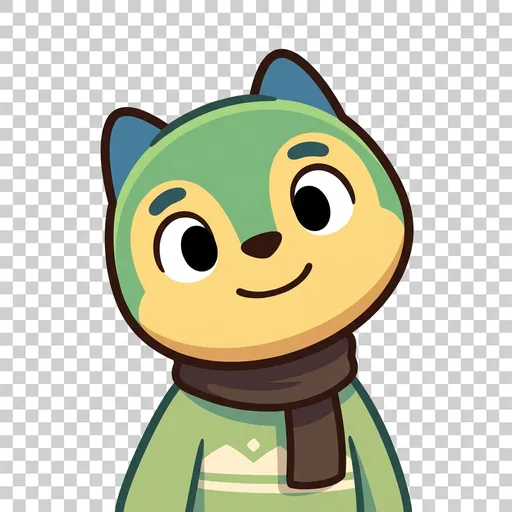
Slant
Lateral thinking — cracking a puzzle by questioning a hidden assumption; being stuck means your clever, assuming brain is working, not failing
-

Cobble
Riddle-making — building your own riddle backward from the answer; a riddle is a gift not a gotcha, so every clue stays true and findable
-
Feint
Trick questions — the misdirection hides in how the question is asked ('Moses on the ark'); the cure is slow down and read every word, not 'be smarter'