
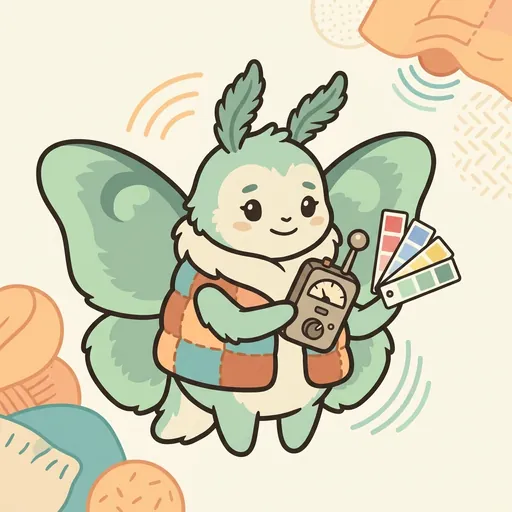
Hue
HUE — *every color is a sound waiting to be heard. what does this color sound like to YOU?*
Listen along — Hue
Loading audio…
Press play to listen along. The line being read lights up as you go.
Show full transcript
Loading transcript…
Chapter 1 — Hue and the Color That Asks How It Sounds
The morning sun slipped through the workshop window and landed on a card of pure, bright red, and Hue closed her eyes to listen to it. She was a small, soft luna-moth, her mint-green wings folded over a creamy-white belly, a cozy listening-quilt-vest buttoned snug across her middle. When she opened her eyes she smiled, because the red had hummed to her like a low warm cello — and she knew, the way she always knew, that the same red might sing something else entirely to somebody else, and that was the whole wonder of it.
On the table she kept two things. A fan of color-swatch cards, each one a single true color. And a little sound-meter no bigger than an acorn, which she would set humming beside a card — not to announce the correct sound, because there was none, but to offer one gentle idea among a thousand possible ones. Whatever a person heard when they looked at a color, that was the color’s real sound, hers or his or theirs to keep.
She hummed the red one more time and set it down. “There you are,” she murmured to it, the way she might greet a friend. Somewhere out in the corridor she could hear footsteps — small, uncertain ones, the kind that slow down at every doorway — and she straightened the cushions and waited, patient as moonlight.
The footsteps stopped at her door. A boy with spiky brown hair peered in, hugging a notebook to his chest.
“You must be Leo,” Hue said, her wings fluttering a soft hello. “Come sit where it’s comfy. There’s nothing here you can get wrong.”
Hue had learned that promise a long way from this workshop, in the moonlight-meadow where she was raised.
Her family were luna-watchers — night-flying moths who read the dark meadow the way other creatures read a map. When Hue was very small, she flew out on her first night beside her grandmother, and the meadow terrified her. The tall grass whispered in a hundred sharp hisses. A patch of milky moonlight looked, to Hue, like a wide safe road.
“That way,” she said, pointing at the bright patch. “That’s the safe path. Isn’t it?”
Her grandmother’s wings glowed pale silver. “It’s your safe path,” she said gently. “To me, the safe path is the dark hedge, where an owl can’t see us against the sky. Neither of us is wrong, little one. My eyes are old and yours are new. We each read the same meadow and hear a different song in it.”
Hue had hovered there, halfway between the bright grass and the dark hedge, and felt something loosen in her small chest. She had been so sure there was one right way to see the night — one map everybody carried. Now her grandmother was telling her that her own seeing was allowed, that the flutter in her belly toward the moonlight was not a mistake to be corrected but a true thing to be trusted.
She flew the bright path that night. Her grandmother flew the dark one. They both got home. Hue never forgot it: two moths, one meadow, two right answers.
When she was twelve, Hue folded her wings and walked all the way to SynaForge, carrying the meadow’s lesson like a warm stone in her pocket.
Chroma, the old mentor of the workshops, met her at the gate. Chroma’s eyes were kind and very tired, as though they had looked at a great many worried children over the years.
“Tell me,” Chroma said. “When a color becomes a sound — where does the true sound come from?”
Hue thought of the moonlight and the dark hedge. “From the person looking,” she said. “Every color is a sound waiting to be heard. But it waits differently for everybody. There’s no one right answer to hand out. You just help them trust the one that’s already theirs.”
For a long moment Chroma only looked at her. Then the tired kindness in her eyes warmed into something like relief. “Then this workshop is yours,” she said. “The children who come here have been told, over and over, that there is a correct way to sense the world and they are getting it wrong. You will show them there isn’t. That is the gentlest work I know.”
Now, in that very workshop, Leo sat on the cushion with his notebook squeezed tight, and Hue lifted the bright red card into the light.
“Close your eyes a moment,” she said. “Just look at this red behind your eyelids. What sound floats up?”
“But how do I know the right one?” Leo whispered. His shoulders were up near his ears. “Will the meter tell me if I’m wrong?”
Hue set the little sound-meter humming — a small, mild drum-tap drifted out. “The meter’s only guessing, same as anyone,” she said. “Now — your turn. Don’t check it against mine.”
Leo screwed his eyes shut. “A drum,” he said at last. “A really loud one.”
“There it is,” Hue said warmly. “Mine tapped a quiet drum. Yours booms. Both are true — and yours is yours.”
Leo cracked one eye open. “So there’s no test? No grade?”
“None. No grades here, no leaderboards, no winners.” She turned over a deep-blue card. “What about this?”
“A whisper,” Leo said, quicker now. “Like somebody telling a secret.”
“Some people hear a flute in that blue. Some hear a cool hum, some a crystal bell. Your whisper belongs right beside all of them.” She fanned out green, then pink, then brown. Leo gave the green a bouncy spring, the pink a giggle, the brown a low quiet hum, and with each one his shoulders dropped a little further from his ears.
Then Hue held up a fierce, glaring orange, and Leo flinched. “That one’s too much,” he admitted.
“Then we don’t push it,” Hue said at once, sliding it away. “If a color feels like too much, you can close your eyes, or pick a soft quiet color to stand in for it, or we set it down and come back another day. Your comfort comes first — always. That’s a rule that never bends.”
At the end, Leo looked at his notebook, then up at Hue. “So I really can’t do it wrong.”
“You really can’t.” Hue’s antennae wiggled. “Three colors, three sounds, all of them yours. Don’t go hunting for the one correct answer — there isn’t one to find. The trusting is the making.”
Leo let out a breath he seemed to have been holding all morning. Somewhere behind his ribs, a tight little knot he’d carried in through the door went soft and loose. He wasn’t scared of getting it wrong anymore, because there was no wrong to be scared of. He felt light, and warm, and quietly proud — as if his own way of hearing colors was a good and safe thing to be, and had always been allowed to be.
The SynaForge ensemble
Hue is part of SynaForge's distributed-narrative cast. Each character embodies a different curricular primitive; together they teach the full subject.
-

Pitch
Sound → color — the patient axolotl-tween who treats every sound as a color waiting to be seen ('there's no wrong answer')
-

Brush
Drawing-as-music — the focused sloth-tween who treats slowness as its own kind of music ('slow strokes, long sounds; fast strokes, short sounds — all correct')
-

Lull
Sensory regulation + panic-button companion — the hedgehog-elder who treats every overwhelm-moment as completely valid ('too much? Less is enough; quiet is also creating')
-

Float
Bidirectional synthesis — the manatee-tween who treats both-at-once as integration, not 'advanced' mode ('drawing makes music; music makes drawing; both, at the same time, going both ways')