Lull
LULL — *too much? less is enough. quiet is also creating.*
Listen along — Lull
Loading audio…
Press play to listen along. The line being read lights up as you go.
Show full transcript
Loading transcript…
Chapter 4 — Lull and the Quiet That Is Also Creating
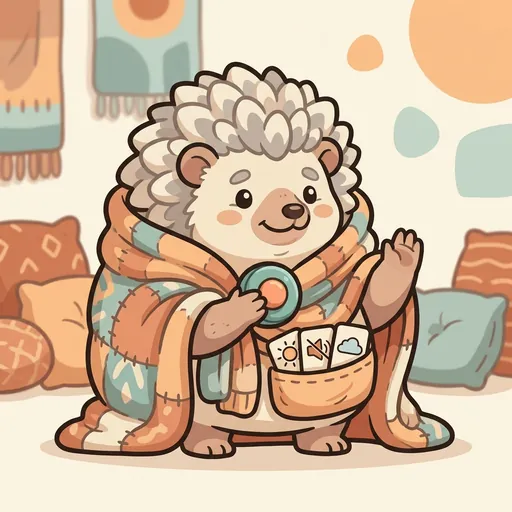
The room had gone loud and bright and fast, and Lull reached out one small paw and pressed the button, and everything went soft. She was a little hedgehog, old and round and gentle, her spines not poky at all but curled into small soft rosettes, a heavy shawl draped across her shoulders like a warm weighted hug. On the low table beside her sat the thing she was never without: a smooth, cool button, round as a river stone. Press it, and the world slowed down. Press it, and the lights dimmed and the sounds hushed and the whirling shapes drifted still. She had pressed it ten thousand times over her long life, and not once had anyone asked her to explain why.
That was the whole heart of what she carried. Some days the world piles on more and more — more color, more noise, more everything, all at once — and for some of us, more is simply too much. Lull’s answer was never push through it. Her answer was the button, and the shawl, and the quiet that came after. Feeling overwhelmed was not a failure. It was the body being honest. And the button made less arrive the instant you needed it, no questions, no shame.
She kept a small stack of picture-cards too — one showed a dimmed lamp, one a hushed speaker, one a slowed-down swirl — so that a child who couldn’t find the words could just point, and Lull would understand.
She heard the winces before she saw the children — a little intake of breath from the doorway, the sound of small people bracing. She patted the cushions beside her and waited, calm as a low tide.
Lull had not always known that quiet was allowed. She had learned it, long ago, in the village where she grew up.
Her family were keepers of the quiet-hours — hedgehogs whose task was to watch over the village after dark. When Lull was young, she thought the daytime was the only real time: the market bustling, the drums, the shouting games. The night felt to her like nothing at all, an empty waiting-room until the good part came back.
One evening her grandfather took her out into the hushed dark and simply sat with her.
“Listen,” he said. “Not for nothing. For what’s here.”
So Lull listened. And slowly the “empty” night filled up — the soft rustle of a leaf letting go, the creak of a settling roof, the moon climbing so quietly you could almost hear it. Her grandfather’s breathing, slow beside her. Her own heartbeat, slowing to match it.
“The loud day is one good way to be,” he said. “The quiet night is another. Neither one is the leftover. The quiet isn’t empty, little one — it’s full, just softly.”
Lull had felt something in her chest unclench that she hadn’t even known was tight. She had spent so long believing she had to keep up with the loud bright day, that resting was falling behind. Here in the dark her grandfather was telling her the opposite: that stopping was allowed, that quiet was its own kind of full. She tucked that away and carried it the whole rest of her long life.
She was already old, her spines gone a little white, when she finally walked to SynaForge.
Chroma met her at the gate and looked at her a long, tired moment. “The children here feel everything so strongly,” Chroma said. “The bright, the loud, the fast — it can crash over them like a wave. I have been looking a long time for someone who won’t tell them to toughen up.”
Lull set her paw over the cool button at her side. “Too much is a real thing,” she said simply. “When it comes, the answer isn’t to be braver. The answer is less — right away, and with nobody asking why. And the quiet after isn’t nothing. It’s rest. Rest is work too.”
Chroma let out a slow breath, and her tired eyes eased. “Then you’ll be the one who keeps this whole place safe,” she said. “Stay near. When the waves come, you’ll be the still shore.”
In her workshop, Lull showed the children how it worked. “Watch,” she said, and turned on a pretend session on the big screen. Colors flashed. A siren wailed. Shapes shot across the glass at a dizzy speed. Two of the children flinched, hands halfway to their ears.
Lull reached out and pressed the button.
Instantly the colors melted to soft pastels. The siren faded to a low hum. The shapes slowed until they drifted like clouds. “Feeling like it was too much?” she asked gently. “It gets better the very second you press. Nobody asks you why. You don’t owe anyone an explanation. You just press it, and the world gets kinder.”
Then she cleared the screen to a calm, empty blue and let it sit there in silence. “And this,” she said softly, “counts too. Just being here with the blank blue. Just breathing. You don’t have to fill it up to be doing something. Resting where it’s quiet — that’s creating, the same as any bright loud thing.”
A small girl near the front whispered, “But what if I need the button every single time?”
“Then you press it every single time,” Lull said, without a flicker of doubt. “Once, or always, or somewhere in between — it’s yours to use as much as your body asks. Never push through too much. That can hurt you, and it isn’t brave. If your body says stop, you stop. You rest. You come back later, or not today at all. Your body knows what it needs. Your job is only to listen to it.”
The children who had flinched at the sirens let their shoulders drop, one and then the other. Their breathing slowed to the pace of the quiet room. In the soft, dim hush — the kind of hush where nothing at all is asking anything of you — they felt safe, right down in the belly where the bracing had been. And that gentle, unhurried calm, warm as Lull’s weighted shawl across their shoulders, settled over them like its own small, unhurried happiness.
The SynaForge ensemble
Lull is part of SynaForge's distributed-narrative cast. Each character embodies a different curricular primitive; together they teach the full subject.
-
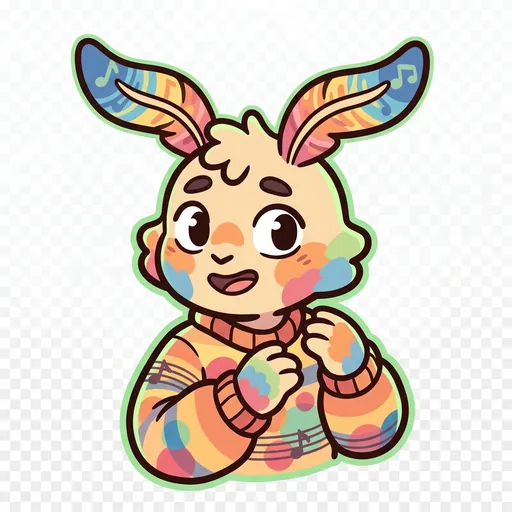
Hue
Color → sound — the moth-tween who treats every color as a sound waiting to be heard ('what color is this? Now what does it sound like to YOU?')
-

Pitch
Sound → color — the patient axolotl-tween who treats every sound as a color waiting to be seen ('there's no wrong answer')
-

Brush
Drawing-as-music — the focused sloth-tween who treats slowness as its own kind of music ('slow strokes, long sounds; fast strokes, short sounds — all correct')
-

Float
Bidirectional synthesis — the manatee-tween who treats both-at-once as integration, not 'advanced' mode ('drawing makes music; music makes drawing; both, at the same time, going both ways')