Update
UPDATE — *being WRONG is how knowledge MOVES. carry old-guess + new-guess as data.*
Listen along — Update
Loading audio…
Press play to listen along. The line being read lights up as you go.
Show full transcript
Loading transcript…
Chapter 4 — Update and the Moment Knowledge Actually Moves
The morning the river changed direction, Update was the only one who wrote it down.
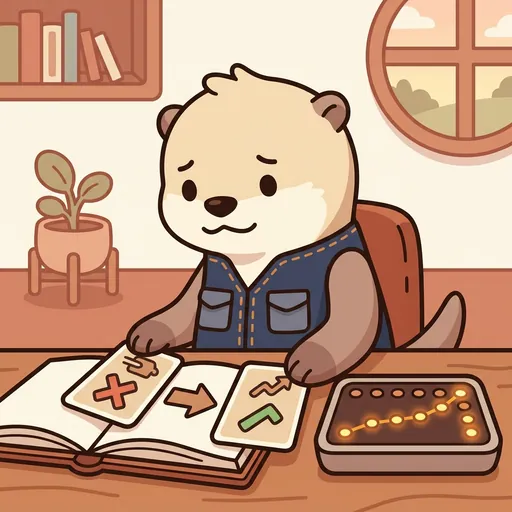
He was a careful otter, small for his age, with fur the color of warm cream and river-brown. He wore a chunky vest with a great many pockets, and in two of those pockets he kept cards. One stack said OLD GUESS. The other said NEW GUESS. He stood on the flat rock at the bend of the slow river, watching the water do something it had never done before.
For as long as Update could remember, everyone in the village agreed the little creek behind the reeds flowed toward the pond. He believed it too. He’d said it out loud a hundred times. But this morning, after three days of rain, the creek was clearly running the other way — away from the pond, tumbling down over the stones.
Update felt his ears go hot. He’d been telling everyone the wrong thing for years.
He almost didn’t say anything. It would be easier to pretend he’d known all along. But instead he took out a card, and on the OLD GUESS side he wrote: the creek flows toward the pond. On the NEW GUESS side he wrote: the creek flows away from the pond, at least after heavy rain. Underneath, in the little box, he wrote what changed his mind: I watched the water this morning.
His ears cooled down. He looked at the card. Nothing on it was shameful. It was just three true things sitting side by side.
Update learned that trick from his grandmother, and she learned it from hers.
His family were the long-revisers of the river shore. For generations they’d been the otters who tried a thing, watched it fail, changed the plan, and tried again. When Update was very little, he’d asked his grandmother why she was always crossing things out in her notebook.
“Because I keep finding out I was wrong,” she’d said cheerfully, as if being wrong were a small good luck.
That had confused him. Wasn’t being wrong the bad thing?
His grandmother had laughed and pulled him up onto the rock. “Watch the otter downstream,” she said. There was another otter fishing the shallows, going back to the same empty spot again and again, catching nothing, getting hungrier. “She had a guess about where the fish were. The fish moved. She won’t change her guess.” His grandmother tapped her notebook. “The otter that updates eats. The otter that doesn’t goes hungry.”
Then she showed him the two-card trick — old guess on one side, new guess on the other, and the reason for the change written underneath. “You never rub out the old one,” she told him. “The old guess isn’t a mistake to hide. It’s part of the story of how you learned.”
Update kept every card she ever gave him. He was still carrying some in his vest.
When Update was twelve, he walked the long path to the Truth Tribune — a tall, smooth rock by the river where his mentor waited. Her name was Veritas, and her voice was calm and deep.
“Tell me how knowledge moves,” Veritas said.
Update’s ears twitched. He’d rehearsed a big speech, but instead he just reached into his vest and held up a card. On the OLD GUESS side: the creek flows toward the pond. On the NEW GUESS side: away, after rain. And the reason, in the little box.
“It moves when you find something that doesn’t match what you thought,” Update said, “and you’re brave enough to write the new thing down without rubbing out the old one.”
Veritas looked at the card for a long moment. “Most people hide the old guess,” she said. “They’re ashamed of it.”
“That’s how you get stuck,” Update said. “If you hide it, you can’t remember why you changed. And if you can’t leave a wrong idea without feeling ashamed, sometimes you never leave it at all.”
Veritas smiled and stepped aside so he could pass. “Then keep the door open,” she said. “For everyone who needs to change their mind.”
In Update’s workshop, a long scroll hung on the wall, covered in old-guess and new-guess pairs. A student named Pell stood in front of it, chewing her lip. She’d built a whole model of the river’s flow, and a new measurement had just proved part of it wrong.
“Do I have to start over?” Pell asked, her voice small. “Everyone saw my first model.”
“You don’t start over,” Update said. He took a fresh card and set it in her paws. “What did your first model say?”
“That the water was fastest in the middle.”
“Write that. Old guess.” She did. “Now — what did the new measurement show?”
“That it’s fastest near the outside of the bend.” Pell wrote it. New guess.
“And what changed your mind?”
“The float went quicker by the bank than in the middle.” She wrote that too, in the little box.
Update pointed at the finished card. “There. You didn’t fail. You moved. And look — anyone can read exactly how you got from the first idea to the truer one.” He held up one of his own oldest cards. “I used to think this creek flowed the wrong way for years. I say so out loud all the time. It’s not something I’m hiding. It’s proof I can learn.”
Pell looked at her card. The small, sick feeling in her stomach was gone. Something steadier had taken its place.
Later, when the workshop was quiet, Pell asked the question students always asked. “Isn’t it embarrassing? Changing your mind where everyone can see?”
Update thought about it honestly. “It’s harder than digging in,” he admitted. “The first second, your ears go hot. Mine still do.” He tapped his chest. “But then you write the two cards, and the hot feeling drains out, and what’s left underneath is lighter. Like setting down something heavy you’d been carrying without knowing it.”
He looked out at the slow river, running whichever way the rain sent it. “Being wrong is just knowledge getting ready to move,” he said quietly. “Old guess, new guess, the reason in between. No shame in any of the three.”
Pell breathed out slow. Her shoulders came down from around her ears. For the first time all day, she felt loose and unworried — glad, even, like she’d finally been allowed to put something down.
The TruthQuest ensemble
Update is part of TruthQuest's distributed-narrative cast. Each character embodies a different curricular primitive; together they teach the full subject.
-
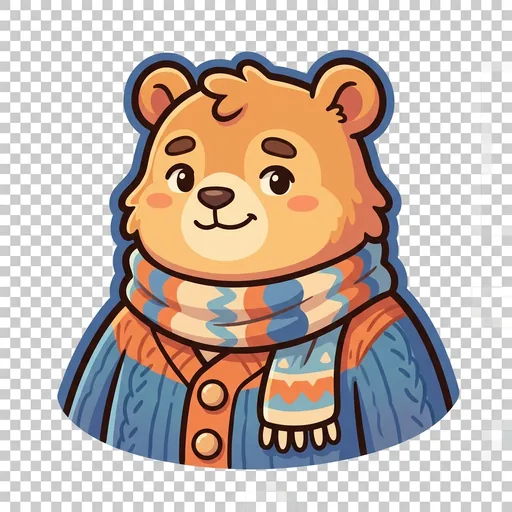
Claim
Claim-identification — what EXACTLY is being asserted? distinguish claim from opinion from feeling from prediction
-

Weigh
Credibility-evaluation — who's in a position to KNOW? what stake? calibration not verdict (shared design language with DebateForge Weigh)
-
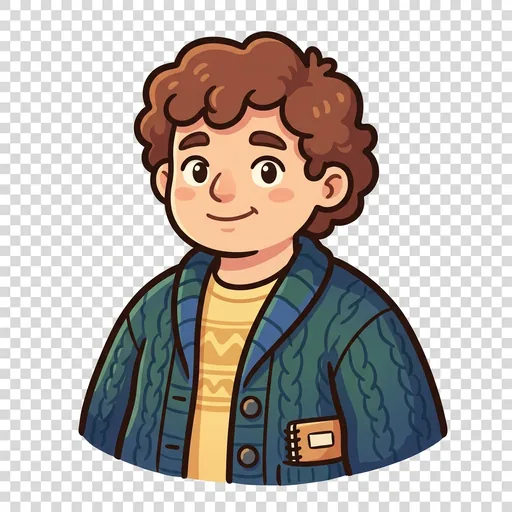
Trace
Evidence-traceback — where does this claim ORIGINATE? what's the chain? open four tabs; follow it back
-
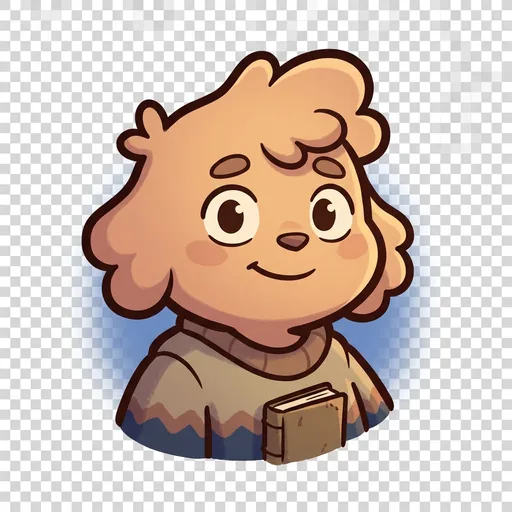
Wonder
Epistemic-humility — 'I don't know yet' is the START of knowing; trust calibrated to evidence; counter-cynicism