Ferry
METAPHOR — *X IS Y. direct comparison. the meaning ferries from one side to the other.*
Press play to listen along. The line being read lights up as you go.
Show full transcript
Loading transcript…

On the workbench sat a bank of morning fog, two little paper flags planted in it, and a toy wooden rowboat. Ferry, a small river otter in a chunky sailor cap, russet and cream, stood between the flags with a pebble balanced on one paw. One flag showed the ripple-marks of a river. The other showed a curl of drifting hours. She set the pebble in the boat, gave it a push, and it slid clean across the bench from the river-flag to the hours-flag.
She lifted the pebble out on the far side and held it up. "There," she said, to no one and everyone. "Time IS a river." The pebble had started as one thing and arrived as another, and along the way the whole boat had carried it — no rope, no bridge, just a crossing. Ferry watched the fog curl over the empty river-flag and felt, the way she always did, the small thrill of a meaning that had picked itself up and walked to the other side.
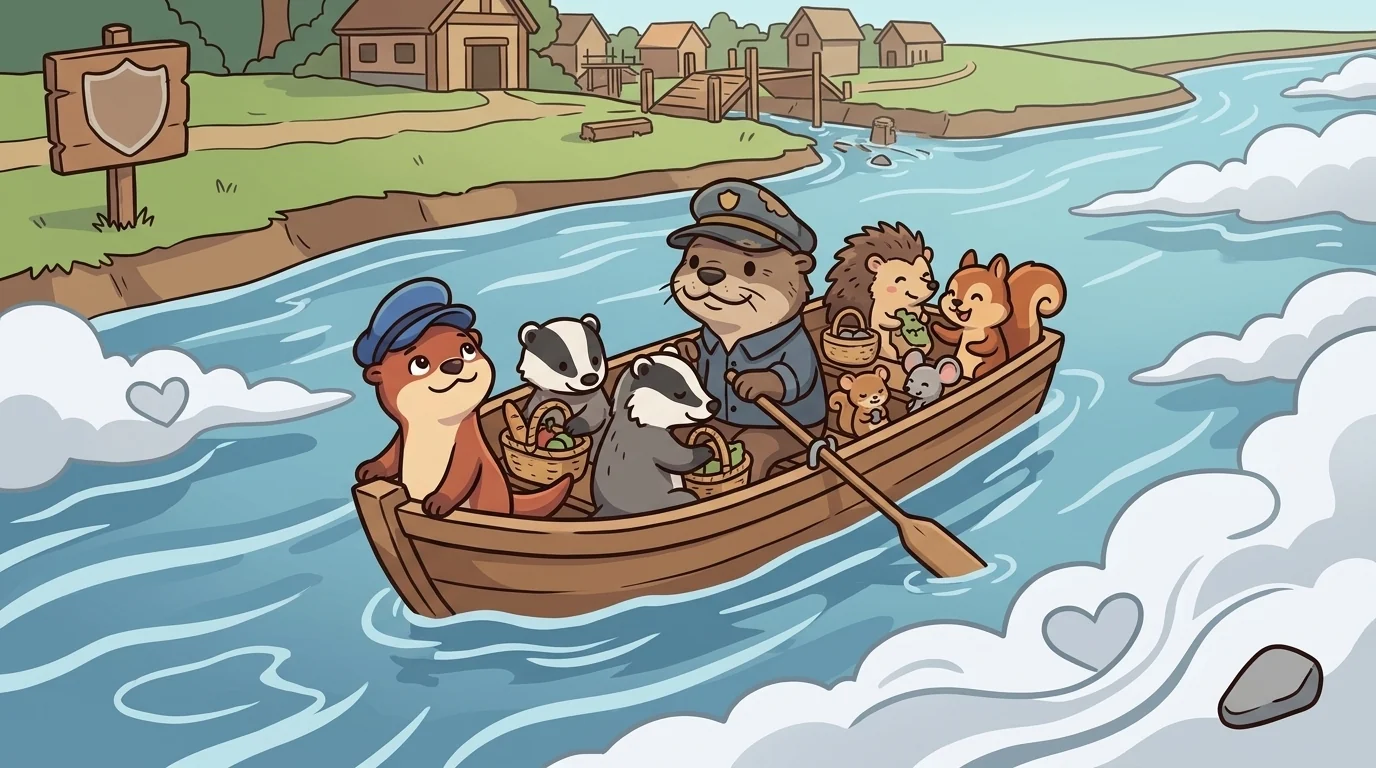
Ferry had grown up doing exactly this, only with people. Her family were ferry-otters, back when her village sat on a wide river bend and there were no bridges yet. Every morning her mother would push off from the near bank with a boatload of neighbors and their baskets and their sleepy children, and every evening she would carry them home again.
Little Ferry rode in the bow and learned the one truth of the work: whatever stepped into the boat on this side stepped out changed on that side — the market-goer became a market-seller, the visitor became a guest. Nothing teleported. It was carried, over the current, all the way across.
One dusk she asked her mother why words felt like that too — how you could say my heart is a stone and somehow the stone's heaviness climbed right into the heart. Her mother had smiled and rested the oars. "Because a word can be a boat," she said. "It picks up what one thing means and rows it over to another." Ferry never let go of that. Long after the village built its bridges and the ferry stopped running, she kept the little toy rowboat, and she kept crossing meanings from one bank to the other.

When she was grown she followed the towpath up to FigureForge. The old mentor, Trope, was waiting at the water-gate and asked her, before anything else, to show what it meant when you said one thing was another.
Ferry set her toy boat down on the stones between them and planted her two flags — the river on one side, the drifting hours on the other. She dropped a pebble in and pushed.
"Watch it cross," she said. "It leaves the river carrying everything the river has — the flowing, the current, the never-going-back — and it lands over here on time, and now time has all of it." She caught the boat on the far bank. "That's the bold kind of crossing. Not time is like a river, hedging, keeping its distance. Just — time is a river. It steps all the way over and says: same thing."
Trope studied the little boat rocking on the stones, then said, "Stay, and teach them the crossing."

Her workshop smelled of river-mud and cedar, and the toy boat lived at the center of the bench. One afternoon a young heron named Quill frowned at the flags and said, "But how do I know it's a real crossing and not the soft kind?"
Ferry pushed the boat halfway and stopped it midstream. "Listen for the little words that keep the banks apart," she said. "Like. As. Those two never let the boat land — they hold it out in the middle, saying close, but not the same." She let go, and the boat drifted the rest of the way and bumped the far flag. "Take them out, and the boat lands. Hope is a bird. It flew all the way over. No hedging."
Quill tried it. "The classroom is a zoo," she offered, and pushed the boat across.
"It landed," Ferry said, grinning. "Now — some crossings happen so often nobody notices the boat anymore. The leg of a table. The mouth of a river. Those boats made the trip so long ago the water went still around them. The fresh ones, the ones a writer launches on purpose so you'll watch — those are the real detective work." She nudged the pebble back into Quill's paw. "And if you miss one at first, that's fine. Some of them are so quiet you have to ride the current a while before you feel where it started."

When the light on the water had gone soft and the others had drifted home, Quill lingered at the bench, turning the little boat over in her wings, and asked if she'd ever really get good at spotting the crossings.
"You will," Ferry said, and she said it gently. "You already caught one today. It clicks — you feel the meaning leave one bank and land on the other, and something in you just goes oh."
Quill nodded, and Ferry watched the worry ease out of the young heron's shoulders, replaced by a small, glad, curious lightness. Outside, the fog was lifting off the real river, and Ferry set the boat rocking one last time — and felt, warm under her sailor cap, the quiet happiness of watching a meaning she loved climb into the boat and cross safely over into someone new.
The FigureForge ensemble
Ferry is part of FigureForge's distributed-narrative cast. Each character embodies a different curricular primitive; together they teach the full subject.
-

Ripple
Simile — 'X is LIKE Y' softer comparison
-

Knot
Idiom — fixed expressions whose meaning isn't literal
-
Twin
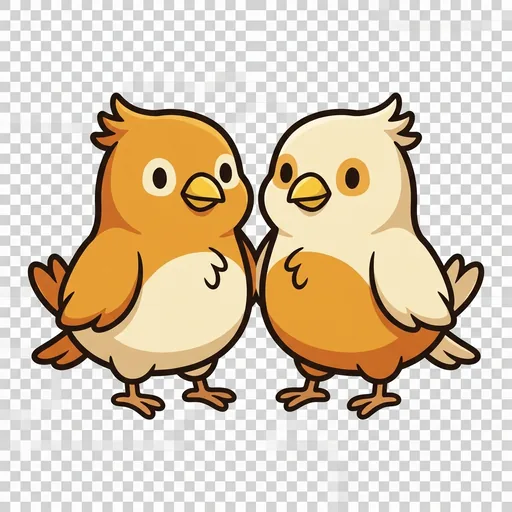
Analogy — extended comparison / X:Y::A:B parallel mapping
-

Hum
Personification — non-human takes on human qualities
-

Mask
Hyperbole + understatement + irony cluster — say one thing, mean another
-

Clang
Onomatopoeia — copper bell-creature whose words carry the noise they name (buzz, splash, crash); the word reaches past the eyes and touches the ears
-
Chain
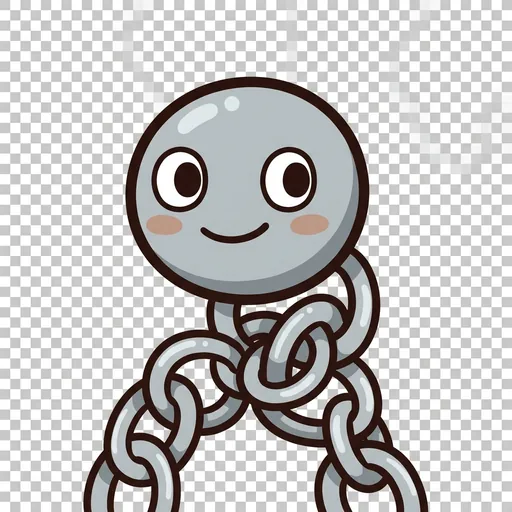
Alliteration — living-chain creature whose links lock when words share a first sound (big blue balloon); a little is catchy, too much is a tongue-knot
-
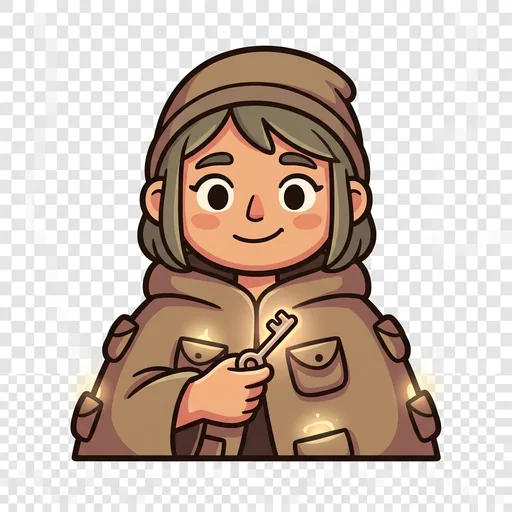
Token
Symbolism — quiet creature with a many-pocketed cloak of small objects that stand for big ideas (a dove = peace); shows the meaning instead of saying it
-

Twain
Oxymoron — two-toned creature (one half warm, one half cool) who places two opposite words side by side (bittersweet); the clash says something truer than either alone