Cleave
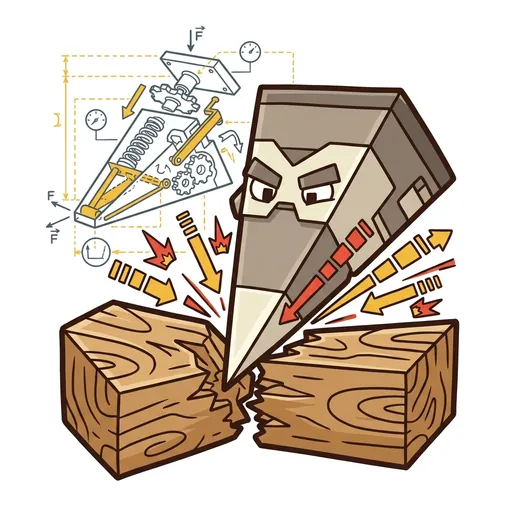
WEDGE — *push forward; split it apart. force concentrated to a sharp edge.*
Listen along — Cleave
Loading audio…
Press play to listen along. The line being read lights up as you go.
Show full transcript
Loading transcript…
Chapter 6 — Cleave and the Force at the Edge
The old fence post had refused to split for three days.
Cleave stood at the edge of the woodpile, a squat grey-and-cream triangle no taller than a bread loaf, its broad flat back turned to the wind and its narrow edge aimed at the seam of the post. A woodcutter had left the post there, muttering, sure it was ruined. Cleave did not think so.
It leaned its edge into the seam. It waited for the log-splitting mallet, which the wind was carrying toward the woodpile in the hands of a very tired apprentice. When the mallet came down on Cleave’s broad back — thock — a hairline crack opened in the post, thin as a spider’s thread. Cleave rocked forward a whisker. Thock. The crack yawned wider. The post that would not budge for three days of shoving gave way in six patient taps, and fell open in two clean halves.
“Push forward,” Cleave murmured, mostly to itself, “and it splits apart.”
Cleave had not always known that trick. Long ago, when it was new, it had tried to be strong. It had thrown its whole flat body against things — walls, stumps, a stubborn barn door — and bounced off every one, aching.
An old field-plow found it sulking by a boulder one evening. The plow was scarred and cheerful. “You keep pushing broad,” it said. “Broad spreads the push out thin. Try pushing narrow.”
Cleave turned itself around and set its sharp edge — not its wide back — against the boulder’s crack. It pushed. The same push it had wasted all day suddenly gathered into a single sharp line, and the boulder’s crack lengthened with a soft tick.
Cleave felt something click into place inside it, quieter than the boulder but just as sure. All that force, it understood, was not about being big. It was about where the force arrived. Gather a wide push down to a narrow edge, and the edge does what the whole body never could.
Word of the patient triangle reached the MachineForge, the village workshop where machines that understood themselves were welcomed. Cog, the old grey gear who kept the place, met Cleave at the door and did not ask it to explain. Cog asked it to show.
There was a knot of oak on the workbench, gnarled and mean, the kind of wood that turns axes. Cog set a splitting-wedge and a mallet beside it and stepped back.
Cleave nudged the wedge until its edge sat exactly in the knot’s one weakness. It lined the mallet up over the wedge’s flat back. Then, unhurried, it let the mallet fall — thwack — and the oak knot, which had turned two axes that morning, opened along a single willing line.
Cog’s stern face softened by a hair. “You didn’t fight it,” the old gear said. “You found the edge and let the edge do the work.” He nodded toward the empty bench along the wall. “There’s a place for you here.”
The apprentices came to Cleave’s bench on splitting day, half of them nervous, because a wedge is a sharp thing and sharp things deserve to be treated with a little fear.
“Watch my edge, not my back,” Cleave told them. It set the metal wedge against a log rough with clinging bark. “All the push from the mallet — all of it — travels down to this one thin line.” Thwack. A splinter popped free; a woody smell filled the air. “And as I sink in, my two slopes shove outward, one to each side, and pry the log apart. I’m really just two ramps, glued back to back. Push my spine; my slopes do the splitting.”
A small apprentice named Rill hung back. “Doesn’t it feel dangerous?”
Cleave went still, and its voice went quiet and serious. “It is strong. Strong isn’t the same as dangerous — but you treat strong things slowly. You never test my edge with your finger. You never wave a knife around for fun. You line the tool up, you keep your hands clear, you ask a grown-up when the edge is truly sharp. Respect at the handle, force at the edge. Both. Always both.”
Rill nodded, and stepped a careful, sensible half-step closer instead of away. Cleave was glad of that half-step most of all.
At the end of the day the mean oak knot lay open in two halves on the bench, its stubborn grain finally undone.
Cleave looked at it for a long moment. It had not shoved the knot. It had not bullied it. It had found the one line the wood was willing to give, and gone there gently, and let its edge carry the force the rest of the way.
A warm, steady glow rose through Cleave’s small grey body — not the sharp thrill of the split, but something calmer underneath it. The quiet pride of doing something powerful, and doing it carefully, and hurting nothing that didn’t need to break. That feeling, Cleave thought, settling its edge against the cool bench to rest, was the best part of the whole work.
The MachineForge ensemble
Cleave is part of MachineForge's distributed-narrative cast. Each character embodies a different curricular primitive; together they teach the full subject.
-
Pry
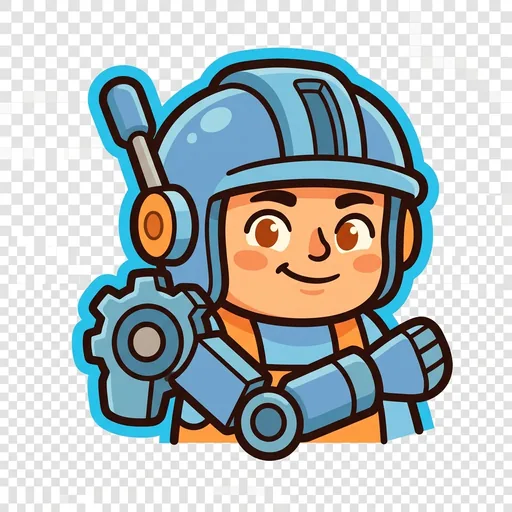
Lever — push longer to lift heavier; the trade between force and distance
-

Hoist
Pulley — pull down here and watch it go up there; redirecting force
-
Ramp
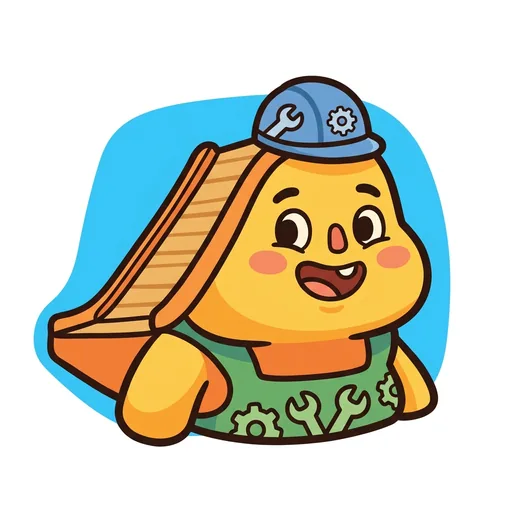
Inclined plane — climb the long slow way; less force, same work
-
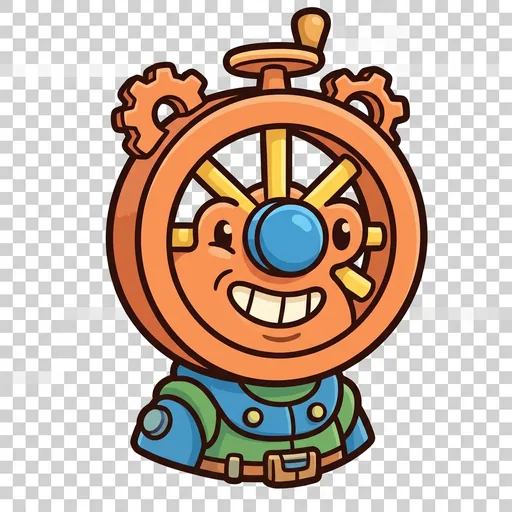
Spoke
Wheel-and-axle — one turn of the hub, many turns of the rim
-
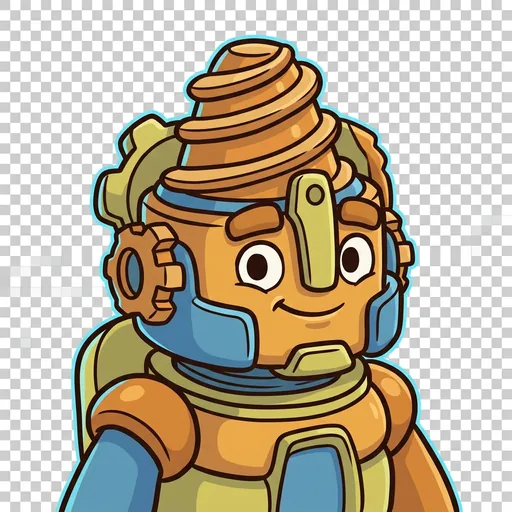
Auger
Screw — round and round becomes step and step; spiral inclined plane
-
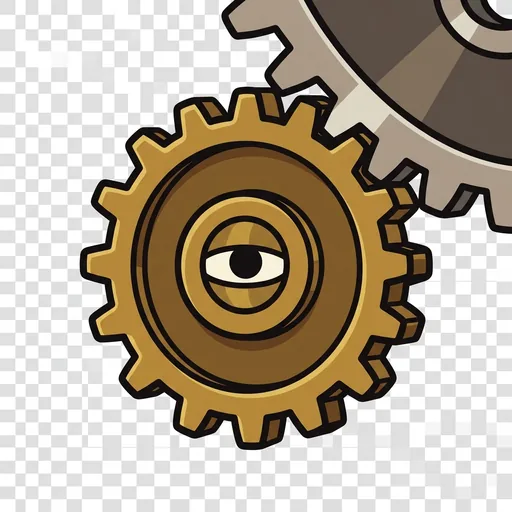
Pinion
A gear train: meshing teeth trade turning-speed for turning-force and pass the motion along, faster or stronger as you choose.
-
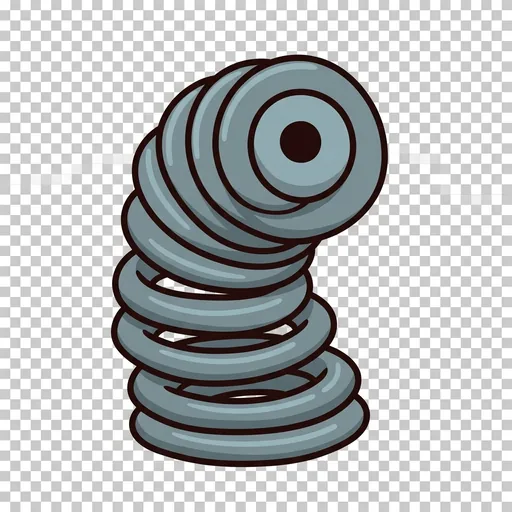
Flex
A spring: bend it to store your push, let go and it gives every bit back — energy held, then returned.
-
Lobe
A cam: a spinning shape with a bump that turns steady spinning into a repeating push, like a music box keeping a beat.
-
Ratchet
A ratchet: lets motion go forward freely but locks when it tries to slip back, holding every bit of progress, click by click.