
Lobe
CAM — *a spinning shape that turns round-and-round into a repeating push.* A cam is a wheel with a bump; as it spins, the bump lifts a follower up and lets it drop, over and over. It converts steady rotation into a rhythmic up-and-down motion — same turning, new pattern.
Press play to listen along. The line being read lights up as you go.
Show full transcript
Loading transcript…
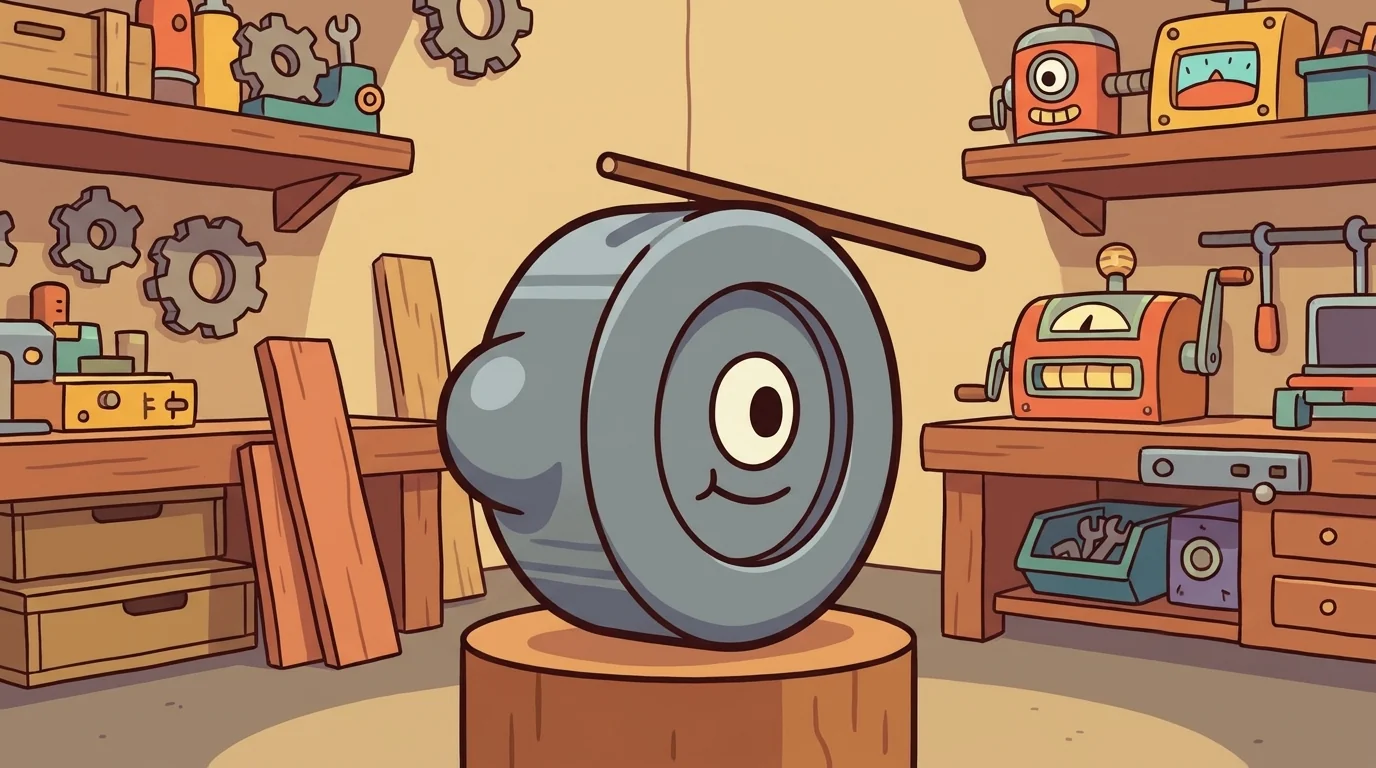
In the corner of the workshop, a thick grey wheel turned smoothly on its spindle, round on every side but one, where a single smooth bump rode out and back. Resting on top of it sat a slim little rod. Each time the bump swung up under the rod, the rod climbed. Each time the bump passed, the rod dropped. Up, down. Up, down.
Lobe turned and turned, and the rod ticked out its patient rhythm, and Lobe was perfectly content. "Round and round, that's all I'm given," it said, its calm center-eye watching the rod rise and fall. "But look what I make of it — a beat you could set a heart to." The bump came around again; the rod lifted, dropped. "A spinning shape becomes a repeating push. Same turning, new pattern." Lobe loved nothing more than this steady up-and-down, dependable as a swing.
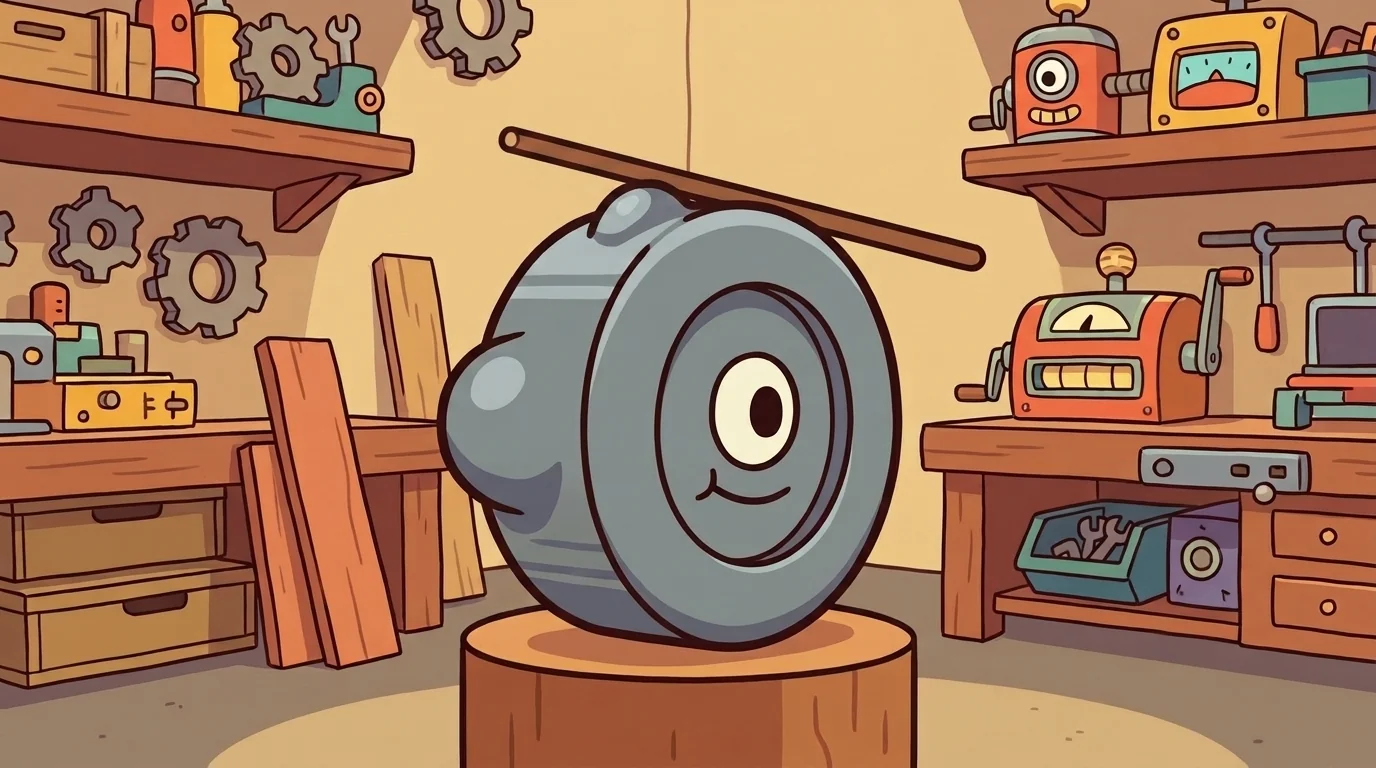
Long ago, Lobe had lived inside a music box, spinning below a comb of thin metal teeth. Its edge had been dotted with tiny bumps, and each bump, as Lobe turned, had plucked one tooth — plink — before letting it go.
The bumps were arranged just so, and because Lobe spun at a steady pace, the plinks fell into a tune. Lobe never chose the notes; the shape of its bumps did. But it was Lobe's faithful turning that carried the melody around and around, the same little song every time the box was wound.
That was the day young Lobe understood what it was for. A spinning thing could only spin — it couldn't tap or beat or count time by itself. But add a bump in the right place, and dumb, plain spinning became a rhythm. When the music box's lid finally cracked, the workshop lifted Lobe out, dusted its edge, and set a new follower-rod on top so it could keep making beats out of turning.
The first day at the workshop, Cog rolled over to watch the grey wheel turn and the little rod tick above it.
"Show me what you do," Cog said.
Lobe turned once, slow and deliberate. The bump swung up; the rod climbed; the bump slid past; the rod dropped — tap. "That," Lobe said. "You gave me a steady spin. I gave you back a beat. I don't add any motion of my own — I just reshape the spinning you already have into a rise and a fall, over and over. Change the shape of my bump and I'll change the rhythm: a tall bump for a big lift, two bumps for a double-tap."
Cog rolled around the wheel once, watching the rod keep perfect time. "You make motion dance," it said, and settled back to give Lobe room to spin.
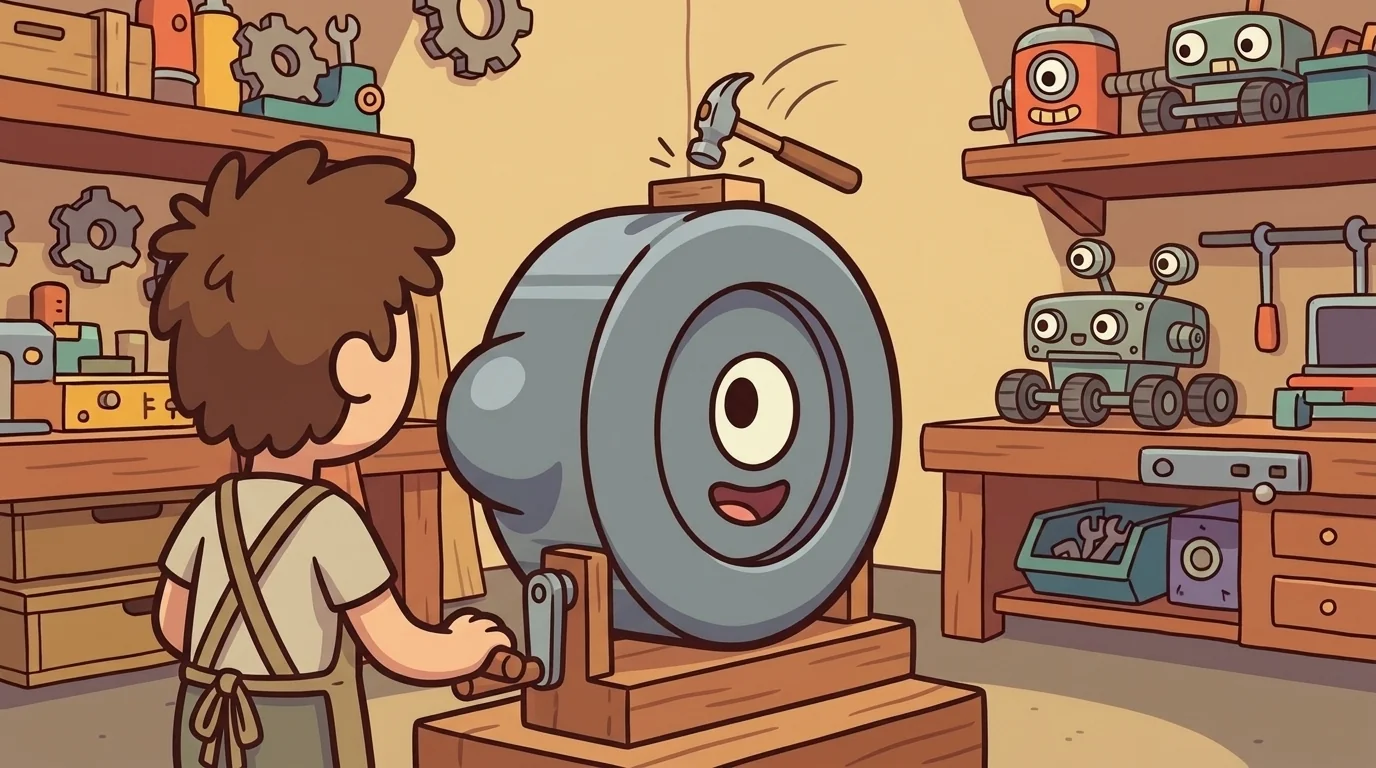
An apprentice named Pip hooked Lobe up to a hand-crank and balanced a tiny hammer on top as the follower.
"Crank me slow," Lobe said. Pip turned the handle. Lobe spun; the bump came around and lifted the hammer, then let it fall — tap. Around again — tap. Again — tap. A perfect, even beat filled the corner of the workshop.
"You hear that?" Lobe said. "Your steady cranking turned into a drumbeat. You didn't tap the hammer once — I did, every single time my bump came around." Pip cranked faster, and the taps came quicker, still perfectly spaced. "See? Speed the spin, speed the beat. Now watch this." Lobe held still while Pip swapped in a wheel with two bumps. When Pip cranked again, the hammer went tap-tap … tap-tap … tap-tap, a little double-knock instead of a single.
"Two bumps, double the taps," Lobe said, delighted. "A music box plucks its notes this way. An engine opens its valves at exactly the right moment this way. A toy makes a figure wave and bow this way. All of us take a plain spin and give it timing."
Pip cranked and cranked, watching the hammer keep faultless time, grinning at the neat little pattern coming out of nothing but a turn.
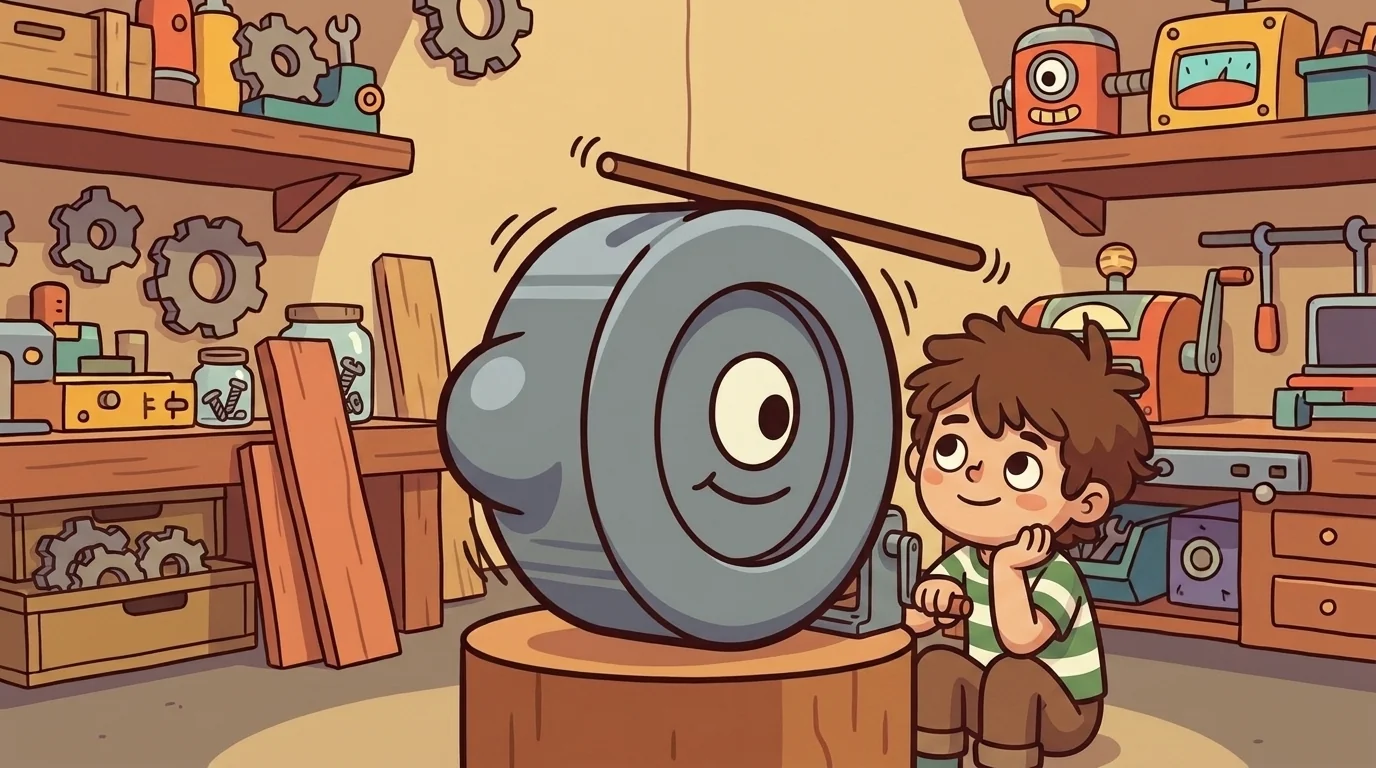
When his hand tired, Pip slowed the crank and let the last few taps ring out — tap … tap … tap — softer and softer, until the wheel eased to rest with its bump pointing up at the ceiling.
"There's something lovely in it, isn't there," Lobe said quietly. "The same small motion, again and again, never wrong, never late. Like a swing you don't have to push. Like a heartbeat you don't have to think about."
Pip nodded, resting his chin on the bench, listening to the memory of the beat still ticking in his head. Something in him had gone calm and glad — the same soft, steady feeling as being rocked, or hearing rain keep an even patter on a roof. He set the crank going one more gentle turn, and the little hammer answered — tap — and the whole corner of the workshop seemed happy in the quiet, dependable rhythm of it.
The MachineForge ensemble
Lobe is part of MachineForge's distributed-narrative cast. Each character embodies a different curricular primitive; together they teach the full subject.
-

Pry
Lever — push longer to lift heavier; the trade between force and distance
-

Hoist
Pulley — pull down here and watch it go up there; redirecting force
-

Ramp
Inclined plane — climb the long slow way; less force, same work
-

Spoke
Wheel-and-axle — one turn of the hub, many turns of the rim
-

Auger
Screw — round and round becomes step and step; spiral inclined plane
-

Cleave
Wedge — push forward and split it apart; force concentrated to a sharp edge
-
Pinion
A gear train: meshing teeth trade turning-speed for turning-force and pass the motion along, faster or stronger as you choose.
-
Flex
A spring: bend it to store your push, let go and it gives every bit back — energy held, then returned.
-
Ratchet
A ratchet: lets motion go forward freely but locks when it tries to slip back, holding every bit of progress, click by click.